The Looming Construction Labour Supply Crunch in Western Canada
Western Canada faces a looming construction labor shortage as demand for skilled workers in non-residential projects is set to rise significantly.
2 min read

ICBA Alberta President Mike Martens recently joined Jordan Bateman on our Coffee & Construction podcast to review the bulging array of investment projects now on the books in Alberta. This ICBA Economics post provides some additional detail and context on where matters stand with significant capital projects in the province.
To begin with, as of mid-2026 the provincial government counts over 1,000 individual projects with estimated capital costs of $5 million more, for a cumulative total of $318 billion in investment spending (assuming they all were to proceed). This represents a substantial jump from earlier iterations of the rolling project inventory, and it reflects a brighter outlook for capital spending in Alberta. The latest count finds higher levels of planned investment in the oil and gas, petrochemical, utility, infrastructure and transportation industries, together with multi-billion dollar proposed projects involving AI data centres and carbon capture and sequestration.
Of the 1,023 projects, 120 are under construction, accounting for $80 billion of capital spending. The rest – totalling just under $240 billion of cap-ex – are at the planned/proposed stage. This latter category includes the Pathways carbon capture/sequestration project and a new oil pipeline to the west coast recently announced by Prime Minister Mark Carney and Alberta Premier Danielle Smith. It is important to note that some projects on the planned/proposed list will not come to fruition.
Overall, the investment picture has improved in Alberta, with more projects started or planned in the areas of energy, energy-infrastructure, manufacturing, data-centres, utilities, and public sector facilities and infrastructure. That said, most of the projects tracked by the province remain “proposed,” which means their progress is sensitive to changes in commodity prices, trade rules, macroeconomic conditions, and government policy.
The accompanying figure summarizes the principal categories of current/planned capital projects in the province, as of August 2026.
Figure 1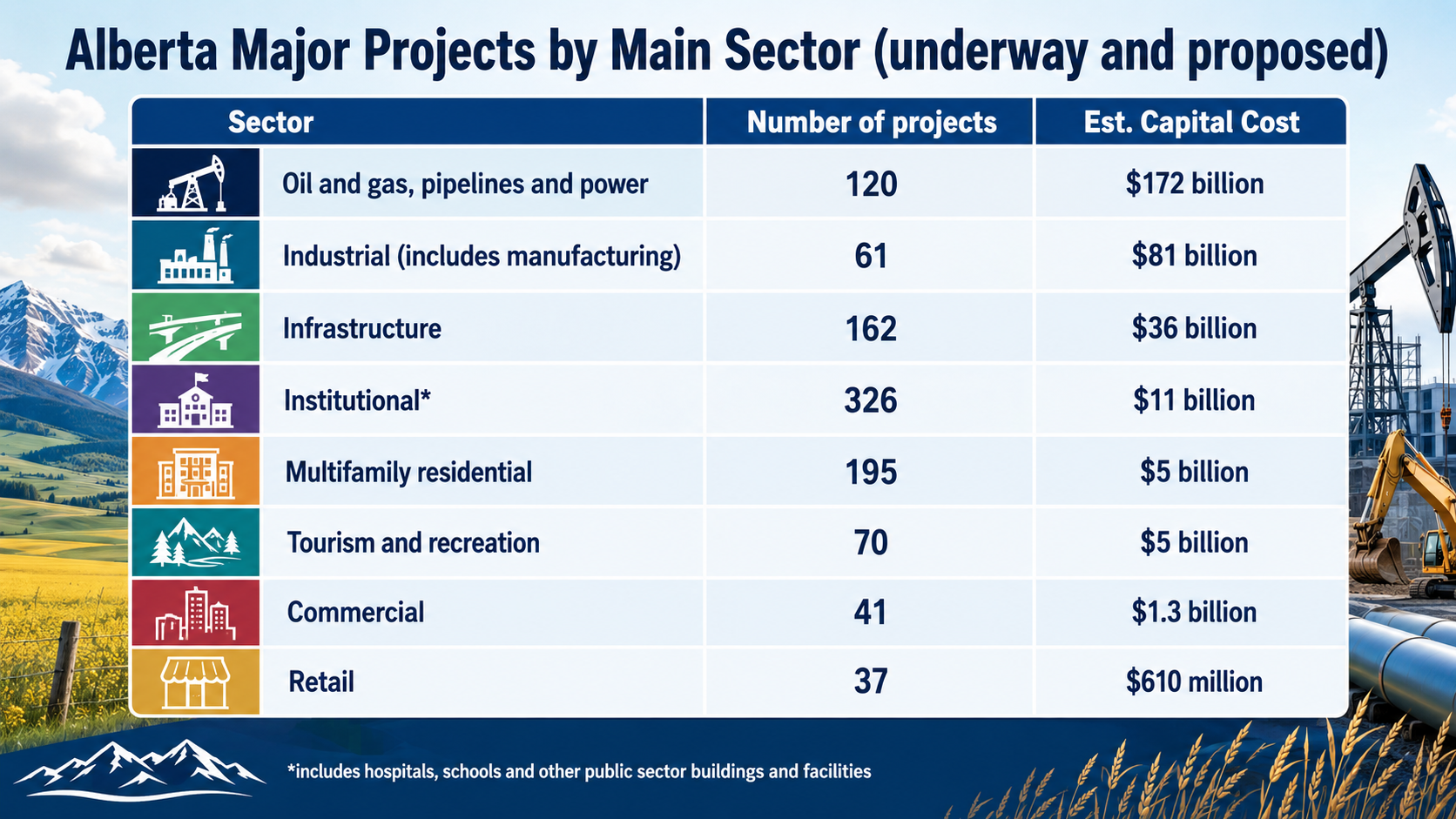
In looking at the scale of major project activity underway and planned in Alberta, an important question is where the skilled labour will be found to enable these projects to move forward. Other than in the home-building sector in parts of Ontario and B.C., Canada today does not have an abundant pool of unused or unemployed workers with the skills and experience required to meet the growing demand for construction-related work spanning all parts of the sector – including in the non-residential building and engineering segments.
Labour supply constraints create a risk of cost escalation and make it less likely that proposed projects will proceed to shovels in the ground. The federal government and several of the provinces recognize the issue and have taken some steps to mitigate the risk that the Prime Minister’s “build-build-build” agenda will be derailed by a lack of qualified workers.
For our part, ICBA has formulated policy recommendations which aim to ensure that Canada will have enough skilled tradespeople and other construction workers to expand home-building while also significantly boosting capital spending tied to natural resource and other industrial development, building infrastructure, and advancing new projects in other sectors. This includes ICBA’s recent recommendations to the Alberta government around establishing apprenticeship and other training tax credits similar to those already in place in other Western provinces.
Western Canada faces a looming construction labor shortage as demand for skilled workers in non-residential projects is set to rise significantly.
B.C. faces a housing slump while Alberta's market thrives. Explore the latest Statistics Canada data on residential investment and job impacts across...

Bill C-39 promises one project, one review, one year on federal permitting. The fine print reopens the Canada Labour Code. Plus B.C. multi-unit...