ICBA ECONOMICS: A Snapshot of Exports and Jobs in Canada
Exploring the critical role of exports in supporting 4 million Canadian jobs, with a focus on British Columbia and Alberta's key export-driven...
2 min read
With housing market developments still featuring prominently in the news across some parts of the country, now is a good time to check in with the latest results of Statistics Canada’s Housing Economic Account (HEA). The HEA includes a wealth of information on housing related economic activity through the end of 2025. It offers estimates of residential investment, depreciation, the average age of the existing housing stock, and the overall economic impact of homebuilding nationally and in the provinces.
The first figure provides data on nominal residential investment over the period 2021-2025 for Canada and the provinces of British Columbia and Alberta. Nationally, total residential construction investment rose almost 3% last year, on the heels of a similar increase in 2024. In current dollars, Canadian housing construction investment reached almost $250 billion in 2025.
Figure 1.png?width=1600&height=900&name=fig%201%20(1).png)
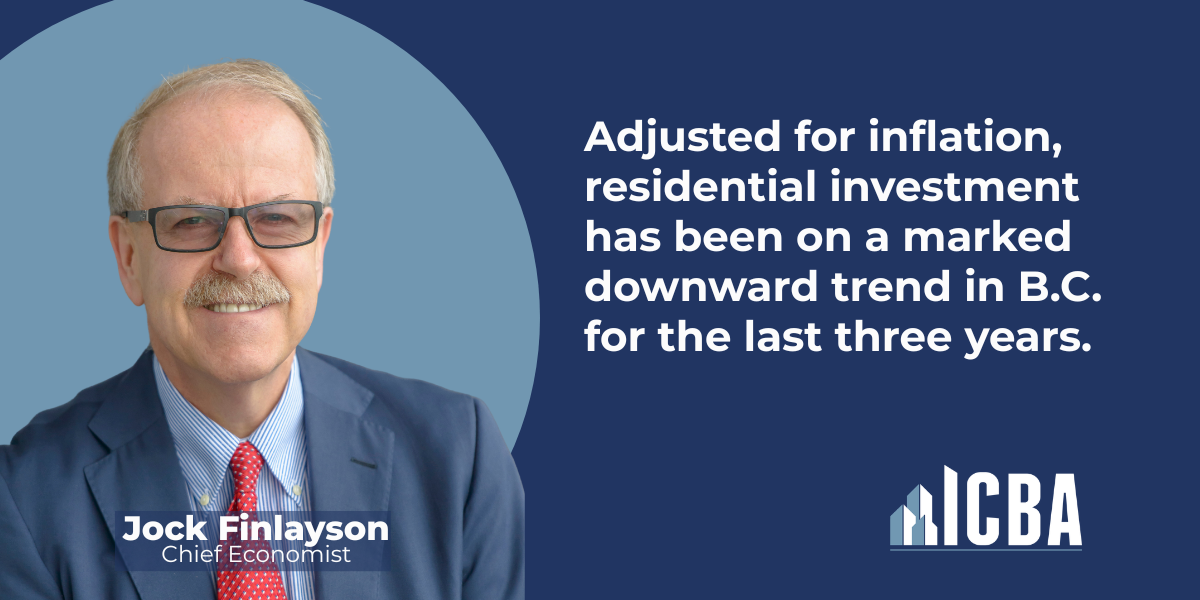
Alberta posted another solid gain in 2025, while B.C. saw a slight decrease in housing-related investment. In fact, nominal residential investment has been unusually weak in Canada’s western-most province since 2022. Adjusted for inflation, residential investment has been on a marked downward trend in B.C. for the last three years. ICBA Economics sees this pattern continuing over 2026-27, as the province’s homebuilding and real estate development slump persists.
Fueled by strong population growth, residential investment spending in Alberta has been on a tear, climbing another 6% last year and up almost 40% since 2021. Growth is expected to cool in 2026-27, amid a significant drop in Canada’s projected annual intake of new immigrants.
The second figure reports on the employment impact of residential investment for Canada, B.C. and Alberta. Statistics Canada calculates that 1.22 million nation-wide jobs were “associated” with residential construction in 2025, little changed from the year before. For B.C., residential construction supported – directly and indirectly – 200,600 jobs last year, down from a peak of 217,000 in 2022 but virtually unchanged from 2021. In Alberta, residential construction supported 172,500 jobs last year, up from 160,400 in 2024 and a bit less than 127,000 in 2021.
Figure 2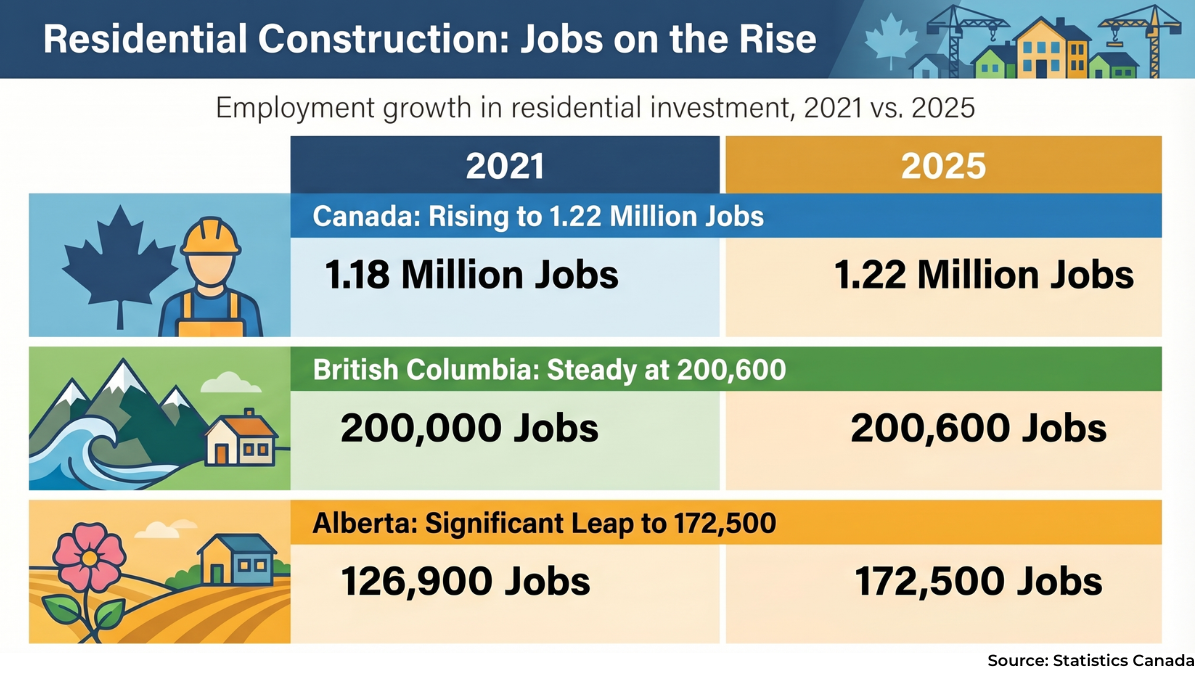
Finally, the average age of the entire stock of Canadian dwelling units was estimated at 17.2 years last year, with almost no change recorded over the last five years. The housing stock is “newer” in both B.C. (14.5 years) and Alberta (16.2 years), in part reflecting comparatively high levels of homebuilding in these provinces over most of the last 5-6 years.
The housing sector has a large presence in the Canadian economy and job market. And traditionally, it has played an even bigger role in driving economic growth in B.C. – including homebuilding, home renovation, and real estate sales activity. That pattern has broken down in B.C., as the province experiences a period characterized by economic weakness, zero population growth, and dwindling consumer and business confidence.

Exploring the critical role of exports in supporting 4 million Canadian jobs, with a focus on British Columbia and Alberta's key export-driven...
%20(1).png)
Insights on Alberta's small business landscape, focusing on the construction sector's substantial role and recent trends in business formation and...
.png)
Explore the economic growth of construction in B.C. and Alberta, highlighting trends, sector performance, and future outlook for 2025.