ICBA ECONOMICS: Inflation and Employee Pay
By Jock Finlayson, ICBA Chief Economist There is a popular view – common in media stories, and repeated ad nauseum by union leaders and ‘progressive’...
4 min read

ICBA celebrates 50 years of serving open shop construction this year, and we are looking back every week at some of the significant moments, milestones, and people who helped ICBA become Canada’s largest construction association.
Today, we look at ICBA Economics, a relatively new addition to ICBA’s advocacy work.
From the beginning, ICBA’s founders were sharp, practical builders who understood the economy the way contractors always have: by watching the bid lists, the cranes on the skyline, the payroll, and the pipeline of work. They knew when things were tightening, when red tape was choking projects, and when government decisions were quietly making life harder for the people who build British Columbia. What they didn’t have was an in-house economics shop to turn those lived experiences into a steady stream of charts, forecasts, and formal analysis. For decades, ICBA advocacy was driven by smart instincts, close contact with members, and whatever public data could be scraped together.
Over time, the construction and resource economy became more complex. Housing markets in major metros started to behave very differently from smaller centres. Government budgets grew, even as private-sector investment lagged. Major projects became multi-billion-dollar, multi-jurisdictional undertakings, wrapped in regulation and litigation. The stakes rose, and so did the need for deeper, ongoing economic insight tailored to construction and free enterprise.
 Launching ICBA Economics was the natural next step. It formalized something ICBA had always valued: understanding how macroeconomic trends, demographic shifts, interest rates, and government policy ripple through job sites, balance sheets, and paycheques. Instead of relying on occasional outside reports or ad-hoc number crunching, ICBA decided to build that capacity inside the organization, making economic analysis as much a part of its identity as training, benefits, and advocacy.
To do that properly, the association needed the right person to lead the work. In 2023, ICBA appointed Jock Finlayson as its first Chief Economist – a new role in the organization’s nearly 50-year history, and a clear signal of where ICBA was headed. Jock brought decades of experience at the top tier of business and policy circles in British Columbia and Canada. He had advised governments and business leaders on tax, regulation, productivity, human capital, trade, and competitiveness. He had served on corporate and public boards, written widely on economic trends, and become a familiar voice in media whenever there were questions about where the economy was headed.
Bringing Jock into ICBA didn’t just add a well-known name; it changed the way the organization built its arguments. As Chief Economist, he was tasked with tracking the forces that shape the construction and resource sectors: housing starts, labour markets, wage pressures, business investment, interest rates, fiscal policy, and the pace of major projects. He began to produce regular analysis explaining how these forces interact – why, for example, B.C.’s headline GDP numbers might look acceptable even as the private sector was clearly softening, or how delays and uncertainty around large projects hurt not just contractors, but the broader economy and government revenues.
ICBA Economics quickly became the banner for this work. Under that brand, ICBA started publishing regular Construction Monitors, budget reviews, and issue-specific papers that drilled into topics like housing supply, major projects, labour shortages, and the impact of regulation on growth. Instead of simply saying “construction matters,” ICBA could show, with data, that construction is a massive share of B.C.’s GDP, that it supports hundreds of thousands of jobs, and that every slowdown in building has knock-on effects for families, communities, and public finances.
This deeper analysis strengthened ICBA’s advocacy on multiple fronts. When ICBA spoke out on housing, it did so with charts showing the gap between new home construction and population growth. When the association criticized federal or provincial budgets for neglecting private-sector investment, it could point to trend lines in business capital spending, productivity, and comparative performance with other provinces. When it urged governments to streamline permitting and approvals for major projects, ICBA could quantify the billions in investment at risk and the number of jobs tied up in delays.
Media, policymakers, and industry partners took notice. Jock’s work began appearing regularly in newspapers, business magazines, and online outlets. His columns, interviews, and presentations brought a construction-centric lens to broader conversations about inflation, interest rates, labour markets, and economic competitiveness. For many readers and listeners, ICBA Economics became a trusted source explaining what national and global trends actually mean for builders on the ground in British Columbia and Alberta.
Inside ICBA, the presence of a Chief Economist began to subtly change the culture of advocacy. Letters to government, position papers, and submissions were increasingly built on a foundation of economic evidence: tables, graphs, historical context, and forward-looking assessments. Campaigns that were once driven primarily by member stories and common sense are now reinforced by carefully assembled data. The stories are still there – the contractor who can’t find enough skilled workers, the builder whose project has been stalled by endless approvals, the company squeezed by higher taxes and fees – but those stories sit alongside charts and numbers that make them impossible to dismiss as anecdotes.
For members, ICBA Economics has provided something they often lack the time or capacity to do themselves: step back from the day-to-day scramble and see the bigger picture. Through ICBA’s analysis, contractors can better understand why financing conditions feel tighter, why certain regions are hotter than others, how public-sector expansion can mask private-sector weakness, and where future demand is likely to come from. That kind of perspective doesn’t replace local knowledge, but it sharpens it.
Looking back over 50 years, the creation of ICBA Economics and the appointment of a Chief Economist stand out as a milestone in the association’s evolution. The founders were never short on intelligence or insight; they built ICBA on keen observation, hard-won experience, and a willingness to stand up for open shop contractors when it was far from fashionable. What they didn’t have was a dedicated economics unit with the tools and mandate to dig into the data full time.
Today, that gap has been filled. ICBA Economics represents the marriage of those original instincts with the kind of rigorous, ongoing analysis that modern advocacy demands. In an industry that lives by numbers – bids, budgets, schedules, margins – it is fitting that ICBA’s next chapter in advocacy is grounded in numbers too. As ICBA marks its 50th anniversary, the rise of ICBA Economics shows how far the organization has come: from a small group of builders fighting for a fair shot, to a national voice pairing real-world construction experience with the economic evidence needed to move governments, shape policy, and keep building opportunity.
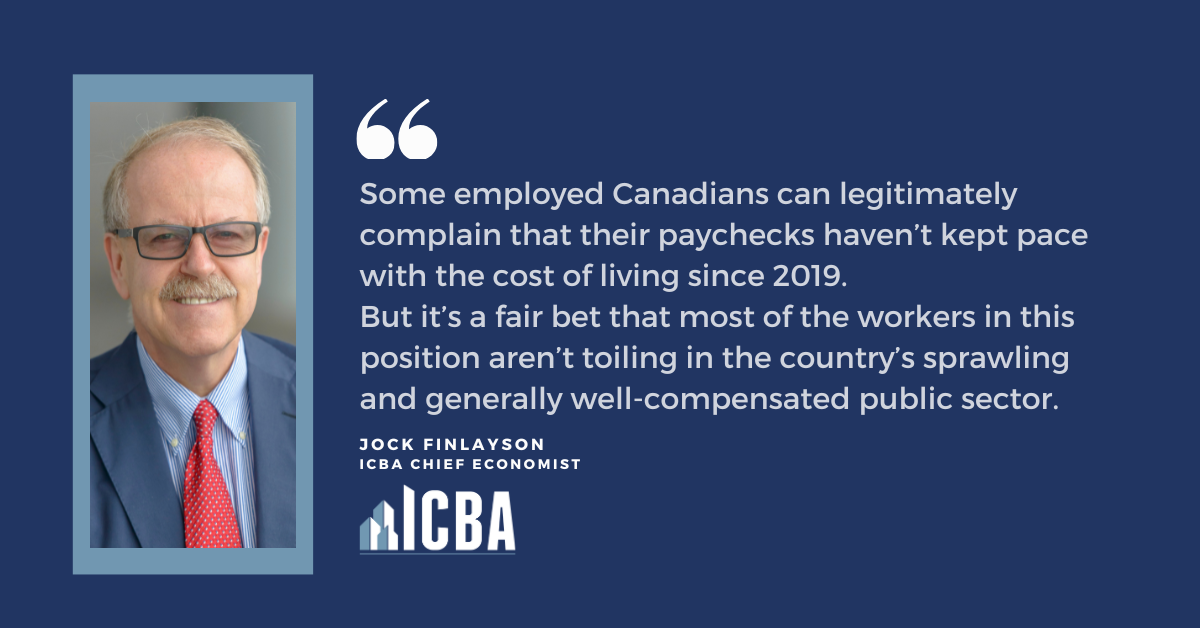
By Jock Finlayson, ICBA Chief Economist There is a popular view – common in media stories, and repeated ad nauseum by union leaders and ‘progressive’...
By Jock Finlayson, ICBA Chief Economist Earlier this year, the Senior Deputy Governor of the Bank of Canada took the unusual step of publicly...
By Jock Finlayson, ICBA Chief Economist When an irresistible force meets an immovable object, conflict typically ensues. So it is with the halting...