ICBA ECONOMICS: A Mix of Canadian Construction Industry Statistics
An overview of Canada's construction industry, highlighting its economic impact, key components, and future growth prospects amid current challenges.
3 min read
Earlier this year, the Senior Deputy Governor of the Bank of Canada took the unusual step of publicly referring to Canada’s stagnant productivity as an “emergency.” And recently, Bank of Canada Governor Tiff Macklem reinforced that sobering message by describing lagging productivity as the country’s “Achilles’ heel”.
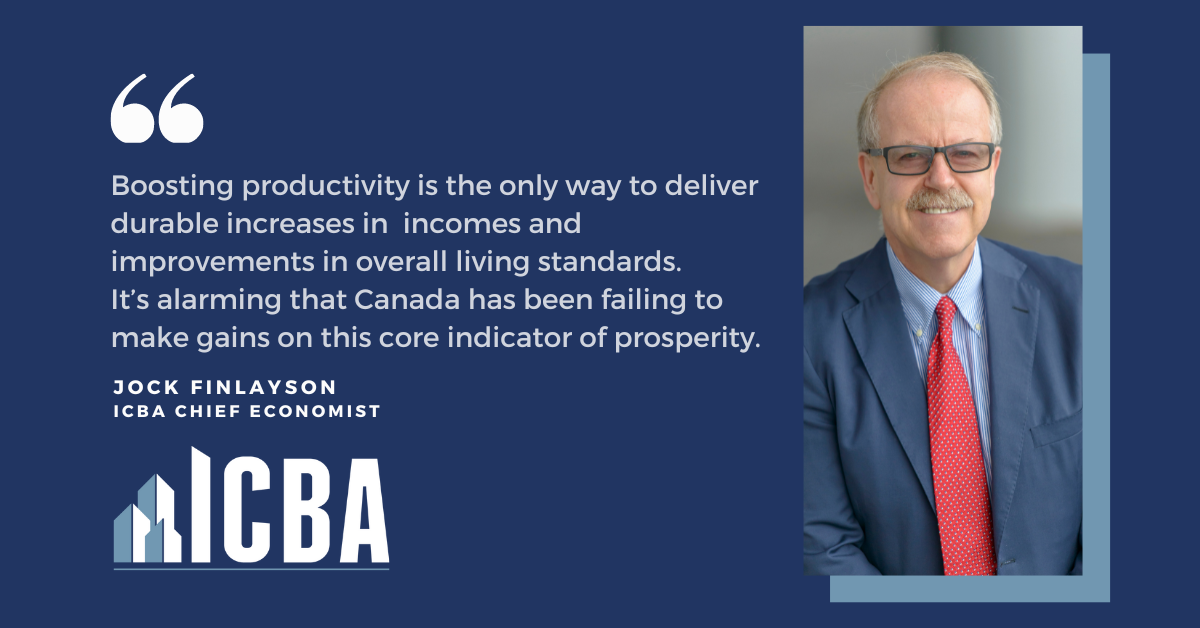
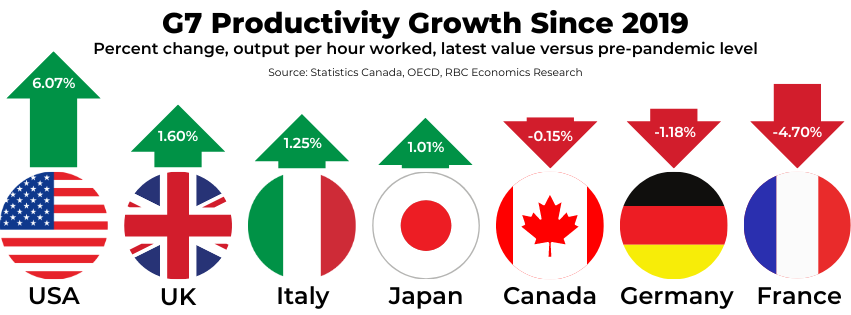
Boosting productivity is the only way to deliver durable increases in incomes and improvements in overall living standards. It is therefore alarming that Canada has been failing make gains on this core indicator of prosperity. Indeed, from 2019 through the end of 2023, the level of overall productivity in Canada diminished slightly, while advancing by a hefty 6% in the United States over the same period (Figure 1).
Figure 1
Productivity is the amount of “output,” or gross domestic product (GDP), the economy produces using a given level and mix of “inputs.” Labour is one such input, and most public discussions of productivity focus on this measure – “labour productivity “ – which is defined as GDP per hour worked. It can be estimated for the entire economy or for specific industry sectors. In the Canadian construction industry, for example, labour productivity in 2023 was $48.60 per hour, adjusted for inflation using 2017 dollars. By comparison, labour productivity across the entire Canadian economy was $63.60 per hour, meaning productivity in the construction sector is below the all-industry average. There are good reasons for this, including the highly fragmented nature of the sector and the fact that about 80% of contractors have 25 or fewer employees.
Over time, there tends to be a fairly tight linkage between productivity in an industry, on the one hand, and the wages and non-wage benefits paid to employees in that industry, on the other. In other words, the most productive industries, on average, pay their workers more, an empirical relationship that is supported by Canadian research. As noted in a recent RBC Economics report, productivity growth is “essentially the only way that business profits and worker wages can sustainably rise at the same time.”
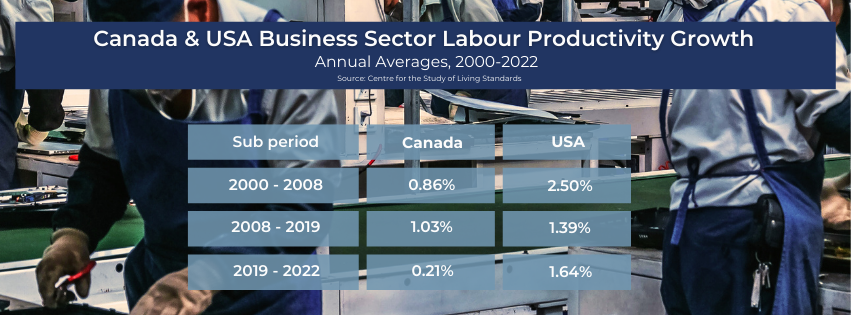
Until approximately the year 2000, Canada generally held its own against the United States on measures of productivity in the broadly defined “business sector” (consisting of industries where government, in some capacity, is not the dominant supplier of goods or services). Since then, we have been steadily losing ground vis-à-vis the U.S., as shown in Table 1. As a consequence, by 2022 labour productivity in Canada’s business sector stood at only 70% of the U.S. benchmark, down significantly from around 90% of the U.S. level in the early 1980s.
Table 1
An expanding U.S.-Canada productivity gap has negative implications for future gains in real wages and incomes in Canada, versus those in the United States. This raises the risk of ever-widening disparities in investment per employee, the returns on the acquisition of credentials, and entrepreneurial wealth creation on our side of the border, compared to our principal trading partner and competitor for investment dollars.
Turning around Canada’s lacklustre productivity performance is a key challenge for policymakers and business leaders alike. There is no silver bullet that will quickly solve the problem of chronically sub-par Canadian productivity growth. However, a review of recent Canadian economic studies and related policy commentaries suggests a five-pronged approach will put the country onto a better productivity growth trajectory:
These five recommendations underpin ICBA’s current advocacy efforts aimed at federal and provincial government officials and elected representatives.
An overview of Canada's construction industry, highlighting its economic impact, key components, and future growth prospects amid current challenges.

Canada's productivity is in decline. Explore practical solutions from ICBA's Chief Economist, Jock Finlayson, to reverse this trend and secure...
-1.png)
Alberta continues to lead Canada in household income, with insights into its economic factors and future prospects amid recent challenges.