2 min read

OP/ED: Wealth and net worth — a bird’s-eye view of Canada

OP/ED: Wealth and net worth — a bird’s-eye view of Canada
OP/ED: Wealth and net worth — a bird’s-eye view of Canada
3:48

The following op-ed, by ICBA Chief Economist Jock Finlayson, first appeared in the Toronto Sun on March 24, 2026.

What can we say about the economic well-being of families and households in Canada, in the aftermath of the COVID-19 pandemic and amid uncertainty about Canada’s economic prospects in the face of U.S. President Donald Trump’s tariff barrage?

One way to gauge how well households are faring is to examine their earnings and income. Another approach is to track their accumulated assets, liabilities and “net worth” over time. The latter is the focus of this column.

Net worth — or wealth — is defined as total household assets minus total liabilities (debts). Assets include the accrued value of workplace pensions (excluding the Canada Pension Plan) and other retirement accounts, funds in investment and bank accounts, real estate assets (including principal residences) and equity ownership in private businesses. The liabilities of households encompass mortgages and other real estate debt, credit card balances, automobile and student loans and various other types of debt.

The latest data on household balance sheets come from Statistics Canada’s Survey of Financial Security (conducted in 2023).

Nationally, median household net worth reached $519,700 in 2023 (we use the “median” rather than the “average” because the former is a better approximation of the wealth of the typical household). Net worth was $218,000 in 2008 and rose to $361,000 by 2016. From 2016 to 2023, the typical Canadian household saw its wealth climb by 50% — in the 15 years after 2008, the increase was almost 140%. These wealth gains are calculated after stripping out the impact of inflation and suggest the average household has enjoyed an impressive boost in its “real” wealth, contrary to the impression conveyed in many media stories.

Age key driver in wealth accumulation, decumulation

There are noticeable regional variations in net worth. British Columbia leads the pack at $773,500 in 2023, mainly due to the high value of real estate assets (especially principal residences) in Canada’s westernmost province. Median wealth in Ontario sits at $666,500; in Alberta, it’s $457,100. Net worth is lowest in Atlantic Canada and Quebec.

The data confirms the dynamic nature of wealth accumulation and decumulation. Age is a key driver. As people grow older, they generally acquire assets such as homes and retirement savings, which rise in value over time. They also pay down debt, notably mortgages. Households where the primary income earner is over age 50 account for most of the aggregate wealth. Canada’s aging population clearly helps explain the increase in net worth since the early 2000s.

Even after adjusting for age, wealth is not evenly distributed among families. The richest fifth accounts for a little more than 60% of overall household net worth. But the gap between the top 20% and the bottom 40% of households “declined by five percentage points to reach a record low of 60 percentage points” by 2023, according to TD Economics. Canada continues to experience significant economic mobility across the population.

Finally, the recent decline in housing prices in certain regions — particularly B.C. and Ontario — should not be ignored.

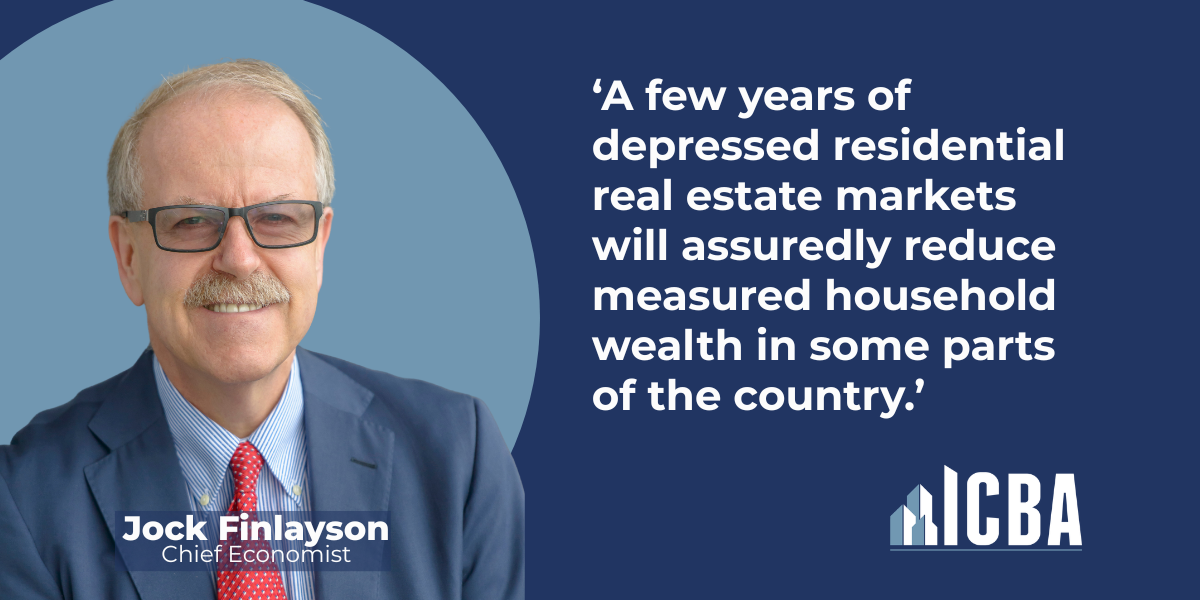
The value of principal residences counts as the biggest asset on the balance sheets of millions of Canadian households. A few years of depressed residential real estate markets will assuredly reduce measured household wealth in some parts of the country.

Earnings, Income and Wealth in B.C. and Alberta

Earnings, Income and Wealth in B.C. and Alberta

What can we say about the economic well-being of families and workers in Canada’s two westernmost provinces – British Columbia and Alberta? The...

Read More
ICBA ECONOMICS: Household Formation, Immigration and Housing Markets

ICBA ECONOMICS: Household Formation, Immigration and Housing Markets

By Jock Finlayson, ICBA Chief Economist The 2024 federal budget unveiled dozens of new initiatives intended to address Canada’s unfolding housing...

Read More