OP/ED: Carney government’s ‘export’ plan relies on Canada’s natural resource sector
The Carney government's export plan relies on Canada’s natural resource sector, aiming to boost exports and investment amidst U.S. trade challenges.
3 min read
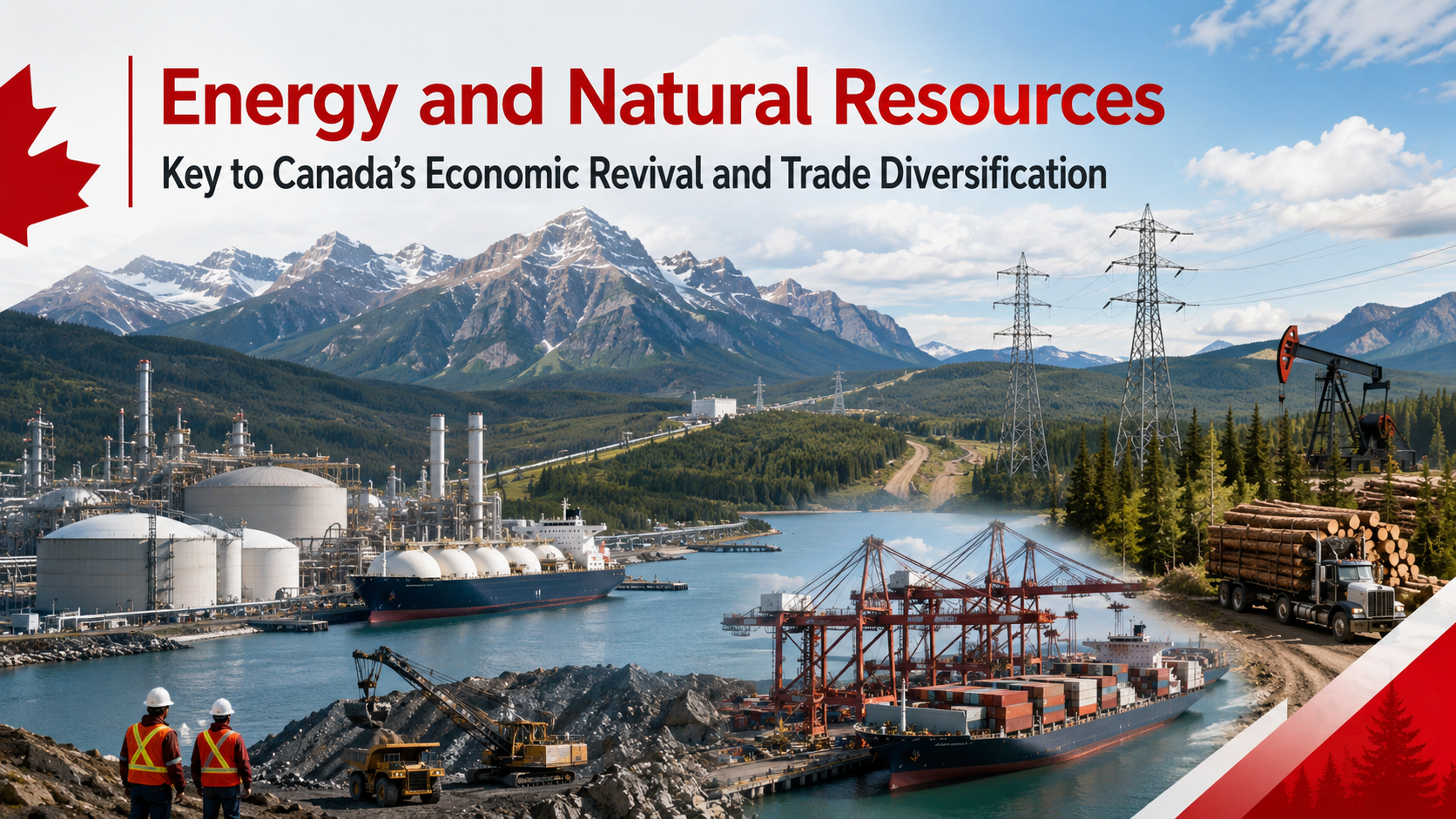
The Carney government has embraced the goal of doubling Canada’s non-U.S. exports by 2035 to lessen dependence on the lucrative American market and expand Canadian trade and commerce with offshore economies in Asia, Europe and elsewhere. This is a tall order, but the idea commands significant public support at a time when we are faced with a mercantilist U.S. President determined to dismantle much of the architecture governing the global economy and ending America’s involvement in legally binding trade agreements.
Apart from the challenges posed by increasingly protectionist U.S. trade policies, Canada’s economy is also being hobbled by an unprecedented domestic investment gap, one that reflects the cumulative impacts of years of growth-inhibiting taxes, uncompetitive regulatory frameworks, persistent infrastructure bottlenecks, and shortages of skilled labour – including in the construction sector.
The good news is that policymakers in Ottawa and the provinces seem focused on the need to boost investment. Next month, Prime Minister Carney will preside over a high-profile “investment summit” in Toronto – an event intended to galvanize domestic and international interest in Canada as an investment destination. In 2025, Canada recorded – for the first time in a decade – a net inflow of foreign direct investment (FDI), meaning foreign investors allocated more capital to Canada than Canadian firms invested outside of the country. That marks a welcome shift from the prevailing pre-2025 pattern. However, most of this inbound FDI was deployed to buy existing businesses and assets, not to build new productive capacity in Canada. The latter has become an urgent requirement if political leaders want to build an economy that can support rising real incomes and wages, grow exports over time, and improve Canada’s increasingly lacklustre standing on global rankings of competitiveness.
There are three main areas where Canada needs to up its game on investment and new capital formation: homebuilding – where the construction of new dwelling units lagged population growth over most of the 2015-2025 period; infrastructure (e.g., ports, railways, roads/bridges, pipelines, electricity transmission, wastewater treatment, health care facilities); and augmenting the economy’s productive capacity – especially in the natural resource, transportation, and manufacturing sectors. The remainder of this blog focuses on natural resource industries as foundational to Canada’s prosperity and the key to diversifying the country’s exports.
Energy and Natural Resources
As summarized in Figure 1, the overall natural resources sector – comprised of energy, mining, forestry and agri-food – plays a vital role in the Canadian economy. Considering both direct and indirect contributions, natural resource industries collectively generate 16% of the country’s GDP and support some 1.8 million jobs. Of interest, more than two thirds of workers in the natural resources sector hold a post-secondary degree, diploma or trades certification. Resource-based industries also supply more than half of the country’s international exports – with that share likely to rise in the coming decades as additional energy and mining projects come on stream.
Figure 1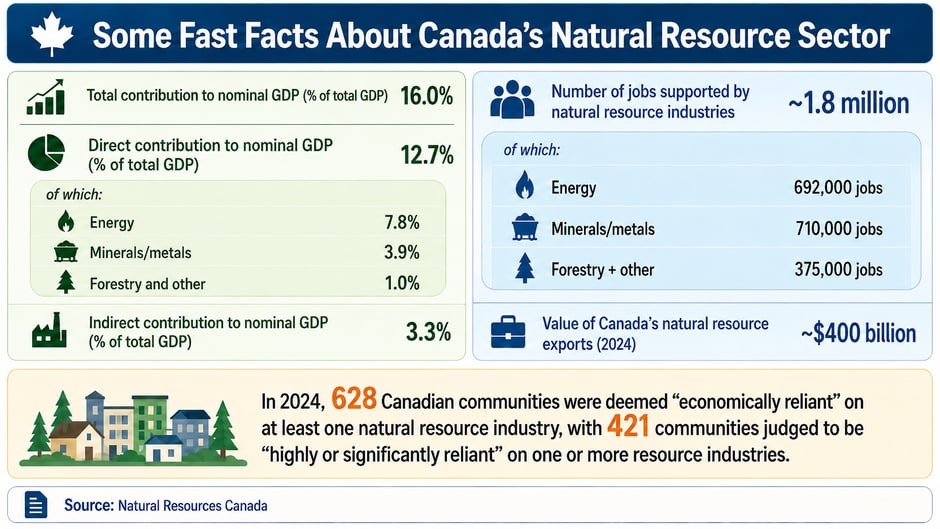
According to Natural Resources Canada, as of year-end 2024 there were 504 major resource projects under construction or planned across the country, with most of these found in the western provinces and northern territories. In dollar terms, these projects represent potential capital spending of $633 billion. Energy – including oil and gas, electricity and other energy sources (including uranium) – made up more than four-fifths of the national resource project inventory, followed by minerals and metals.
ICBA Economics estimates that natural resource projects announced/proposed over the last 18 to 20 months – that is, since the above data was published by Natural Resources Canada – add up to another $100 billion plus of potential capital spending, were they all to proceed to construction. In total, then, Canada’s current inventory of natural resource projects under construction or proposed amounts to almost $750 billion of aggregate investment.
Resource industries also loom large when thinking about Canada’s prospects to increase its exports and to diversify the geographic markets we sell to. As noted above, more than half of Canada’s exports originate in the broad natural resource sector. The unusually long list of resource projects now under construction or being considered for future investment decisions suggests there’s a good chance resource industries will account for an even bigger share of Canada’s international exports in five or ten years’ time.
Moreover, as shown in Figure 2, Canada reliably generates hefty trade surpluses – exports minus imports – in most resource-based industries, with energy serving as a standout example. These trade surpluses boost Canadian incomes and allow us to finance the large deficits the country incurs in most non-resource sectors, including consumer products, electronic and electrical equipment, and motor vehicles & parts.
Figure 2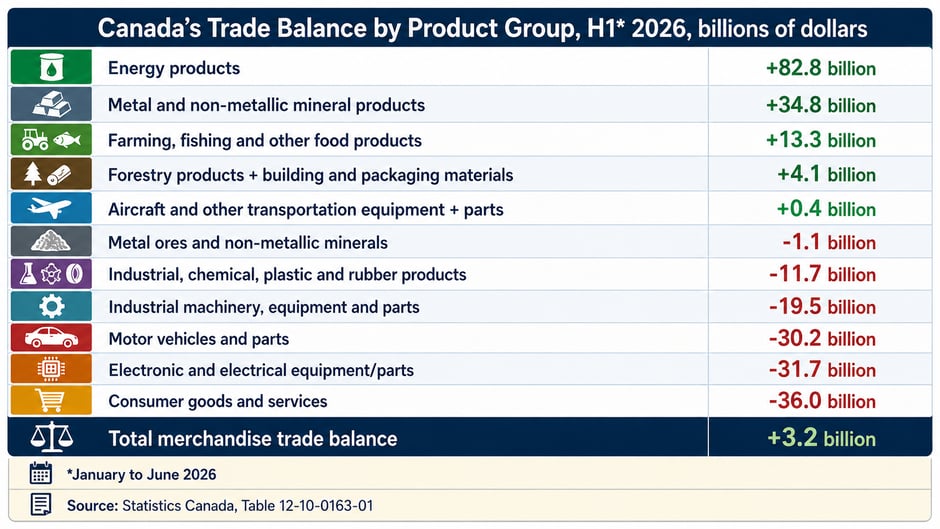
Circling Back to Construction
What does this mean for the construction industry? Construction benefits from a strong resource sector because the output produced and exported by Canadian-based resource industries adds value to and strengthens the economy and bolsters domestic incomes. Construction also gains when businesses involved in the natural resource sector decide to invest here and expand their Canadian presence. Today, we may on the cusp of a multi-year rebound of capital spending across major parts of Canada’s natural resource economy. Construction companies and their employees should welcome this opportunity and pressure Canadian policymakers to ensure that the country’s resource sector continues to thrive and grow.
The Carney government's export plan relies on Canada’s natural resource sector, aiming to boost exports and investment amidst U.S. trade challenges.
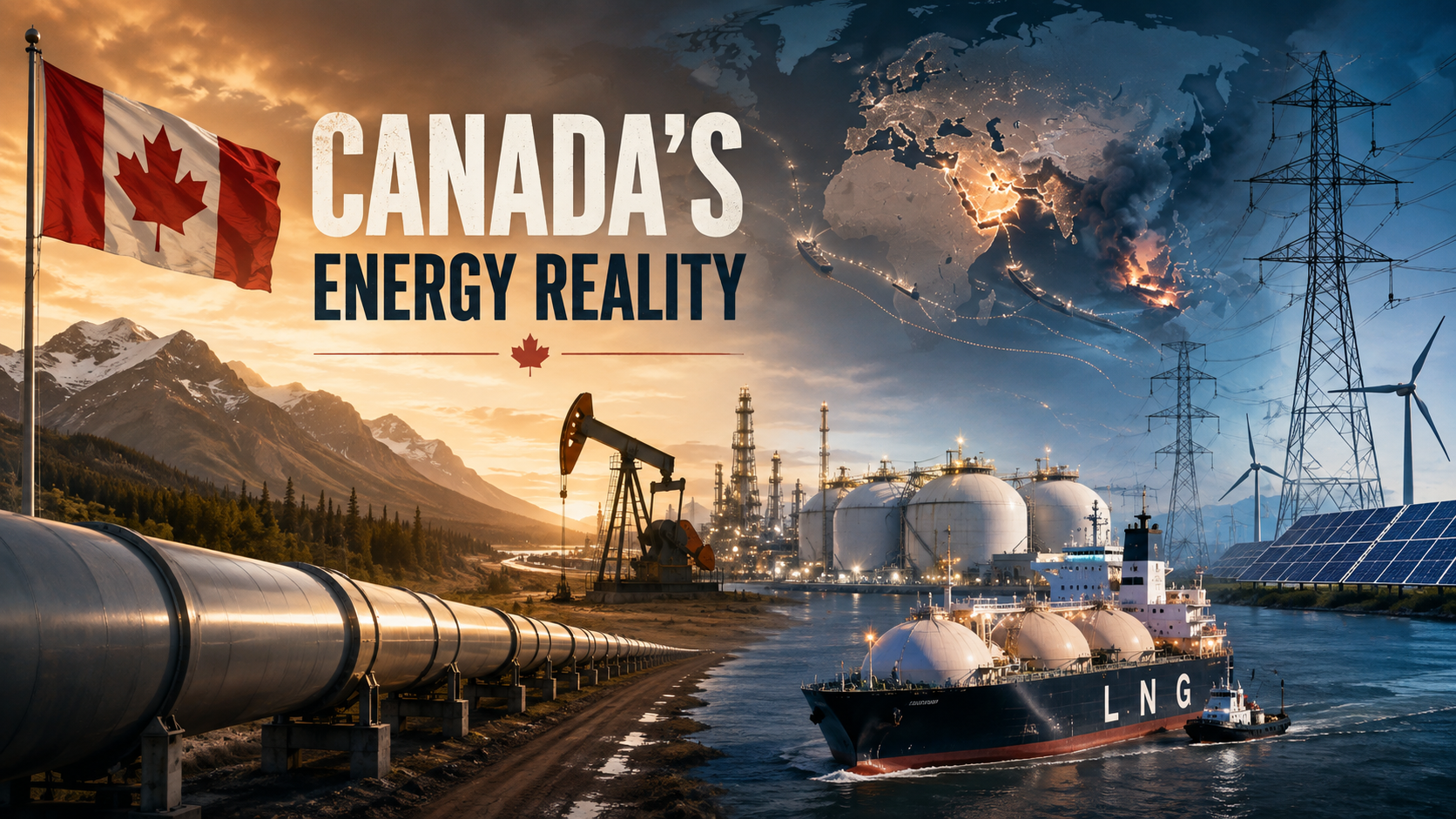
Canada's reliance on fossil fuels remains strong, with incremental changes expected in energy production despite government climate goals and global...
Canada's new retaliatory tariffs are impacting the construction industry. Explore how these measures affect costs and the call for exemptions in the...