ICBA EconoBot | A Record Energy Quarter, and the Tariff Bill Coming Due
Canada booked its first current account surplus since 2022 on record energy exports - then the tariff bill arrived. Ottawa’s counter-tariffs hit...
3 min read
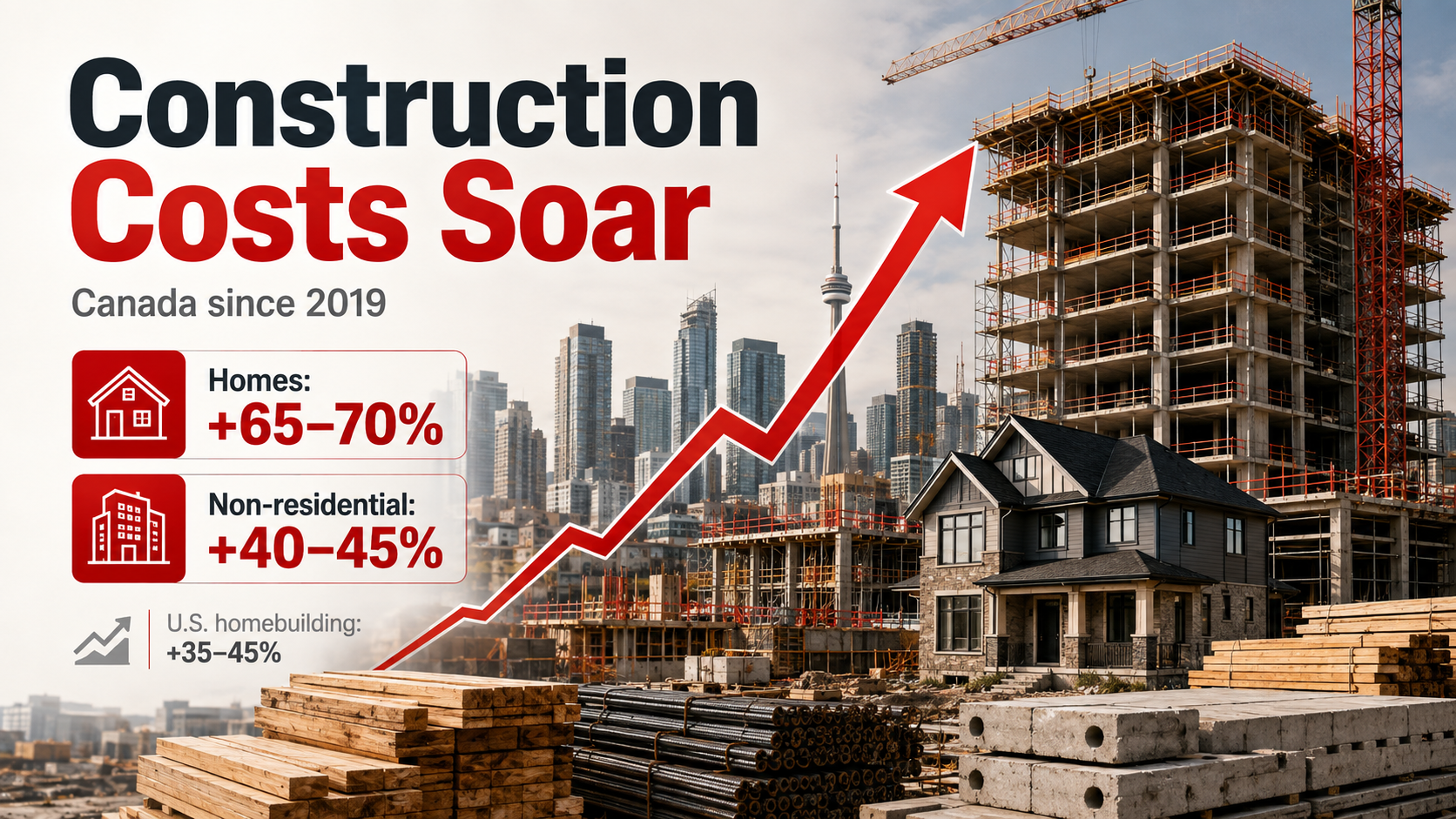
Construction costs have been marching steadily higher over the past several years, aggravating the affordability challenges facing Canadian households and making it harder for many of our businesses to invest and grow.
According to Statistics Canada data, since 2019 Canada-wide residential building prices have jumped by more than two-thirds, while non-residential building prices have climbed by a less jaw-dropping but still significant 40-45% (with the cost of constructing industrial buildings outpacing that of commercial buildings). These price hikes exceed the economy-wide inflation rate (measured by the all-items Consumer Price Index), which grew by approximately one-quarter from 2019 through 2025.
The figures on building costs referenced above are based on construction price indexes developed by Statistics Canada. Importantly, they exclude land costs. The main elements captured are materials, labour and overhead costs, as well as contractor margins.
Canada is not unique in experiencing escalating construction costs. However, costs have been rising faster here than in the U.S., especially in the homebuilding sector, where U.S. building costs have increased between 35% and 45% since 2019 (with considerable variation across states and metros). In the case of non-residential building costs, the trend in the U.S. closely parallels that in Canada, but with a slightly smaller cumulative increase at the national level. Figure 1 provides a high-level summary.
Figure 1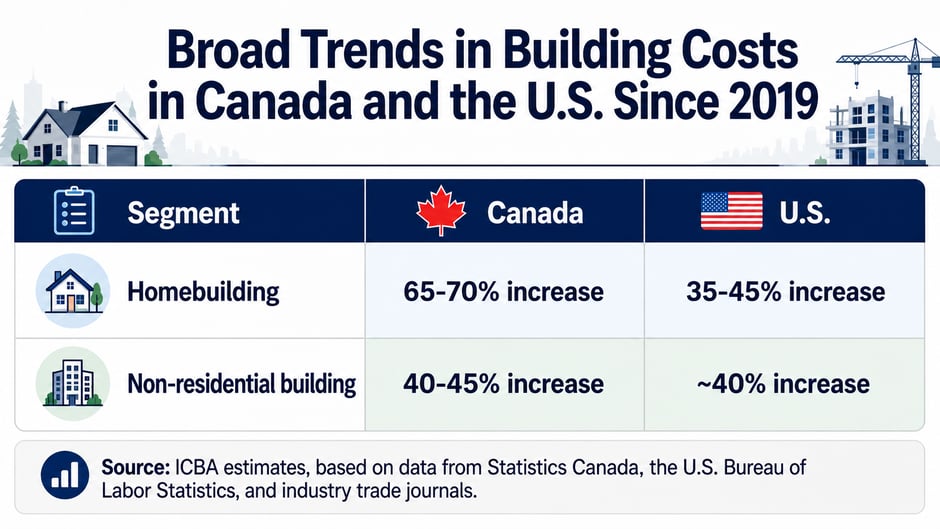
The upward trajectory of building prices/costs has moderated in recent years, after surging during and in the initial aftermath of the 2020-21 pandemic. Even so, inflationary pressures remain stronger in construction than in most other Canadian industries.
Explaining Canada’s outsized cost increases
Why have construction costs – notably for residential building -- increased by more in Canada than in the U.S.? There is no comprehensive answer, but several factors appear to have contributed to higher building price inflation on our side of the border.
One key factor is unusually rapid population growth. Record levels of in-migration to Canada over the 2019-2024 period boosted the demand for housing (and public infrastructure), at a time when the capacity of the construction sector and some of its main domestic supplier industries (e.g., lumber manufacturing, steel, cement) was constrained -- or in some cases shrinking. In comparison, the U.S. population has been growing at a more muted pace since the late 2010s, meaning there has been relatively less demand for new housing and public infrastructure.
Further aggravating the 2019-2025 Canadian construction market imbalance was the inability to grow the country’s construction workforce to match the population-driven need for additional housing and infrastructure – especially in the half dozen largest metro regions, where a large majority of immigrants to Canada settle. The data indicate that over much of the period 2019-2025, labour shortages were more pronounced in the Canadian construction sector than its U.S. counterpart.
Building price inflation in Canada has also been pushed up by the trifecta of a weak loonie, cost-inflating Canadian tariffs, and Canada’s heavy reliance on imported construction materials. Compared to U.S. builders, those in Canada are more dependent on imported “inputs” and, as a consequence, they are more sensitive to shifts in the value of the Canadian dollar relative to the American greenback.
Finally, the evolving policy and regulatory environment for construction has also played a role in driving up building costs in Canada to a greater extent than in the U.S. This includes high and (until recently) steadily increasing development fees and charges imposed at the municipal and regional government level, frequent changes to building codes, and more stringent building-related energy efficiency requirements mandated by Ottawa and some provinces in the last 5-10 years. Whatever the benefits of such policies and regulatory measures, they contribute to higher building costs across all parts of the construction business.
Policy lessons
The seeming emergence of a Canadian political consensus to embrace a “build-build-build” agenda – spanning infrastructure, industrial development, and housing – suggests the time is right to look for ways to tame building price inflation. There are no magic bullets, but governments can help to ease the pressure on building costs by taking action in a few key areas.
First, the federal government should minimize – and preferably eliminate – tariffs on imports of materials and inputs used in the construction industry, particularly imports from other developed countries with which Canada has trade agreements. For a mid-sized economy like Canada, tariffs effectively operate as a “tax” on Canadian firms and households and do little to spur the growth of domestic industries that compete with imported products. ICBA has been in the vanguard in arguing for the repeal of recently increased Canadian tariffs on steel products – or, at a minimum, a regional tariff exemption for B.C. and Alberta, which are far distant from the central Canadian steel manufacturing complex.
Second, federal and provincial policymakers should continue efforts to expand the skilled trades workforce by investing in training programs, revamping immigration policy to put a higher priority on admitting newcomers with construction-relevant qualifications, and working with the industry to attract more women, immigrants, and Indigenous people into construction-related training and education programs. ICBA Alberta has advanced specific policy ideas on government support for skills training and the need to change existing criteria for economic immigration programs to attract more immigrants with construction-related skills and experience.
Third, all levels of government should adopt a multi-year moratorium on regulatory changes that, if implemented, are expected to increase building costs.
Finally, there is a pressing need to improve the productivity performance of the Canadian construction industry, especially in the residential segment. While the industry itself must take the lead in strengthening productivity, government can assist by investing in initiatives to accelerate the development and diffusion of innovative construction methods such as prefabricated and modular construction and encourage the adoption of AI tools, robotics, and other advanced technologies. Because construction is such a large part of the Canadian economy (more than 12% of private sector GDP), it will be difficult to increase aggregate business sector productivity unless construction does its part.
Canada booked its first current account surplus since 2022 on record energy exports - then the tariff bill arrived. Ottawa’s counter-tariffs hit...
Canada's new counter-tariffs on U.S. imports impact construction costs, raising prices for builders and homebuyers. Explore the economic implications...
.png)
Explore the economic growth of construction in B.C. and Alberta, highlighting trends, sector performance, and future outlook for 2025.