OP/ED: Eby may go down as worst fiscal manager in B.C. history
Business in Vancouver op-ed: ICBA economist Jock Finlayson warns B.C. debt is heading $89B→$213B, deficits $11.2B, growth ~1%. Read the analysis.
1 min read
Metro Vancouver is home to more than half of B.C.’s population and is one of three large Canadian metros where a majority of new permanent Canadian immigrants settle (the others are the GTA and Greater Montreal). Thanks to steady in-migration, Metro’s population recently reached 3 million. Population growth has been stronger than in the past and well above the rates seen in other parts of the province in recent years.
Metro’s population has expanded by around 10% since the start of the decade, driven entirely by higher permanent immigration and an unprecedented surge in the number of non-permanent residents. At the same time, the region has experienced rising outmigration among Canadian-born residents, with many of these “leavers” relocating to Alberta and Ontario.


The number of people settling in Metro Vancouver jumped from roughly 30,000 annually to more than 120,000 in the last couple of years. Metro has accounted for about three-quarters of the B.C.-wide population gain since 2000, up significantly from 50% over 2014-2020 period. This has occurred even though more Canadian-born residents have been moving elsewhere in B.C. and across the country.

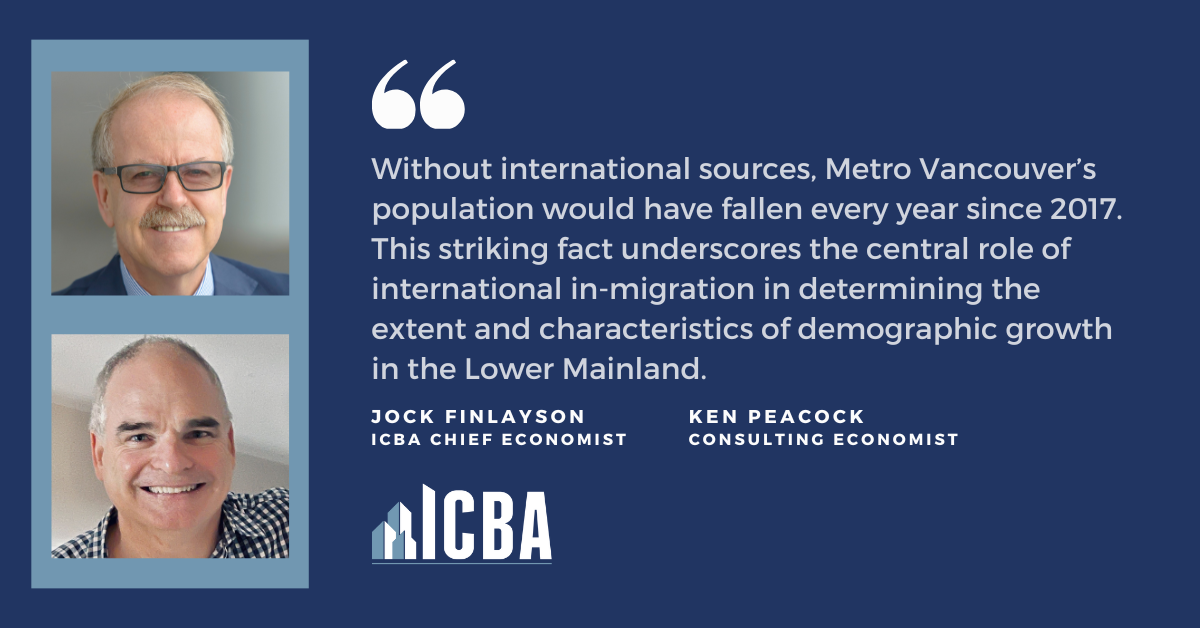
Without international sources, Metro Vancouver’s population would have fallen every year since 2017. This striking fact underscores the central role of international in-migration in determining the extent and characteristics of demographic growth in the Lower Mainland.

The number of immigrants arriving in Metro Vancouver has recently been running at almost double the historic norm – in the case of permanent newcomers. There has been an even larger increase in the number of non-permanent residents – matching the picture across much of Canada since the pandemic. However, with the federal government abruptly shifting course on immigration policy late last year, international in-migration to the Vancouver area is expected to drop sharply in the next two years, before rebounding by 2027. This immigration “pause” may provide some temporary relief amid ongoing shortages of affordable housing and long waits to access health care and other services.

Looking ahead, the B.C. government projects that Metro Vancouver’s population will climb to 3.9 million by 2046 – a little over a decade from now. This represents a 31% increase. Over the same period, the overall B.C. population is expected to rise by 24%. Assuming these forecasts are reasonably accurate, Greater Vancouver will loom even larger within B.C.’s economy and electorate than it does today.

Business in Vancouver op-ed: ICBA economist Jock Finlayson warns B.C. debt is heading $89B→$213B, deficits $11.2B, growth ~1%. Read the analysis.
Policy missteps and natural challenges have led to B.C.'s forestry decline, affecting jobs and industry viability. Recalibrating forest policies can...
An in-depth analysis of Canada's construction sector, highlighting the distribution and size of construction firms across various regions and...