ICBA ECONOMICS: Canada’s Job Vacancy Rates Continue to Ease… Including in Construction
Canada's job vacancy rates are declining, including in the construction sector, reflecting a cooling labour market amidst brewing economic challenges.
2 min read
Construction is one of the biggest industries in the country, whether ranked by total business revenues, value-added (gross domestic product), jobs, or the procurement of goods and services from other domestic supplier industries. Construction also features an unusually large number of individual businesses. In this post, I present data on the number and distribution of construction companies operating in Canada as of 2024.
Construction consists of enterprises that are “…engaged in constructing, repairing and renovating buildings and engineering works, and in subdividing and developing land,” according to the definition used by Statistics Canada when collecting and classifying data on the sector.
Nationally, there were 157,835 construction businesses in 2024 – with “businesses” defined here as those with paid employees. Another 250,000 “non-employee” construction firms (i.e., one-person operations) are also part of the industry; these are not considered in this post, as they account for only small shares of construction sector output (GDP) and overall industry revenues.
The four main sub-sectors that make up the broad construction industry are residential building construction, non-residential building construction, heavy and civil engineering construction, and specialty trades contractors. Figure 1 below shows the number of Canadian construction businesses (with paid employees) in each segment.
Figure 1
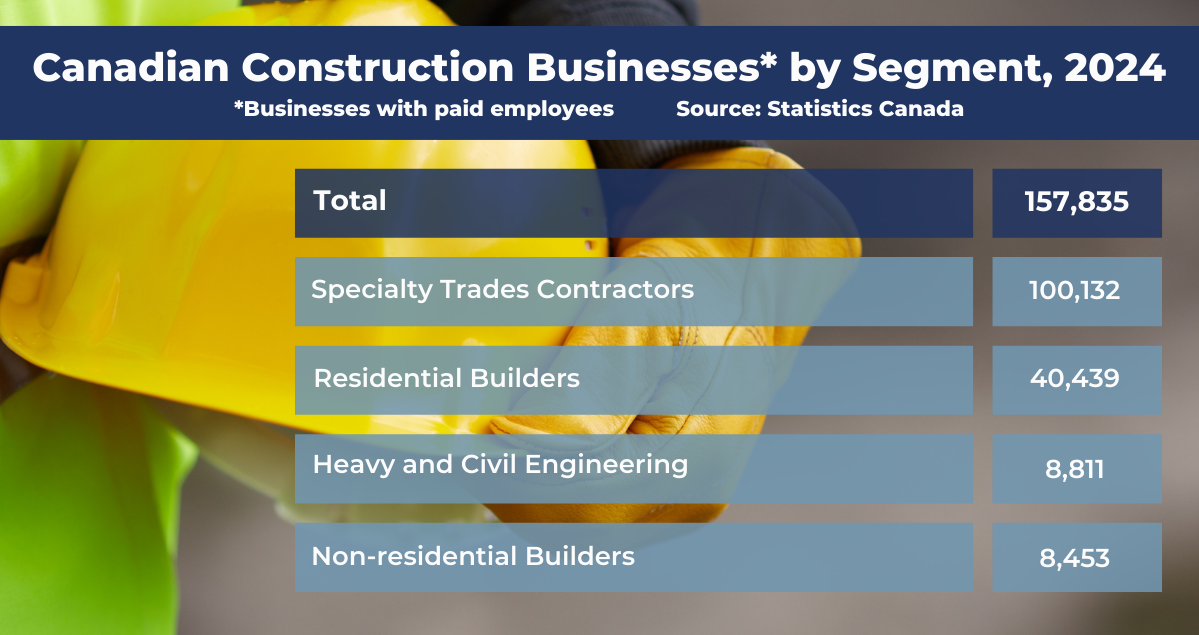
Specialty trades contractors represent more than 60% of all construction businesses with paid employees. These firms are engaged in “trade activities generally needed in the construction of buildings and structures, such as masonry, painting, or electrical work.” Specialty trades contractors may focus on a mix of new build, additions to existing structures, alterations, maintenance, and repairs. They typically work under contract to general contractors or primary builders, to carry out specific work on a larger project or undertaking. The average specialty trades contractor is smaller in size than companies involved in other parts of the construction sector.
The next largest sub-sector ranked by number of enterprises is residential construction, representing approximately one-quarter of all Canadian construction firms, followed by heavy and civil construction companies and businesses primarily involved in non-residential building.
Figure 2 provides summary data on construction businesses in B.C. and Alberta as of 2024. B.C. is home to about 17.5% of Canada’s construction companies and Alberta to slightly more than 13% of the national total.
Figure 2
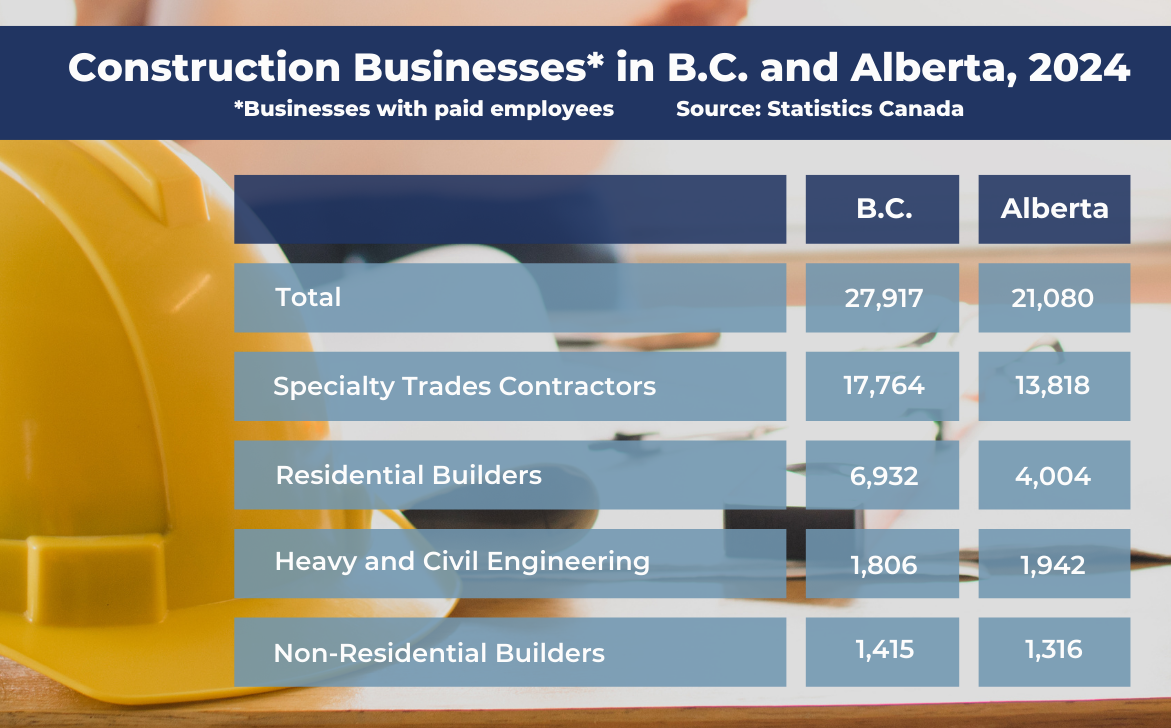
In both provinces, the distribution of construction companies by industry sub-sector roughly mirrors the national picture, but with a few notable differences. In particular, Alberta is home to more companies in the heavy/civil engineering segment than is B.C., despite having one-quarter fewer construction businesses overall compared to its western neighbour. The residential part of the industry – measured by number of companies – is smaller in Alberta than in B.C. or Canada as a whole. This is consistent with Alberta having a significantly more capital-intensive industrial structure along with a much bigger energy industry than other regions of the country.
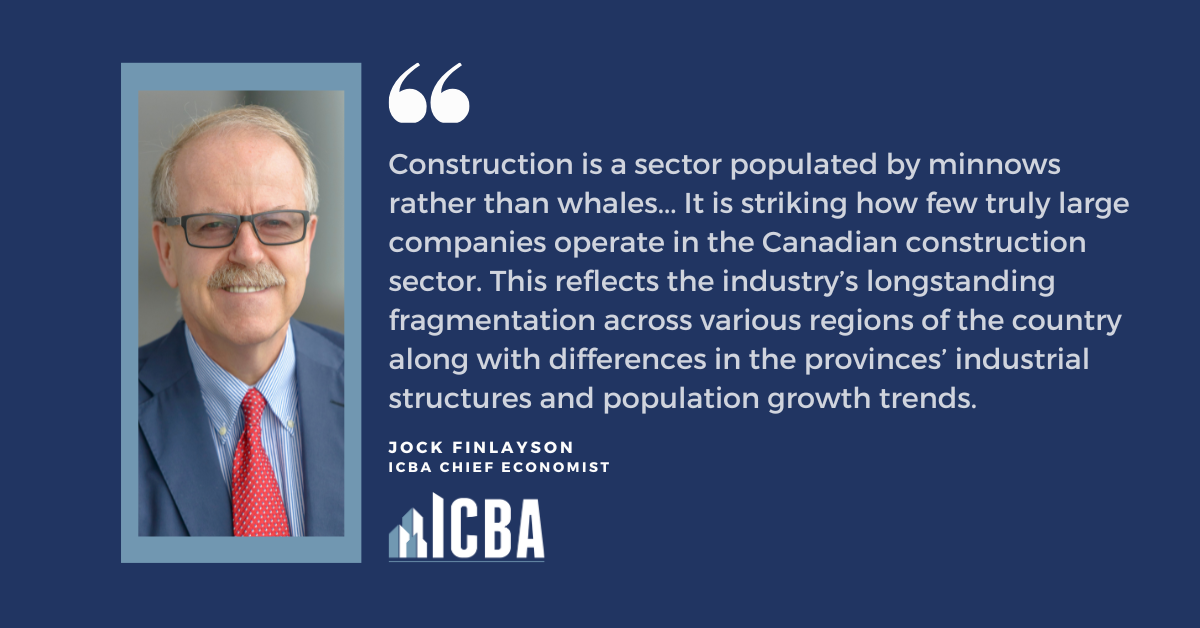
Finally, a word should be said about the size distribution of construction companies. Put simply, construction is a sector populated by minnows rather than whales. Figure 3 breaks down the number of construction businesses based on their payroll employees. Construction is characterized by a preponderance of very small businesses – “micro” firms (1-4 employees) accounted for more than 60% of all Canadian construction companies in 2024. The same general pattern prevails in B.C. and Alberta, although the latter province is home to more “large” construction firms (those with at least 500 employees).
Figure 3
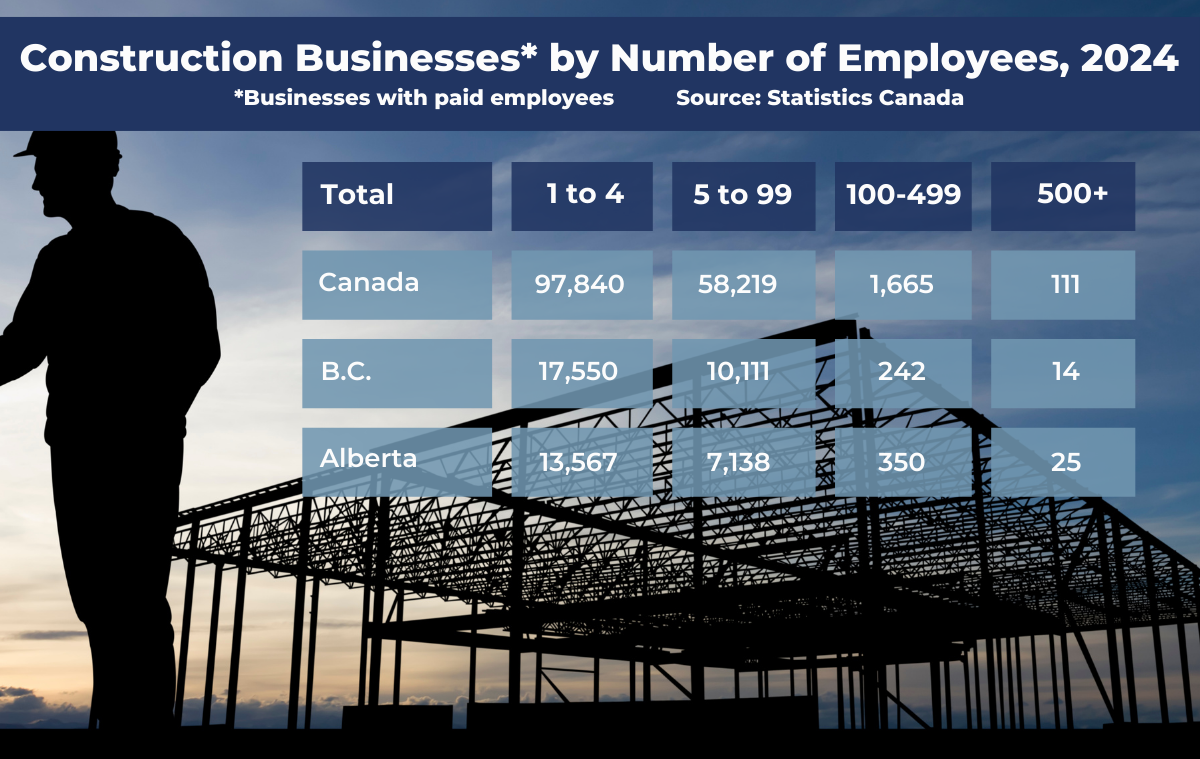
It is striking how few truly large companies operate in the Canadian construction sector. This reflects the industry’s longstanding fragmentation across various regions of the country along with differences in the provinces’ industrial structures and population growth trends. The paucity of large construction companies is also consistent with the fact that a lot of the work required to deliver many construction projects is farmed out to other, generally smaller firms.
Canada's job vacancy rates are declining, including in the construction sector, reflecting a cooling labour market amidst brewing economic challenges.
%20(2).png)
Canada's construction sector faces a downturn as job vacancies and payrolls decline, highlighting economic pressures and rising costs.

Winter 2026 Construction Monitors for B.C. and Alberta reveal economic forecasts, key sector indicators, and strategic insights for planning and...