NEWS RELEASE: B.C.'s Economy has gone from Leader to Laggard
B.C.'s economy is declining as government spending rises, private sector struggles, and job growth stagnates. Explore the findings of a crucial new...
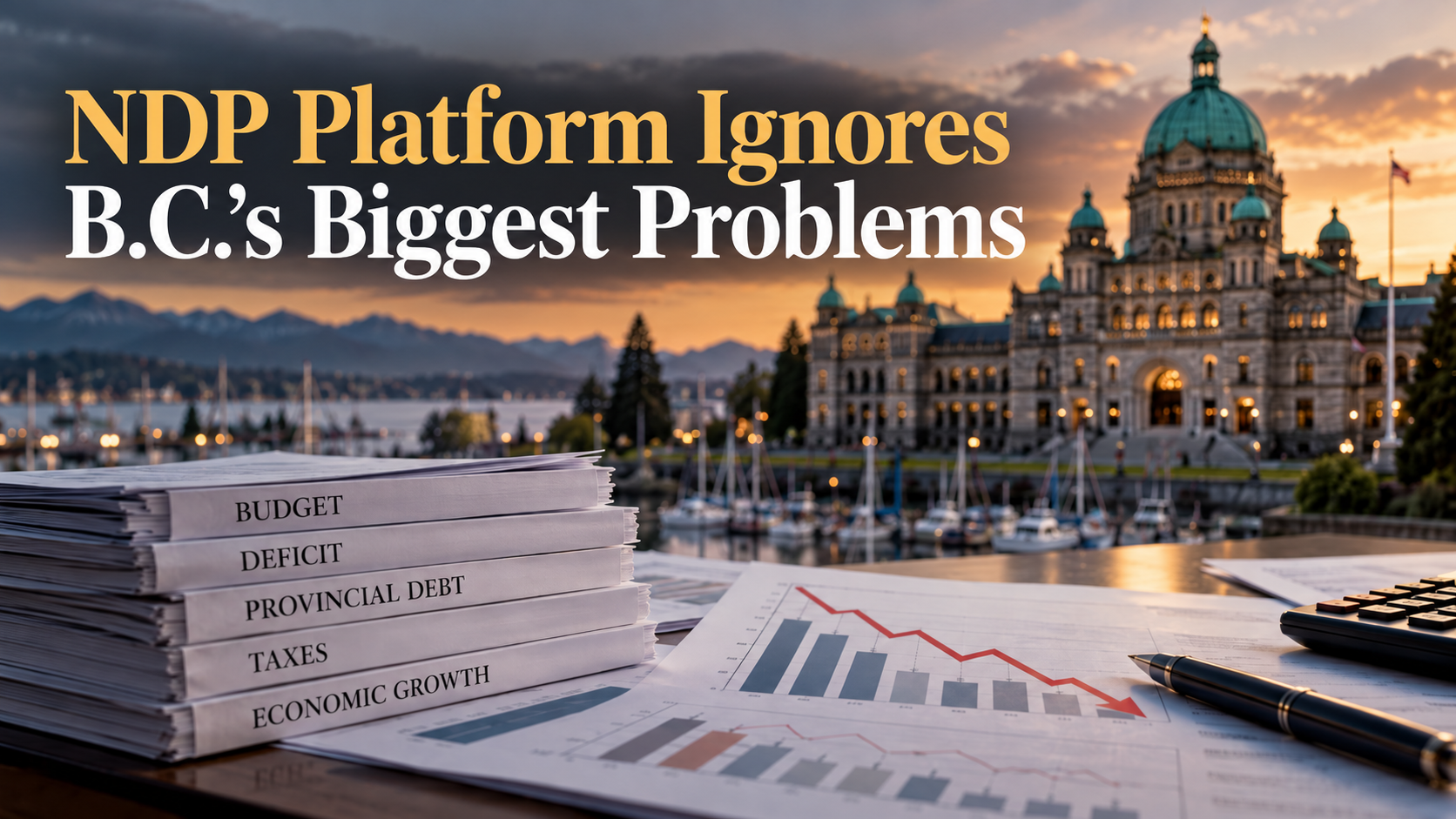
The following analysis of the B.C. NDP 2026 election platform was written by ICBA Chief Economist Jock Finlayson and consulting economist Ken Peacock.
Election platforms give political parties an opportunity to explain what they intend to do if elected and demonstrate that their promises fit within a credible fiscal framework. This is especially important in B.C. at present, as the province grapples with two closely related challenges: rapidly deteriorating public finances and a prolonged period of weak growth across the private sector.
Against this backdrop, the NDP's latest election platform is revealing, both for its dubious revenue assumptions and, especially, for what it leaves unsaid. For a governing party that has been in office for almost a decade and presumably knew an election was approaching, its platform is remarkably thin on fiscal substance, says little about the government’s checkered record, and offers few ideas for improving the economy.
Although presented as a costed platform, the document attributes revenues expected from major projects already underway or initiated as flowing to the provincial Treasury because of its fiscal plan. Meanwhile, the NDP offers little to address the weak investment climate and stagnant private-sector employment that have become defining features of B.C.'s economy under Premier Eby. Most alarmingly, the NDP platform outlines no meaningful strategy to reverse the province's deteriorating fiscal position.
A fiscal problem the platform barely acknowledges
B.C. is running record deficits that are the largest in Canada on a per-person basis, while provincial debt has approximately doubled in just a few years. Credit rating agencies have repeatedly downgraded the province, reflecting concerns about the speed and scale of its accelerating debt accumulation. Rating agencies have signalled that further downgrades are imminent if nothing changes.
Yet the NDP’s platform opens by declaring that "B.C. remains in a strong fiscal position compared to other provinces." This assertion ignores negative trends in the government’s finances since 2022 – notably, a doubling of the total provincial debt under David Eby. Continued borrowing at the pace set by Mr. Eby will increasingly constrain the government's ability to fund public services. A government in power for almost a decade is presiding over a slow-moving fiscal crisis but doesn’t even acknowledge the problem.
Oddly, the NDP platform provides no explanation of how the fiscal gap will be narrowed, how spending growth will be restrained, or what fiscal targets would guide future government decisions on these issues. Even though government spending has ballooned from $59 billion in 2019-20 to more than $100 billion in the current fiscal year (2026/27), the platform does not commit to a wide-ranging review of the sprawling and steadily expanding B.C. public sector. That counts as a major weakness of the document, in our view.
Instead, the platform relies on additional revenues from major construction projects that are underway and higher taxes on upper-income earners. The latter points to a further weakening in private-sector investment, job creation, and entrepreneurial activity if the NDP remains in power and adopts the measures outlined in the platform.
Counting revenues from major project investments already in train as a fiscal benefit attributable to the NDP platform is slippery accounting. That said, ICBA agrees with the NDP (and the Conservative Party) that B.C. has attractive opportunities to advance more large-scale projects in the energy, mining and transportation sectors in the next few years. Successfully executing on these projects will help to narrow the yawning deficit by delivering stronger economic growth that provides a lift to government revenues.
Where is the plan to revive private-sector growth?
The heavy emphasis on major projects as the solution to B.C.’s economic woes also exposes a less visible problem with the NDP platform: its limited attention to the economic conditions facing small and mid-sized businesses across the province as well as industry sectors that aren’t directly involved in major projects.
Private-sector economic growth in B.C. stalled in 2024 and barely advanced in 2025. Recent forecasts suggest there will be essentially zero private-sector GDP growth this year. Private-sector employment has made virtually no headway since David Eby became premier, even as public-sector employment has ballooned.
This is not a short-term fluctuation. It points to a prolonged period in which many B.C. businesses across multiple industry sectors have struggled to expand, invest and add employees – and even to survive.
Major resource and infrastructure projects are an important part of B.C.'s economy, and efforts to advance them are welcome. But they represent only part of the private sector. Most British Columbians work for businesses operating outside the sectors driving these big projects, including manufacturing, retail and wholesale trade, construction, transportation, business and professional services, real estate, technology, tourism and thousands of smaller enterprises. For example, the platform is almost entirely silent on the province’s diverse technology sector (7-8% of GDP). Nor does it address the downturn unfolding in the province’s homebuilding industry.
A durable economic recovery requires stronger investment and employment growth across the broader B.C. business sector. Yet the platform offers no new measures aimed at improving the general business and investment climate. It says nothing about reducing the cumulative costs of doing business or increasing regulatory predictability. There is little proposed in the platform to encourage productivity-enhancing investment or strengthen incentives for businesses to expand and hire. It is also silent on the need to bolster fragile business confidence which has eroded amid President Trump’s trade war and also because of the cumulative impact of the many tax hikes and other policies implemented by the NDP since 2017. In general, these have raised costs and made it harder to do business in B.C. over the last nine years.
These omissions matter. Businesses make investment and hiring decisions based on expected returns, operating costs and confidence in future economic conditions. Higher taxes, rising employment costs, growing regulatory burdens and pervasive uncertainty weaken those incentives and discourage new investment.
An election platform that depends on stronger economic growth to bolster the province's finances should explain how it intends to foster that stronger growth – particularly in the private sector, which accounts for 75-80% of GDP and employment in B.C.
Higher taxes are not a solution
The NDP platform proposes to raise approximately $1 billion in additional annual revenue by 2028/29 through higher taxes on the top 3.88% of income earners. This pledge will further increase B.C.'s top marginal personal income tax rate, already close to the highest in North America, to among the highest in the world. With David Eby’s higher tax rates and new “millionaire” tax bracket, the top combined federal-provincial tax rate will climb to just under 58%. And individuals with earned incomes above $265,000 but under $1 million will face a combined top rate of 55.5%, up from 53.5% today.
By way of comparison, in next-door Alberta, the highest personal income tax rate sits at 48%. In most U.S. states, the top rate is between 38% and 43%. What about Western Europe? Based on recent data, here are the highest personal income tax rates in effect in a range of European countries: Belgium – 53%; Croatia – 33%; Estonia – 22%; Finland – 45%; France – 55%; Germany – 47%; Italy – 47%; Norway – 40%; Sweden – 52%; Switzerland – 40% (Tax Foundation Europe, “Top Personal Income Tax Rates in Europe, 2026”). The NDP’s tax plan will leave B.C. with top tax rates even higher than in France, Germany, Italy, Sweden and Finland!
The NDP government introduced substantial tax increases in the last several years, adding to the burden on businesses and households. Its latest proposal concentrates additional taxation on a relatively small group of high-income earners, including physicians, engineers, business owners and other highly skilled professionals. There are legitimate debates about the appropriate distribution of the tax burden. But the economic consequences also matter, particularly in a province competing to attract and retain investment, entrepreneurs, highly skilled workers, business innovators, and corporate head offices.
Higher marginal tax rates influence decisions about where skilled professionals and managers choose to work, where entrepreneurs establish and grow businesses, and where investors deploy capital. These considerations are especially relevant when the province’s overall private-sector economy is already struggling to gain momentum. Moreover, academic research and previous Canadian experience confirm that imposing higher marginal tax rates like those planned by the NDP invariably raises significantly less revenue than governments initially assume, because the people affected change how, how much, and where they work, save, and invest (C.D. Howe Institute, “Ontario’s Tax on the Rich: Grasping at Straw Men,” June 2012; C.D. Howe Institute, “Unhappy Returns: A Preliminary Estimate of Taxpayer Responsiveness to the 2016 Top Tax Rate Hike,” September 2018; Kevin Milligan and Michael Smart, “Provincial Taxation of High Incomes: The Effects on Progressivity and Tax Revenue,” IRPP, 2015).
The NDP’s platform ignores these potential harmful effects from higher personal income tax rates on the most skilled and productive segment of the working-age population. Nor does it explain how raising taxes on a narrow slice of taxpayers would address the underlying drivers of government expenditure growth.
The lessons of the NDP’s 2024 platform
Given the state of the province's finances, voters have reason to examine the government's earlier fiscal commitments.
During the 2024 election, the NDP committed to reducing B.C.'s deficit to $7.6 billion in 2026/27. Just two years later, the Ministry of Finance is projecting the deficit will be nearly $14 billion for the same fiscal year. Whatever the final number, the projected deficit is now nearly twice the figure presented in the previous election campaign – barely two years ago.
The discrepancy is particularly striking because it has occurred despite several new tax measures and continued government revenue growth. It also follows the government's decision to break its promise to deliver a $1,000 grocery rebate per household, a central plank in its 2024 platform. By not delivering this relief the government saved approximately $1.3 billion in 2026/27 according to its own platform projections.
Forecasts inevitably change as economic conditions evolve. But a fiscal miss of this magnitude warrants a clear explanation of what changed and, more importantly, what the government intends to do differently in future.
The latest platform provides neither.
Conclusion
The fundamental weakness of the economic and fiscal components of the NDP's platform is the failure to acknowledge the province's current economic and fiscal trajectory.
B.C.'s economic and fiscal problems are connected. Feeble private-sector growth limits the expansion of the tax base, while persistent deficits, mounting debt and higher taxes further undermine the conditions needed for investment and economic growth.
Addressing one problem therefore requires tackling the other.
The NDP's platform promises to reduce the deficit but offers little explanation of how that will happen beyond imposing higher taxes on a small but important slice of the population – a strategy that will discourage business investment and make it all but impossible to attract highly skilled people to B.C.
A credible fiscal and economic plan should recognize the scale of both challenges, explain the necessary trade-offs, and establish a realistic path toward fiscal stability and stronger private-sector growth.
Instead, the NDP platform basically doubles down on the government’s existing approach: increase spending, raise taxes, downplay the role of entrepreneurs and small businesses in our economy, and count on a handful of big projects to deliver the economic growth and revenues needed to make the numbers work.

B.C.'s economy is declining as government spending rises, private sector struggles, and job growth stagnates. Explore the findings of a crucial new...
Explore the challenges faced by B.C.'s housing market and why a focus on supply and streamlined regulations is essential for lasting solutions.

A recent letter to David Eby, his cabinet and the business community from Brixton Metals should send a chill down the spine of anyone who cares about...