OP/ED: Population decline exposes B.C.’s growth problem
B.C. faces unprecedented population decline, impacting economic growth, housing, and labor supply. The province must adapt to new demographic...
3 min read
%20(1)-1.png?width=1200&height=600&name=jock%20pullquote%20horiz%20(1200%20x%20600%20px)%20(1)-1.png)
If there were any remaining doubts that the David Eby government has mismanaged British Columbia’s public finances, the details of Budget 2026 have firmly laid them to rest.
The new Budget underscores the unprecedented deterioration in the province’s fiscal health during the approximately 3.5 years that Premier Eby has been in charge. His government has run consecutive operating deficits since 2022-23, with the pattern set to continue. Budget 2026 forecasts a string of hefty deficits over the rest of the decade, and there is no hint of a plan to get back to a balanced operating budget in the foreseeable future.
Even more alarming is the stunning rise in the total government debt. In B.C., the growth of government debt is driven by two factors: 1) the accumulation, over time, of annual operating deficits (and, occasionally, surpluses); and 2) the impact of past and projected borrowing by the province to finance infrastructure and other capital projects in sectors such as health care, education, transportation, and energy (the latter predominantly involves capital spending by BC Hydro). Most borrowing for capital spending does not directly appear as part of the operating budget.
The bulk of the province’s current total debt – fast approaching $155 billion – reflects debt issued to pay for capital projects. However, under Premier Eby, a substantial portion of the recent increase in government debt is attributable to record operating budget deficits – a trend that will persist for the next few years at least.
Table 1 summarizes the growth and broad composition of total government debt since the NDP assumed office in 2017. The table starts in 2018-19, as this was the first full fiscal year under the NDP. Note that the figures for 2025-26, 2026-27 and 2027-28 are based on forecasts presented in Budget 2026.
Table 1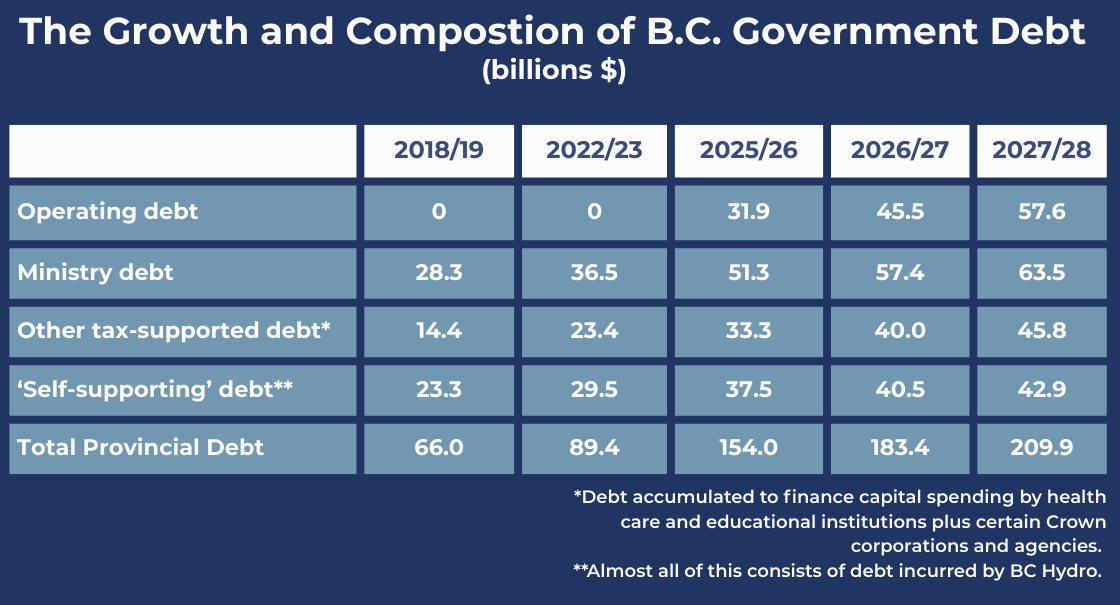
The first row of data relates to the “operating debt” – the sum of previous deficits (and surpluses). The second row in Table 1 reports on borrowing to pay for capital projects that fall directly within the purview of B.C. government ministries. Row three captures debt accumulated to pay for capital spending by health and education authorities, certain Crown entities, and other organizations that are included within the broad provincial public sector but are not a direct part of the government itself. The fourth row, labelled “self-supporting debt,” mainly consists of borrowing by BC Hydro. In this case, the resulting debt appears on BC Hydro’s balance sheet, but ultimately it is 100% guaranteed by the provincial government; therefore, Hydro’s debt is also counted in the total provincial debt, shown in the fifth row.
When David Eby became Premier in late 2022, the province had a substantial operating surplus. The picture changed radically once Mr. Eby was in charge.
Today, B.C. is saddled with a very large “structural” operating deficit – estimated at $12-13 billion per year, according to the Ministry of Finance. The term “structural deficit” refers to a chronic gap between government expenditures and revenues, a gap that is not attributable to temporary fluctuations in the economy and thus cannot be expected to shrink significantly in the event of stronger economic growth. B.C. is currently projected to post a series of unusually large annual operating deficits, which Budget 2026 pegs at $9.6 billion this year and $12-13 billion over the next three years. Premier Eby inherited a budget surplus. By the close of the 2025-26 fiscal year, he will have added almost $32 billion in operating debt to the government’s total debt, with that figure on course to climb to almost $58 billion by 2027-28. Big operating deficits have become an important driver of B.C.’s spiralling government debt in the last few years.
As shown in Table 1, the total provincial debt has skyrocketed, more than doubling in dollar terms since 2018 -- with a further $55 billion increase expected between 2025-26 and 2027-28. In our view, the stunning growth in the provincial debt since 2022-23 is evidence of extraordinary fiscal recklessness on the part of the current Premier.
For additional context, we can examine the trends in government debt relative to the size of the province’s economy (GDP). This provides important insight into the “sustainability” of the government’s finances. It is also one indicator of how fast the provincial public sector is expanding compared to the growth of the economy as a whole.
Figure 1 shows total B.C. government debt relative to GDP since the NDP was elected in mid-2017 (we start with fiscal year 2018-19), with forecasts to 2028-29. According to the projections in Budget 2026, by 2028-29 the province’s debt will have more than doubled as a share of GDP compared to where it stood when Premier Eby arrived in office, jumping from 22.3% of GDP in 2022-23 to more than 46% before the end of the decade. As noted above, the rapidly escalating debt/GDP ratio reflects both a pattern of unusually large operating deficits and the impact of significant ongoing borrowing to fund infrastructure and other capital projects.
Based on Budget 2026, it’s a fair bet that future historians will award David Eby very low marks for his stewardship of B.C.’s public finances since he assumed the premiership in late 2022.
Figure 1.png?width=2752&height=1438&name=unnamed%20(3).png)
B.C. faces unprecedented population decline, impacting economic growth, housing, and labor supply. The province must adapt to new demographic...
Premier Eby's tenure sees B.C.'s fiscal health deteriorate with soaring debt, record deficits, and stagnating economic growth, risking the province's...
David Eby's leadership has led B.C. into economic stagnation and fiscal chaos, with soaring debt and record deficits threatening the province's...