1 min read
ICBA ECONOMICS: Where B.C. and Alberta Stand on Corporate Head Offices
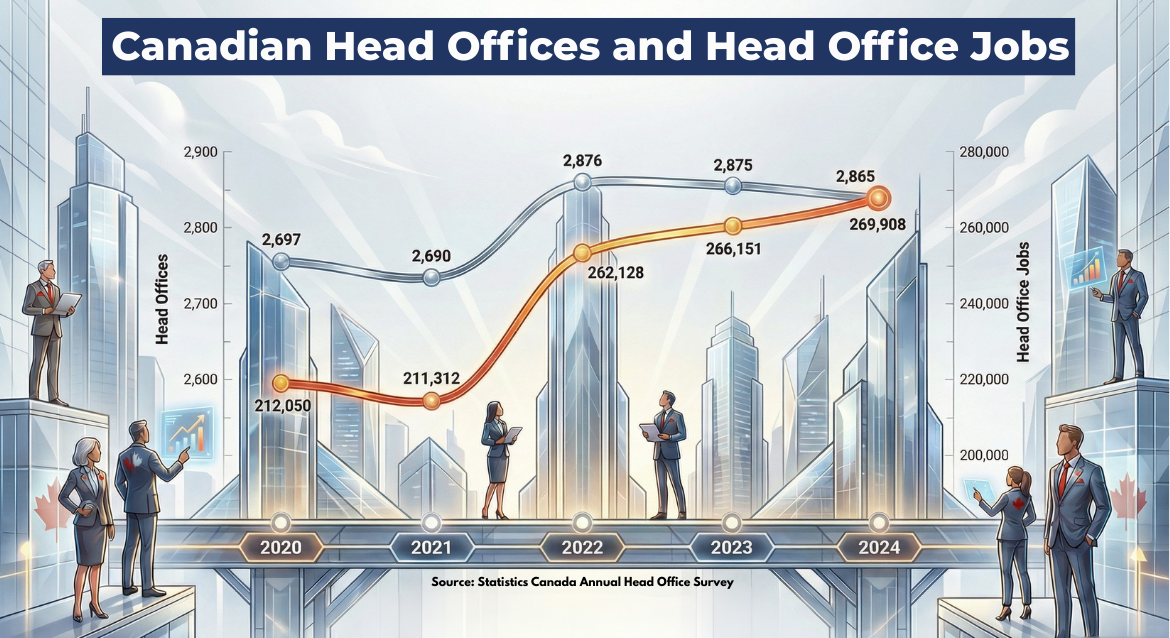
Statistics Canada’s latest survey of corporate headquarters provides updated counts of head offices and direct head office jobs for each province as...
5 min read
.png)
At the halfway point of a notably turbulent 2026, Canadian policymakers and business leaders are navigating an uncertain and, at times, perilous economic landscape. President Donald Trump’s continued indiscriminate use of tariffs to compel other countries to bend the knee to America’s wishes poses an obvious risk to Canada, particularly with the formal review of the Canada-U.S.-Mexico trade agreement (CUSMA) slated to begin on July 1. Global geopolitical tensions remain elevated amid the unresolved conflict in the Persian Gulf and the ongoing Russia-Ukraine war. Price spikes for energy and some other raw materials triggered by lower oil production in the Middle East and the on-and-off closure of the Strait of Hormuz are still reverberating across the world’s economies and supply chains.
Closer to home, Canada is either in or on the cusp of a recession as real GDP has now slightly contracted for two consecutive quarters. Internally, Canada faces economic headwinds from a declining population, persistently weak business investment, and housing markets – especially in B.C. and Ontario – that are grappling with a toxic mix of sluggish demand and high building costs. While the federal and some provincial governments are now prioritizing new industrial and infrastructure projects and positioning themselves as champions of higher business investment, the economic gains from this policy pivot will take time to materialize, leaving the national economy mired in something close to stagnation in 2026.
For this year, ICBA Economics expects Canada to post real GDP growth in the range of 0.5-0.8%, down from approximately 2% in each of the previous two years. In line with other forecasters, we see the economy perking up in 2027 as overall growth rebounds to around 2%. With the Canadian population now shrinking, at least this comparatively feeble economic expansion will translate into marginal gains in real GDP per person – contrasting with the pattern over much of the Justin Trudeau era.
Canada-wide employment growth is unlikely to reach even 0.5% this year, before picking up on the back of a stronger economy in 2027. Total CPI inflation should come in at 2.7% in 2026 and then drop to 2.0-2.2% next year. Housing starts nation-wide are projected to rise modestly after a period of subdued residential construction spending – with most of that weakness concentrated in Ontario and B.C.
ICBA Economics’ base case Canadian forecast assumes no change in the existing mix of U.S. tariffs on Canada’s exports. Specifically, we assume that across-the-board tariffs will not be applied to the bulk of Canada’s southbound exports, with the U.S. levies remaining focused on a few specific categories of Canadian-produced goods.
Our discussion of the updated economic outlook for B.C. and Alberta reflects the Canadian base case forecast described above.
Weak Growth in Store for B.C., Better Outlook for Alberta
As of mid-2026, Alberta is at or near the top among the provinces on most key economic performance metrics, while B.C. finds itself closer to the bottom.
That said, last year B.C. did better than forecasters were anticipating, cranking out a decent 2% increase in real GDP (measured by combining the output of all industry sectors collectively). This roughly matched the national average. Last year, B.C. benefitted from strength in several sectors – e.g., tourism, technology, mining and energy, and a still expanding public sector. Non-residential construction also held up quite well, even as homebuilding began to wilt and an ever-lengthening list of multifamily residential development projects were shelved. Job growth in B.C. came in at 1.1% y/y, but the unemployment rate bumped up to 6.2% (vs 5.6% in 2024).
ICBA Economics sees real GDP growth dipping to just 0.6% in 2026, before turning higher and approaching 2.0% in 2027. Net job creation is likely to be negative for 2026 as a whole before posting a small gain the following year. Currently, B.C. is grappling with reduced immigration, negative overall population growth, an epic slump in the once-dominant forest industry, a generally poor business climate, a sharp drop in residential construction activity, and negative fallout from the NDP government’s failed “reconciliation” strategy with First Nations. Combined, these negative trends are conspiring to keep a lid on the province’s economy and may continue to do so for some time.
Looking to 2027, the B.C. outlook brightens a bit – assuming Canada-U.S. trade relations don’t suffer further shocks. While population growth will remain elusive, we see housing market conditions stabilizing by late next year and business investment increasing modestly as more large projects advance. The tourism sector will cheer the cheap Canadian dollar and a further increase in offshore visitor numbers. Continued solid economic growth in the U.S. will also be positive for B.C., notwithstanding the difficulties created by President Trump’s mercantilist trade policies. The NDP government’s plan to run large budget deficits and keep borrowing heavily to fund capital projects is storing up trouble for future taxpayers, but in the short-term the government’s spendthrift fiscal policy will provide some ballast to a struggling economy.
Figure 1 shows our revised base case forecast for the B.C. economy.
Figure 1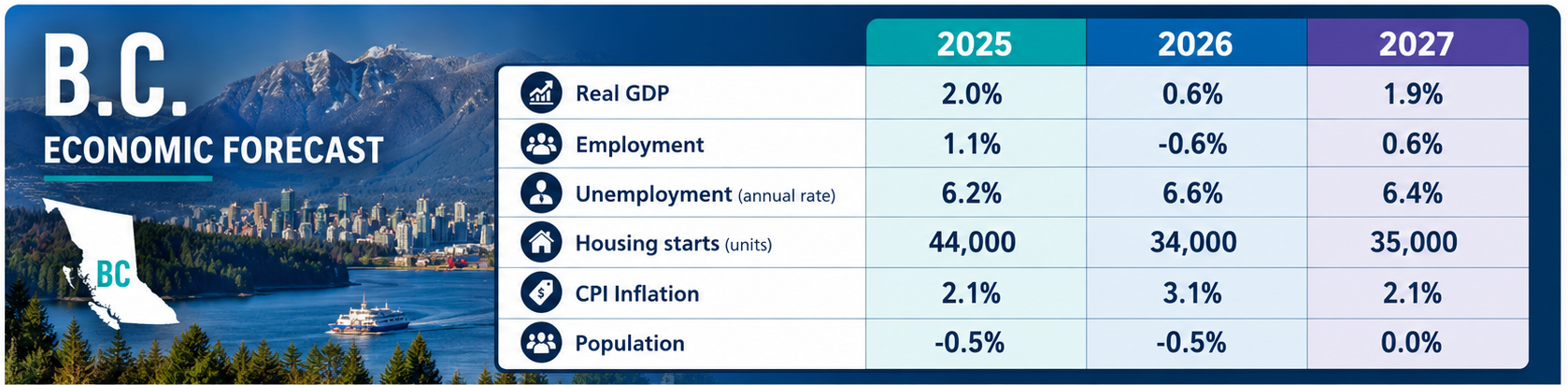
Economic conditions are better in Alberta, and the near-term economic picture is brighter than in its neighbouring province. Alberta has been putting up the most impressive economic numbers of any major Canada province in the last 2-3 years, owing in part to rising energy production, continued population and job growth, and significant investment in non-energy sectors. Within Canada, Alberta is an attractive location for people to live, find housing, and develop their careers. The same mix of positive characteristics is also luring private sector investment and entrepreneurial talent.
Last year, Alberta notched up a 2.7% real GDP growth rate, on the heels of a 3.0% advance in 2024. Job growth reached 2.8% -- 2.5 times faster than in next-door B.C. Over the period 2023-2025, annual employment growth in Alberta exceeded 3%. Due to unprecedented inflows of international migrants and working-age people from other provinces, Alberta’s labour force has expanded rapidly and the unemployment rate remained elevated at a little over 7% in 2024-2025.
Alberta’s oil production hit an all-time high in 2025, at 4.2 million barrels per day, with most of this exported to outside markets. The positive momentum has carried over to 2026. In the last few months, soaring global oil prices have delivered a sizable boost to Alberta’s energy-centric economy and temporarily flattered the provincial government’s fiscal position. The extent to which Alberta can further expand oil production and exports in a sustainable way hinges on building new pipeline capacity to Canada’s west coast as well as to the U.S. While ICBA is optimistic that such capacity will be developed, at this point there is considerable uncertainty and new investment in major oil-related infrastructure is not factored into this updated 2026-27 economic forecast. In the meantime, demand for Alberta natural gas will be rising as LNG production and exports ramp up in B.C.
It is also worth mentioning that compared to other regions of the country, Alberta is benefitting because its population has continued to increase by 1.0-1.5% y/y even, as B.C. and most other provinces have seen their populations dwindle. Residential construction has been on a tear, but we expect a slight drop in housing starts in 2026 – albeit from very high levels. The outlook for non-residential investment depends, in part, on a handful of large projects moving forward. The government counts about $180 billion of “major projects” in its latest project inventory (this includes some residential and public sector projects). An important unknown is the fate of the massive Pathways carbon capture/storage project. In the medium term, energy-related investment will get a lift if new oil pipeline capacity is built. Beyond energy, the outlook is positive for capital spending in agriculture, petrochemicals, advanced manufacturing, data centres, utilities, and some parts of the public sector.
ICBA Economics forecasts that Alberta’s real GDP will climb by 2.5% this year, vs less than 1% for both Canada and B.C. Similar growth is expected for 2027. A relatively strong economy and continued population growth should create a positive backdrop for many Alberta businesses which focus on domestic consumer-facing domestic markets. Job growth is on track to reach 3% this year before cooling in 2027. We see housing starts in Alberta holding up better than some other forecasters, easing to 50,000 this year and between 45,000 and 50,000 in 2027.
Alberta’s public finances are something of a wild card. One quarter of the province’s own-source revenues come from the oil and gas sector. Escalating oil prices have converted a large 2026-2027 deficit projected in Budget 2026 into an apparent surplus. However, this will quickly dissipate as oil prices retreat from recent highs. Looking beyond the near-term, we believe the province will be operating in an underlying deficit position given current policy settings.
Figure 2 summarizes our updated forecast for the Alberta economy.
Figure 2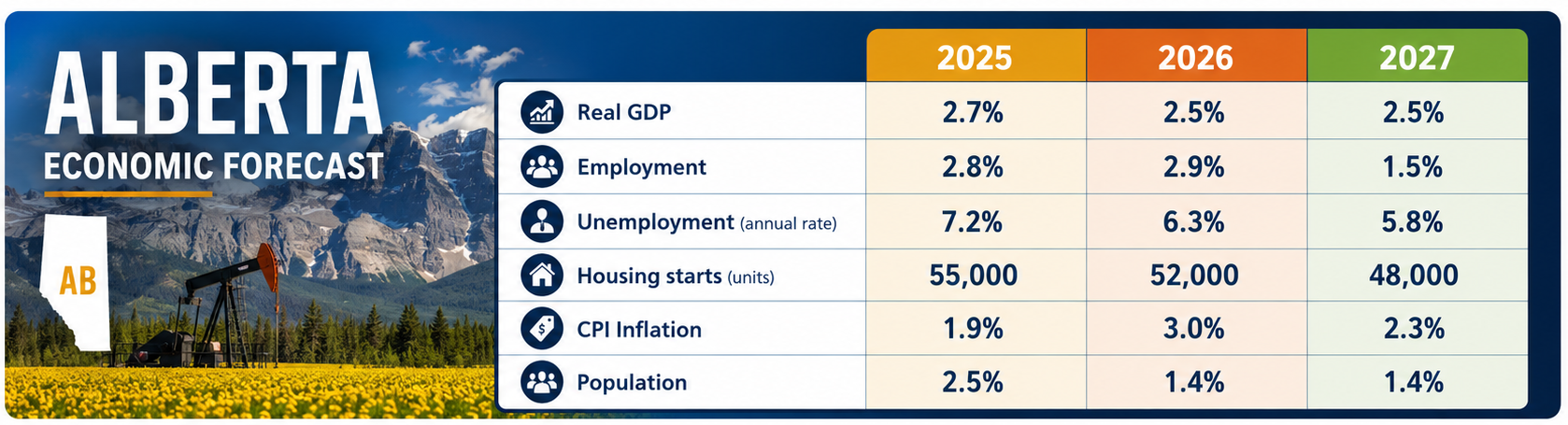
1 min read
Statistics Canada’s latest survey of corporate headquarters provides updated counts of head offices and direct head office jobs for each province as...
.png)
1 min read
In a recent report, the Canadian Federation of Independent Business lamented Canada’s “entrepreneurial drought,” as the ranks of new businesses...
1 min read
With housing market developments still featuring prominently in the news across some parts of the country, now is a good time to check in with the...