OP/ED: Trump tariffs aren’t B.C. forestry’s biggest problem
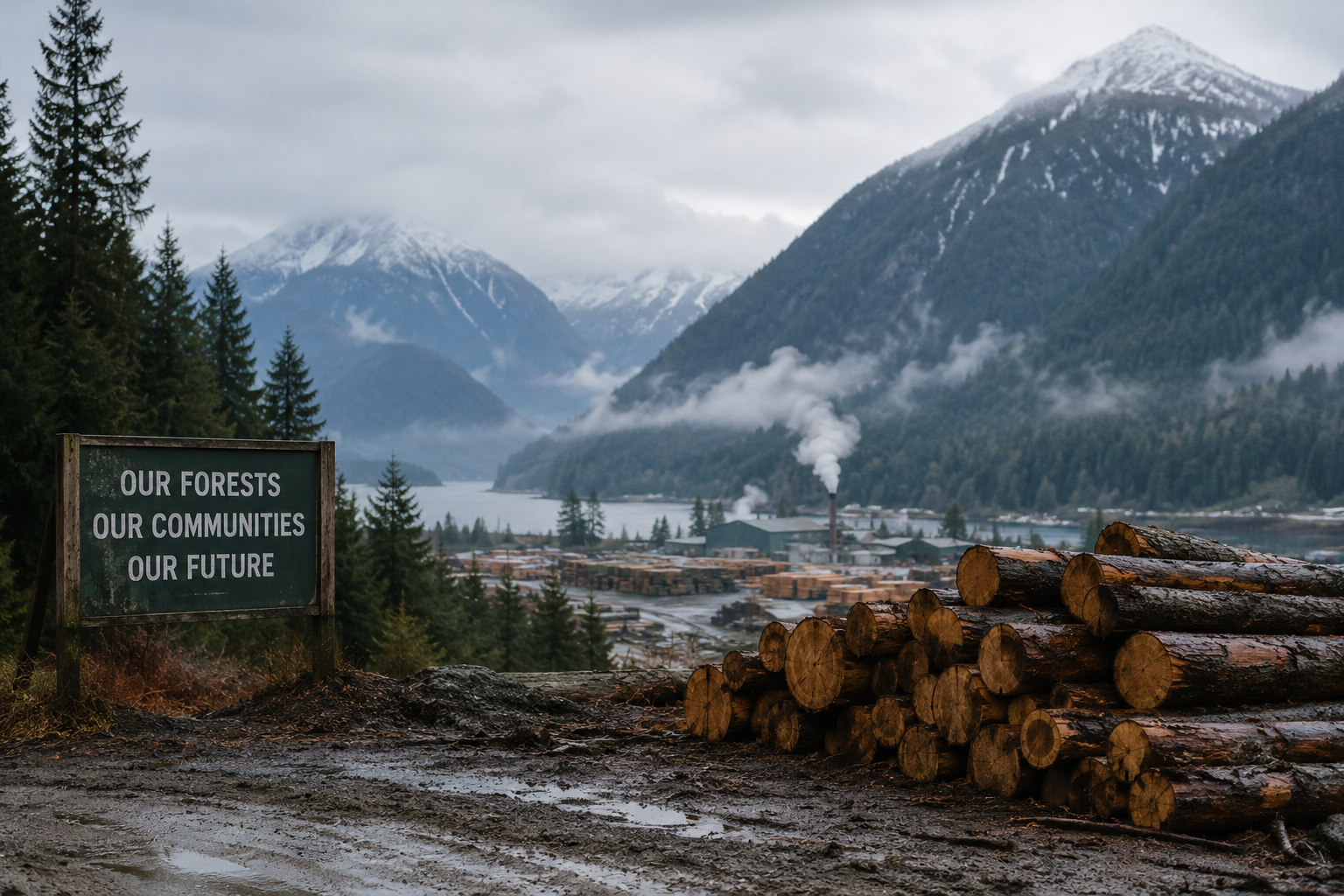
B.C. forestry struggles stem from domestic issues like fiber access and rising costs, not just Trump's tariffs, as industry giants plan relocations.
4 min read
.png?width=2752&height=1536&name=unnamed%20(8).png)
The following piece was co-authored by ICBA Chief Economist Jock Finlayson and consulting economist Ken Peacock. Subscribe to Ken's Substack HERE.
Whenever questions arise about mill closures and job losses in B.C.’s forest products sector, NDP government representatives are quick to blame U.S. tariffs.
But the numbers tell a different story. Softwood lumber exports to the U.S.— and other markets—have been falling more or less continuously since peaking in 2016. By 2024, before Donald Trump returned to office, B.C.’s southbound softwood lumber exports had already tumbled 42% compared to 2016. The Trump-driven expansion of softwood tariffs in 2025 contributed to a further 14% Y/Y reduction over the course of last year.
From a broader Canadian perspective, the downturn in lumber exports is also unique to B.C. Across the rest of Canada, softwood exports to the U.S. edged up 1.4% through 2024 before slipping under the weight of higher American tariffs and stalled U.S. homebuilding (see Figure 1). The relative stability and modest decline of lumber exports from other provinces stands in stark contrast to B.C.’s steep drop. Pretending that mill closures, escalating job losses in the forest sector, and capital flight from the B.C. industry are due to U.S. tariffs that were hiked in 2025 obscures the real challenges confronting the B.C. industry. It also distracts from policy measures that might help to stabilize this struggling but still important piece of the province’s economy.
Figure 1
Rhetoric by B.C. politicians about “diversifying” trade with other markets is similarly at odds with reality. The province’s softwood exports to all non-U.S. markets have also trended lower since 2016. The loss of business and market share in B.C.’s second- and third-largest wood product export markets are especially telling. B.C.’s wood product exports to China have collapsed 80%, while softwood shipments to Japan are down more than 60% from 2016 levels (see Figure 2). One can only conclude that the Eby government’s chatter about market diversification is little more than empty spin.
Figure 2
Market size compounds the problem. In 2025, the United States purchased 75% of all B.C. softwood exports (see Figure 3). China accounted for 9.6% and Japan for 6.8%. Given the dominance of the U.S. market and the erosion of Asian demand for B.C. wood products, genuine diversification is a daunting prospect, particularly in the near-term.
Figure 3
B.C.’s forest sector has been battling an array of headwinds since 2017, of which by far the most important is the decline in domestic fibre supply due to a mix of natural factors (pine beetle, wildfires) and policy choices made in Victoria. Trade issues have also played a role in the troubles facing the B.C. industry, of course. The 2006 Canada-U.S. Softwood Lumber Agreement expired in 2017, and the Americans then imposed fresh countervailing and anti-dumping duties totalling 26% on imports of B.C. lumber. During the pandemic, lumber prices surged to record highs and export volumes briefly rebounded. But after 2021 prices retreated again, domestic fibre-supply constraints tightened, and the B.C. sector’s underlying structural weaknesses re-emerged with a vengeance.
On November 2, 2021, the B.C. government announced its intention to defer the harvest of large stands of old growth timber across 2.6 million hectares. On April 1, 2022, the government implemented additional harvesting deferrals affecting almost 1.7 million hectares of old-growth forest, including roughly 1.05 million hectares within the “timber harvesting land base” (i.e., areas previously eligible for harvest).
The Council of Forest Industries (COFI) warned that if these deferrals proceeded in full, it could lead to between 14 and 20 sawmill closures across B.C., two pulp mills shutting, and the loss of around 18,000 jobs. Industry leaders described the deferrals as having “far-reaching consequences” for competitiveness and investor confidence, worries that have been validated by subsequent developments. Combined with the effects of wildfires, the pine beetle epidemic and ongoing regulatory changes (most leading to higher operating costs for the industry), the government’s additional deferrals further tightened fibre supply, forcing widespread curtailments, closures and layoffs – as predicted by COFI.
From a longer-term perspective, the government’s inclination to serially scale back the supply of fibre for the forest sector has soured both investors and forest companies on B.C. as a producing jurisdiction. This, in turn, has caused capital to be deployed elsewhere and signalled to the marketplace that the provincial government no longer attaches a high priority to the commercial success of what was once B.C.’s largest export industry.
The export data reflect the economic results of the policy-induced fibre supply squeeze. In the wake of the April 2022 deferrals, B.C.’s softwood lumber exports to the U.S. fell 7.4% that year followed by a further 17.4% plunge in 2023.
In 2025, B.C’s lumber exports to the U.S. fell 14.3% compared with 2024 (see Figure 4). While painful, the drop does not stand out as unusually large in the context of the past decade. What’s more revealing, in our view, is that B.C.’s softwood exports to all non-U.S. markets collectively fell 5.4% in 2025. Recently increased U.S. tariffs and duties have been compounding what amounts to an almost decade-long decline in forestry-based economic activity in the province. This negative trend has been driven to a very significant extent by B.C. government policy decisions and policymakers’ evident disinterest in improving the “hosting conditions” for the industry.
Figure 4
The limiting constraint for B.C.’s lumber industry has shifted from demand (once tied closely to U.S. housing cycles) to insufficient domestic fibre supply, a high-cost operating environment compared to competing jurisdictions in North America, Europe and Latin America, and an ever-mounting regulatory burden due to provincial government policies. Elsewhere in Canada, softwood lumber exports have held up much better than they have in B.C., highlighting the unique pressures bearing down on the industry here and the deteriorating business climate for all segments of the B.C. forest industry supply chain.
Also concerning is the sharp fall-off in forest sector productivity that comes out clearly in recent data (see Figure 5). High operating costs and tightening fibre supplies have made it increasingly difficult for B.C. lumber mills to operate profitably. As a result, companies understandably have been directing new investment to other North American and European jurisdictions with more favourable operating conditions and a more stable and attractive policy environment. In 2015, output per hour worked in B.C.’s wood products sector stood at nearly $70, about $12 above the entire Canadian wood products average. By 2024, output per hour had fallen to $48, a drop of more than $20. Over the same period, productivity in the Canadian industry increased and is now some $14 above B.C.’s level. Rising costs, constrained fibre supply, and endless policy-driven uncertainty and instability have strongly discouraged capital investment, reinforcing the B.C. sector’s productivity decline.
Figure 5
If B.C. policymakers and those who elect them have any desire to preserve what remains of one of the province’s iconic industries, let alone to see it expand in the future, something has to change. Politicians should focus less on foreign tariffs—over which B.C. has next-to-no control -- and put more attention on addressing the home-grown competitiveness crisis that is sucking the life out of the B.C. industry. The goal should be to restore a sustainable, predicable and gradually increasing fibre supply – something over which the province has significant influence. Without that, mill closures and job losses will continue and the B.C. forest products industry will remain on its current trajectory of steady decline.
B.C. forestry struggles stem from domestic issues like fiber access and rising costs, not just Trump's tariffs, as industry giants plan relocations.
%20(1).png)
BC's forestry crisis is fueled by declining fibre supply, complex regulations, and U.S. tariffs, causing mill closures and job losses. Solutions...
B.C. faces a troubling decline in business creation, with more exits than entries. A focus on entrepreneurship is vital for sustainable economic...