ICBA ECONOMICS: Where Alberta and B.C. Stand on Corporate Head Offices
Statistics Canada’s latest survey of corporate headquarters provides updated counts of head offices and direct head office jobs for each province as...
3 min read
By ICBA Chief Economist Jock Finlayson and consulting economist Ken Peacock (see Ken's Substack HERE).
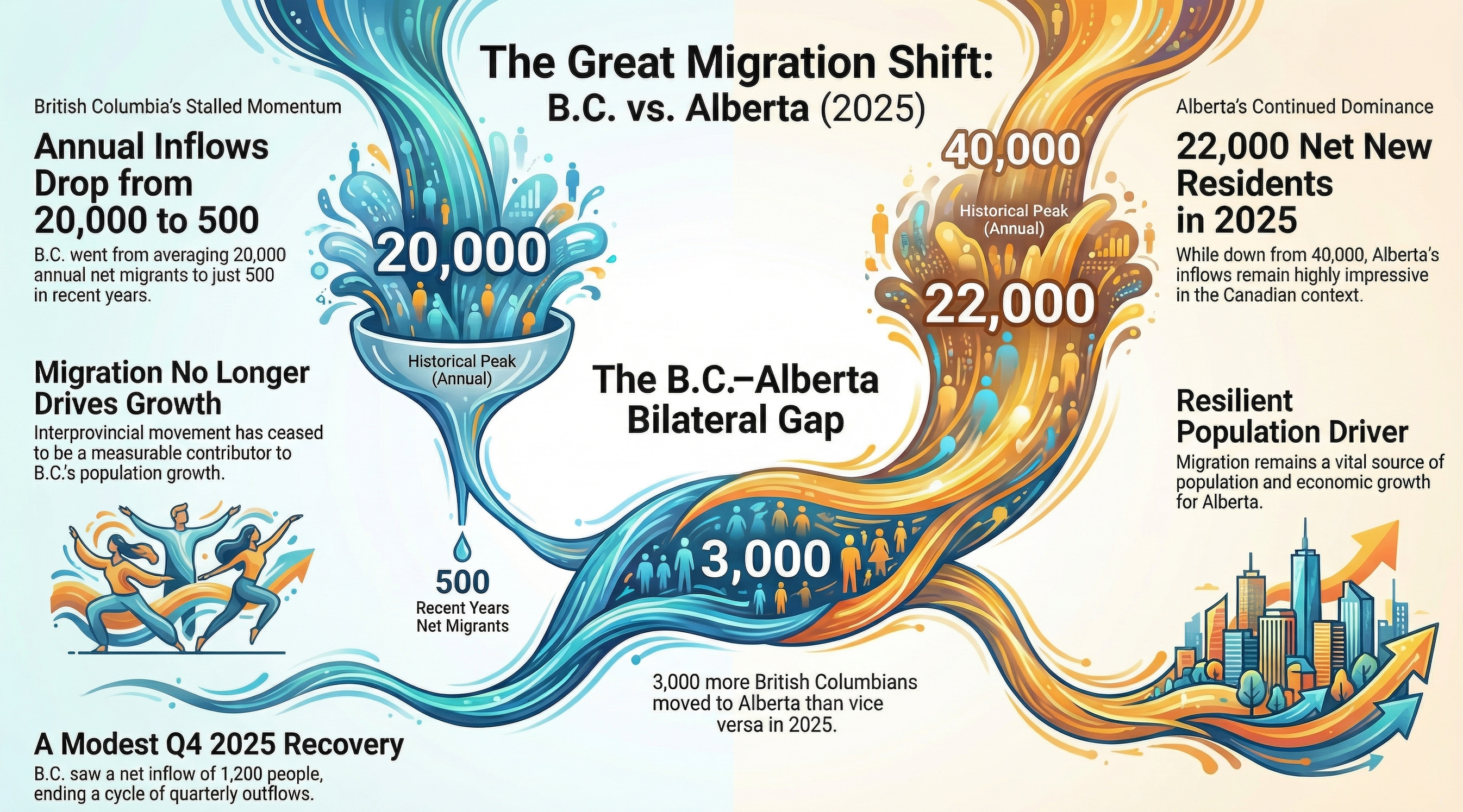
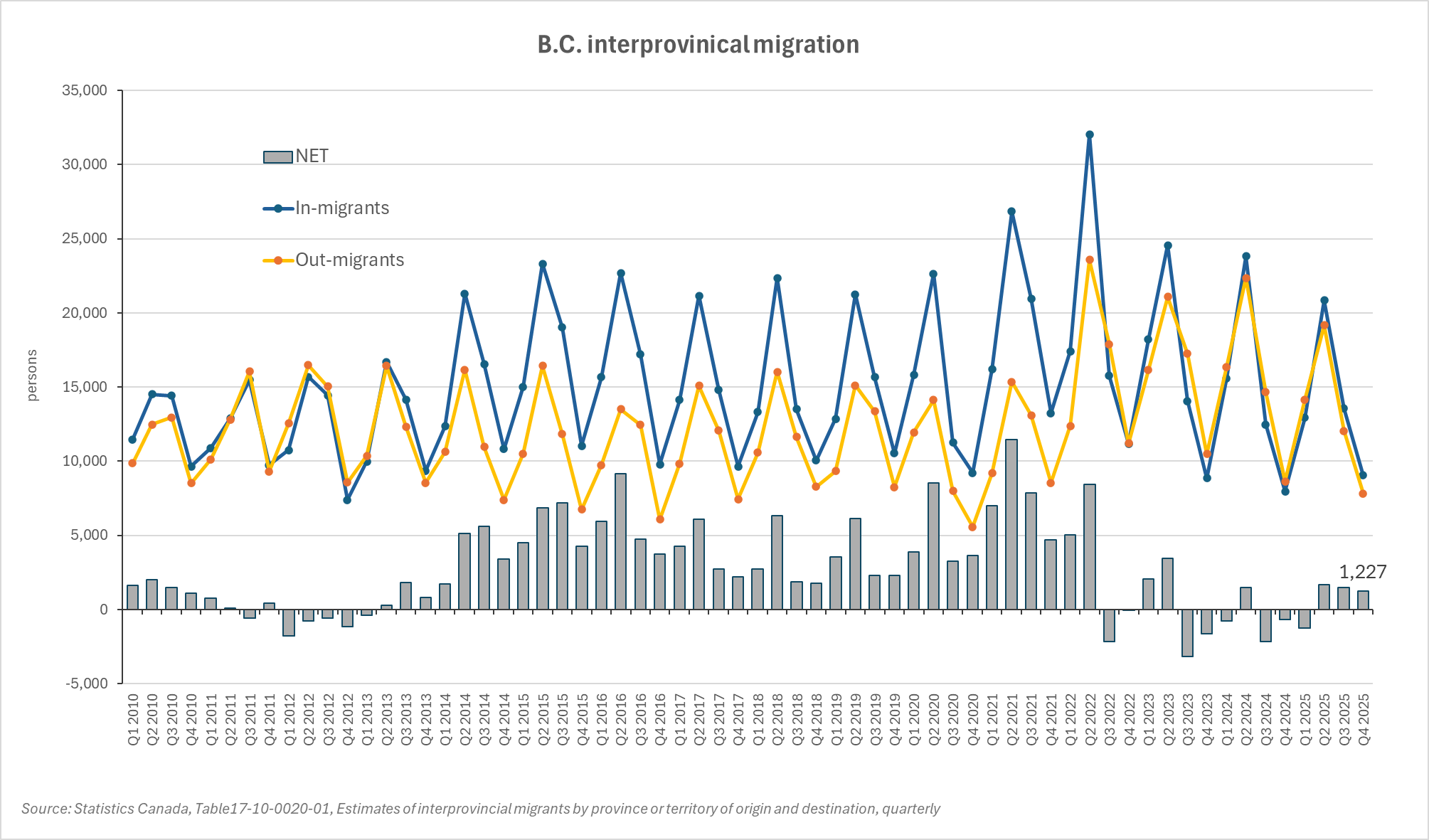
Recently released data from Statistics Canada show that in the final quarter of 2025, B.C. recorded a net inflow of about 1,200 interprovincial migrants. While modest, this marks a shift from the fourth quarters of 2023 and 2024, when B.C. experienced net outflows of 1,600 and 660 people, respectively.
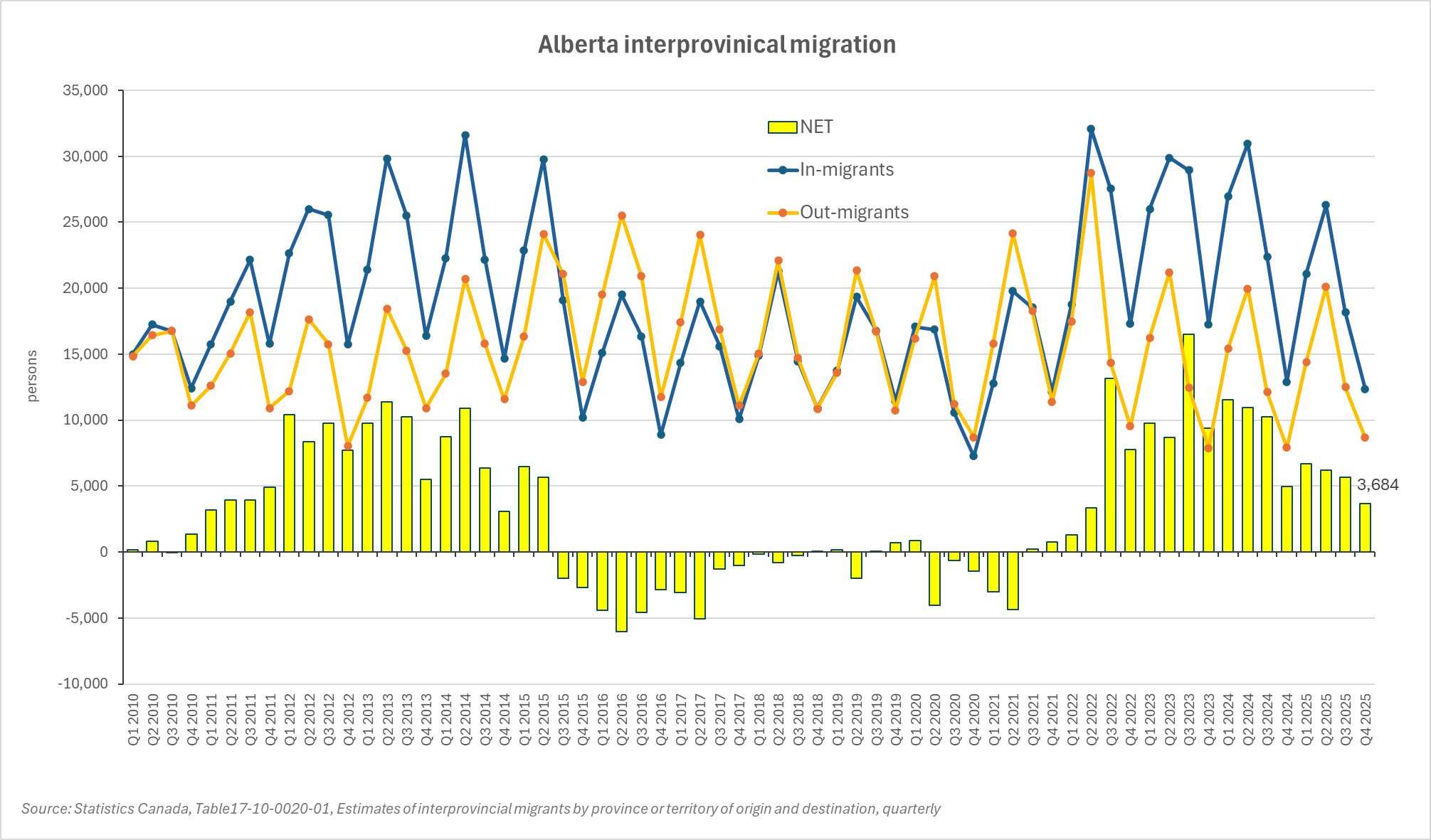
In the same quarter, Alberta recorded a net interprovincial inflow of nearly 3,700. This represents a slowing from the final quarters of 2023 – which saw a net inflow of more than 9,000 persons – and 2024, when Alberta gained almost 5,000 net new residents from other provinces.
This shift is mildly encouraging for B.C., in that more people are once again moving to the province from the rest of Canada versus the number leaving. Last year there was much-discussion about “record outflows” to other provinces. This narrative will need to pause while we await fresh migration data for the coming quarters.
At the same time, the broader shift in B.C.’s migration patterns is unmistakable.
Since mid-2023, interprovincial migration to B.C. has weakened significantly. After years of consistently strong inflows, net migration turned negative in the third quarter of 2023 and has since fluctuated around zero – alternating between small-scale inflows and outflows.
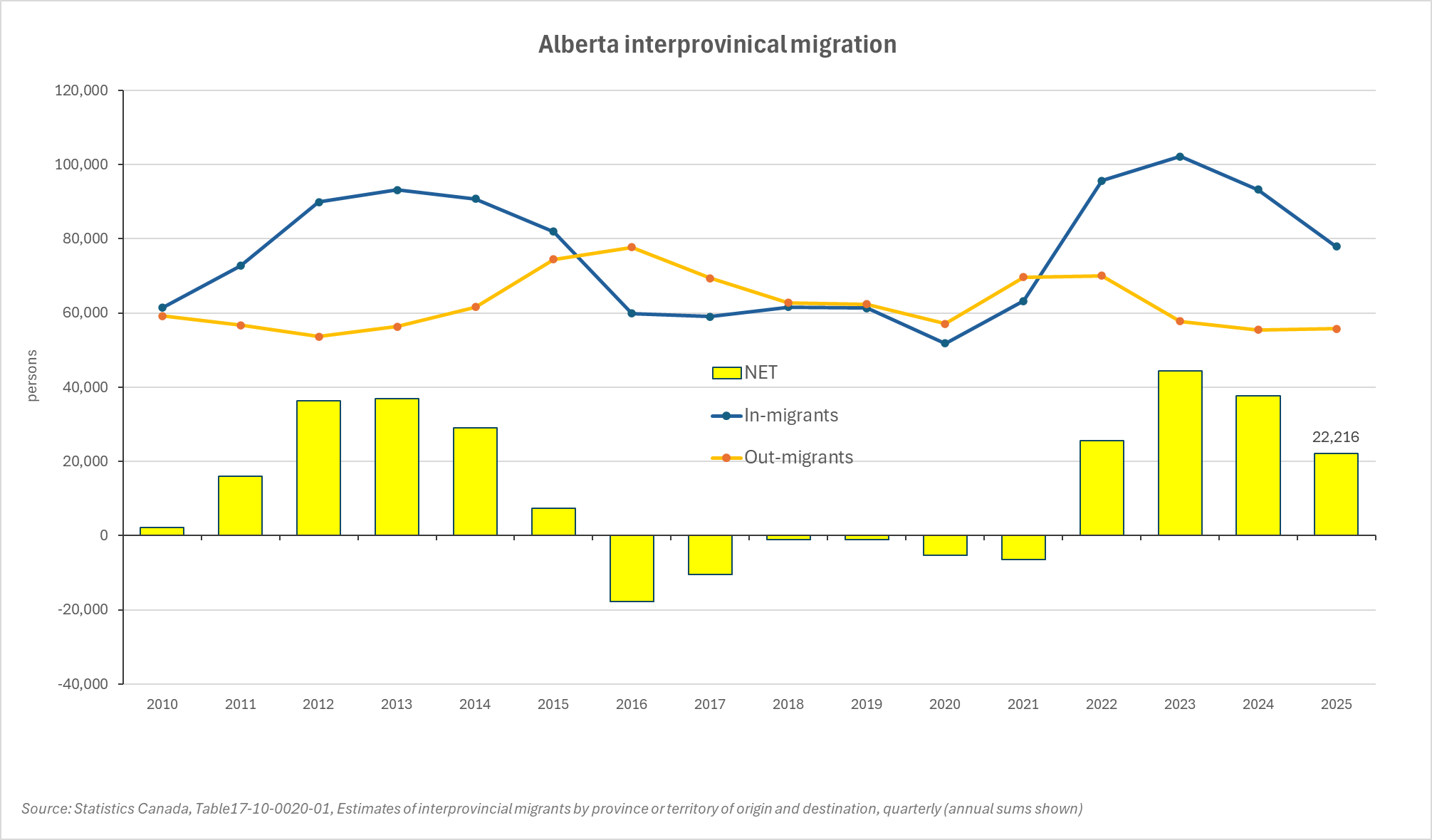
Alberta’s net inflows from the rest of Canada remain substantially larger than B.C.’s, but these have also recently slowed. Importantly, Alberta continues to attract far more interprovincial migrants than it did prior to the pandemic, whereas in B.C.’s case inflows from other provinces have returned to much weaker pre-2014 levels.
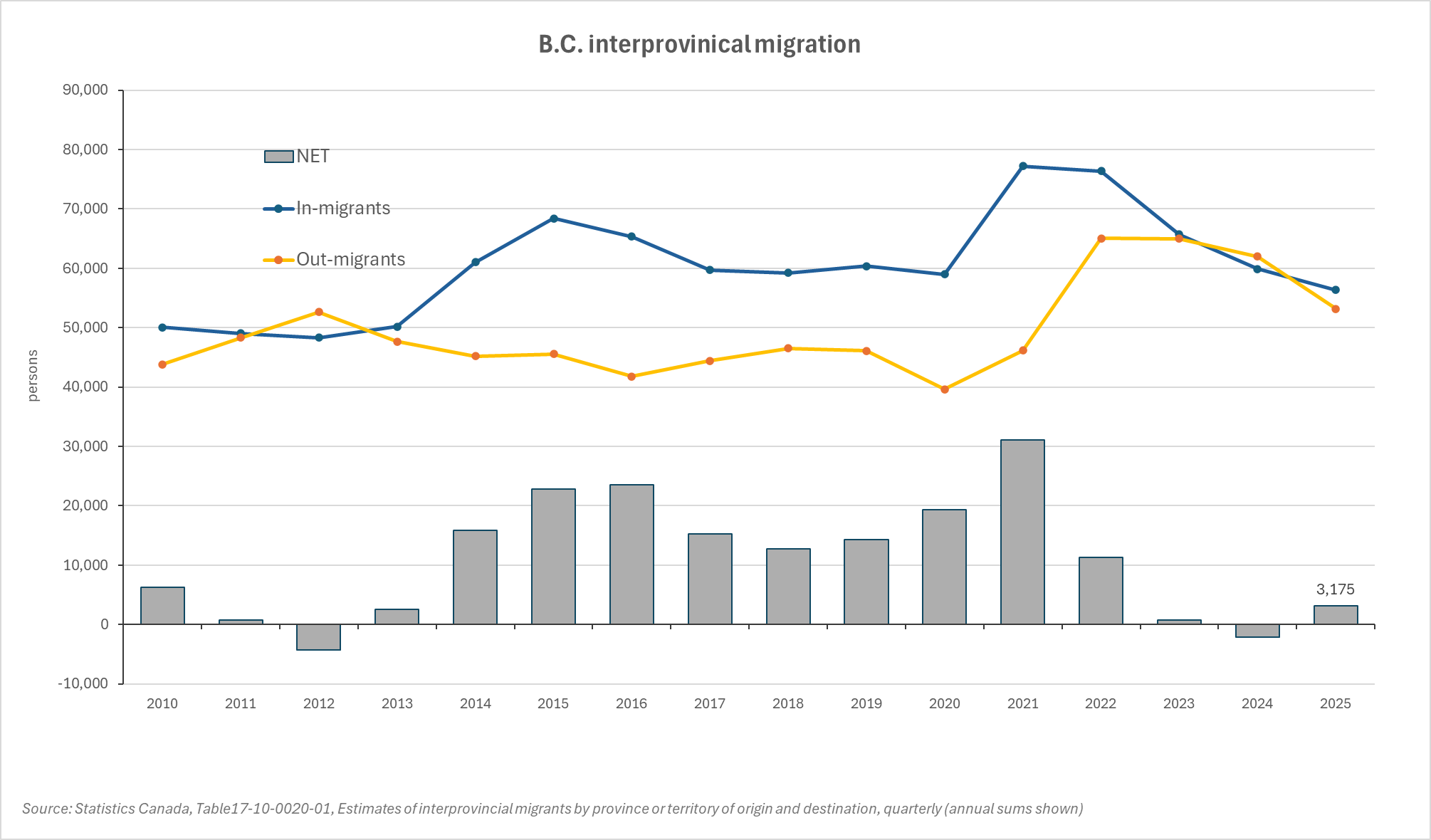
On an annual basis, the change in B.C.’s situation is even more pronounced.
British Columbia has gone from attracting nearly 20,000 net interprovincial migrants per year between 2014 and 2022 to an average of barely 500 per year for the past three years. Interprovincial migration is no longer making a measurable contribution to population growth in this province.
Alberta has also seen a decline in interprovincial migration, but from a much higher base. Net inflows have fallen from more than 40,000 per year to roughly 22,000 in 2025. The latter is still an impressive showing in the wider Canadian context.
Both provinces have experienced a drop of roughly 20,000 net migrants in recent years. The difference is that interprovincial migration continues to be an important source of overall population growth in Alberta, while in B.C. it has effectively stalled.
B.C.’s loss of momentum comes at a time when other sources of population growth are also slowing. Federal policy changes have reduced immigration targets, and the number of non-permanent residents has been sharply curtailed. As a result, weaker interprovincial migration now has a bigger impact on aggregate demographic population growth.
Relative economic conditions continue to drive swings in migration flows between B.C. and Alberta.
B.C. experienced similarly weak interprovincial migration between 2010 and 2013, when stronger economic conditions in Alberta drew workers eastward. At that time, Alberta’s private-sector job growth exceeded 5% year-over-year, while job creation in B.C. was comparatively modest.
The situation reversed after 2014. The collapse in oil prices triggered a downturn in Alberta’s economy in 2015–2016. As job losses mounted in Alberta, employment growth in B.C. strengthened and surpassed its neighbour. Migration responded accordingly, with stronger inflows to B.C.
More recently, labour market conditions have become more balanced. Private-sector job growth has slowed in Alberta and improved marginally in B.C., narrowing the previous gap between the two provinces. ICBA Economics is skeptical that this pattern will persist into 2026.
Housing dynamics have also changed. While still elevated, housing costs in B.C. have eased somewhat amid a protracted market slump, reducing the incentive for some B.C. residents to relocate. Urban housing prices have crept higher in Alberta during a period of rapid population growth in the province.
In practice, much of the variation in B.C.’s and Alberta’s interprovincial migration reflects shifts in bilateral flows between the two provinces. In 2025, ~3,000 more British Columbians moved to Alberta than the other way. This is down from ~9,000 net to Alberta in the prior two years. It’s conceivable that many B.C. residents open to the option of moving to Alberta have already done so.
B.C.’s interprovincial migration advantage has clearly eroded. Net inflows have fallen sharply from the levels seen over most of the past decade and now hover around zero.
For a province that has long relied on in-migration to support population as well as economic growth, this marks a meaningful shift – one that may persist if relative economic and labour market conditions do not improve.
Alberta, by contrast, continues to attract large numbers of interprovincial migrants, along with a growing share of the somewhat diminished total inflow of international immigrants arriving in Canada. Even after recent declines, Alberta’s net population inflows remain well above pre-pandemic norms and continue to make a significant contribution to population growth.

Statistics Canada’s latest survey of corporate headquarters provides updated counts of head offices and direct head office jobs for each province as...

The Independent Contractors and Businesses Association (ICBA) is welcoming the new Ottawa–Alberta Memorandum of Understanding on energy,...
%20(3).png)
What can we say about the economic well-being of families and workers in Canada’s two westernmost provinces – British Columbia and Alberta? The...