ICBA ECONOMICS: Checking Up on Small Business in Alberta
Key Takeaways for Alberta Construction Businesses:
4 min read
%20(3).png)
What can we say about the economic well-being of families and workers in Canada’s two westernmost provinces – British Columbia and Alberta? The question takes on special importance at a time of widespread concern over “affordability” and a high degree of uncertainty about Canada’s economic outlook amid U.S. President Trump’s tariff barrage and the unfolding war in the Middle East.
This ICBA Economics post provides a quick scan of several Statistics Canada data sources to shed some light on the topic.
We start with three relevant measures of economic well-being captured in Figure 1: real economic output (or gross domestic product -- GDP) per person; average weekly earnings for individuals engaged in formal employment; and, personal disposable income per person. As it happens, Alberta leads the country on all three indicators.
Figure 1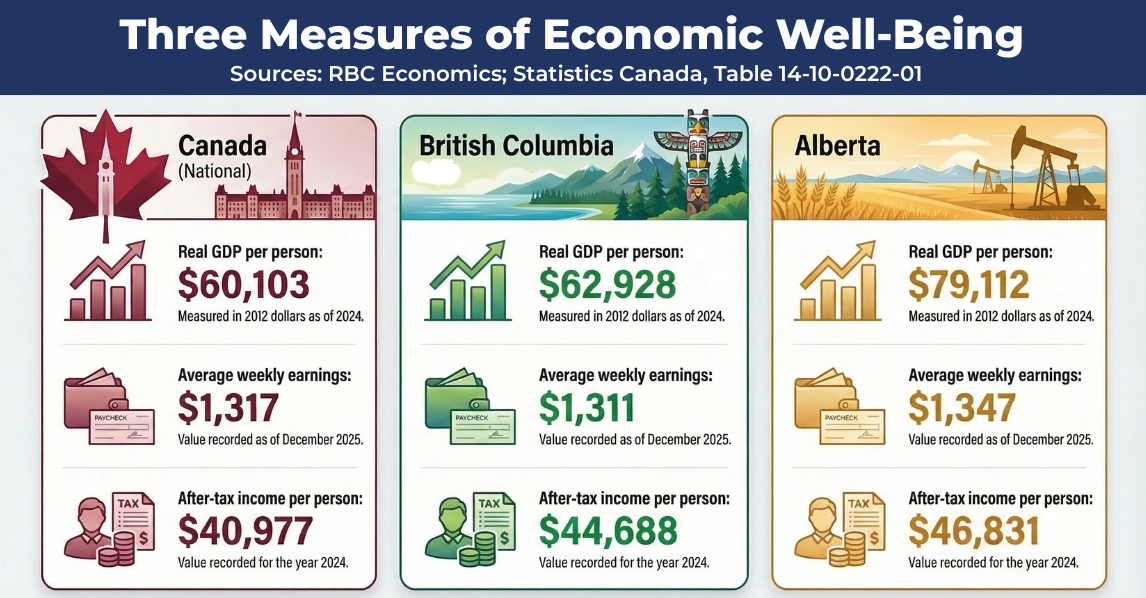
To begin with, Alberta comfortably tops the Canadian leaderboard in per person GDP – and by a wide margin. In part, this reflects the heavy concentration of one of Canada’s most productive industrial sectors – energy – in Alberta. High productivity industries, on average, pay their employees more and create more “value-added” per unit of labour and capital deployed in their operations; they also tend to generate significant positive spillovers across the rest of the economy – especially if, like oil and gas in Canada, they are strongly export-oriented. Coupled with the sheer size of Alberta’s combined oil and gas, petrochemicals, and pipeline industrial complex, this helps to boost the value of overall economic output (real GDP) per provincial resident.
A second factor that raises per person economic output is Alberta’s relatively high employment rate – defined as the share of the total population that holds a job. Here, too, Alberta ranks first in the country. Its high employment rate, in turn, is related to the fact that Alberta has the youngest population among the ten provinces.
British Columbia scores a little better than the Canadian average on per person GDP, a finding that aligns well with the fact that economy-wide productivity in B.C. also roughly matches the national average.
A similar pattern emerges when we look at employee earnings. Alberta boasts the highest average weekly earnings in the country – although on this measure, the gaps with Canada and B.C. are much smaller than with real GDP per person. B.C. slightly trails Alberta as well as Canada in average weekly earnings at $1,311-- vs $1,347 in Alberta and $1,317 for Canada (all of these data are for December 2025).
Finally, we consider disposable (or after-tax) income per person. This is perhaps the most common-sense gauge of individual prosperity. Again, Alberta comes out on top, sitting approximately $5,900 above the Canadian average and almost $2,200 higher than in B.C.
We now shift from earnings and incomes to examining the accumulated wealth or “net worth” of households. Net worth is defined as total household assets minus total liabilities (debts). Assets include the accrued value of pensions (excluding the Canada Pension Plan), other financial holdings (e.g., investment and savings accounts), real estate assets, and equity ownership in private businesses. Liabilities encompass mortgages and other real estate debt, credit card balances, automobile and student loans, and various other types of debt.
Figure 2 reports the “median” net worth of households in Canada, B.C., and Alberta. We use the “median” rather than the “average” because we are interested in the net wealth accumulated by the “typical” household. Average wealth measures are distorted by the outsized impact of small numbers of very wealthy households; using the median gets around that problem.
Figure 2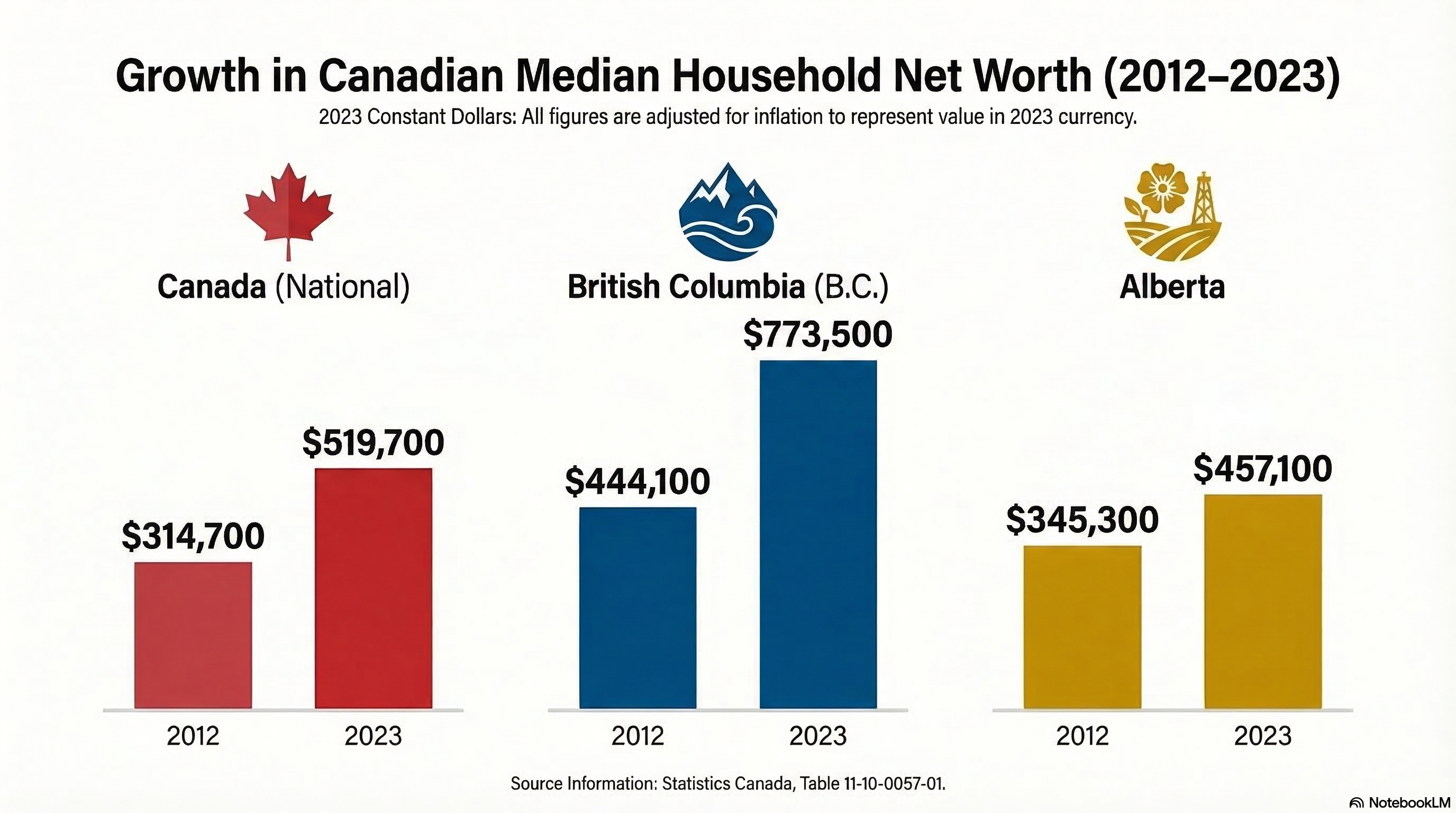
The data in Figure 2 are for 2023, the latest year available, and come from Statistics Canada’s Survey of Financial Security. Nationally, median household net worth stood at $519,700 in 2023. In B.C., the comparable figure was substantially higher -- $773,500. In fact, B.C. ranks first in Canada in median household wealth, despite also having high household debt levels. The reason is that the median B.C. household holds more assets than its counterparts elsewhere in the country. Alberta’s median household net worth was below the national average in 2023, at $457,100. So, while Alberta leads Canada on real GDP per person, disposable income per person, and average weekly earnings, it performs less well when attention turns to household wealth.
How to reconcile the contrasting pictures on economic output, disposable incomes and earnings for the typical household or worker in B.C. and Alberta, on the one hand, and the accumulated wealth of the median household in these two provinces, on the other? A couple of factors stand out as partial explanations for the pattern.
First, recall that Alberta has the youngest population in the country, while in B.C. the population is a bit older, on average, than the national benchmark. There is a very close statistical relationship between 1) age and 2) the value of both household assets and net worth. Put simply, older households (aged 55 and over) account for a majority of household assets and net worth in Canada. This makes intuitive sense: as people age, they have more time to acquire assets and to pay down debt. They also benefit from the rise in asset values – such as real estate and stocks -- over time.
A second important factor that helps to explain the high level of household net worth in B.C. is the outsized role that real estate has long played in the province’s economy.
In British Columbia – which has among the most expensive housing markets in North America – equity in principal residences looms large in the composition of household wealth. While there is much concern about housing affordability, it’s also true that more than two-thirds of B.C. households are homeowners, and of these some two-fifths are mortgage-free while many others have paid down a significant fraction of their mortgage debt. In addition, home values across much of B.C. have risen dramatically since the early 2010s, boosting the value of this asset category for many households in the province.
For the typical B.C. home-owner, the value of real estate assets on that same household’s balance sheet stood at $850,000 as of 2023, with the bulk of this concentrated in principal residences. At the same time, median mortgage debt was just $273,000 – mainly on principal residences – equal to less than one-third of the value of the median household’s real estate assets.
In Alberta, the median household reported real estate assets of $425,000 – exactly half of the amount in B.C. – and mortgage debt of $220,000. The latter figure represents 52% of the value of household real estate assets, considerably higher than the comparable share in B.C. In other words, compared to its counterpart in Alberta, the typical B.C. household holds far more real estate wealth in both aggregate and “net” terms, with the latter adjusted to account for the amount of outstanding real estate debt on the household’s balance sheet.
The above analysis underscores two points: the comparatively high level of wealth among B.C. households collectively, and the fact that this wealth is disproportionately concentrated in a single asset class: principal residences. Should the residential real estate slump that began in British Columbia 12-18 months ago persist for another few years, further dragging down property values (which are already falling), the effect on household balance sheets would be pronounced. Alberta and other provinces where the composition of household assets is less tilted to residential real estate are not as exposed to the risks posed by a protracted housing downturn.
%20(1).png)
Key Takeaways for Alberta Construction Businesses:
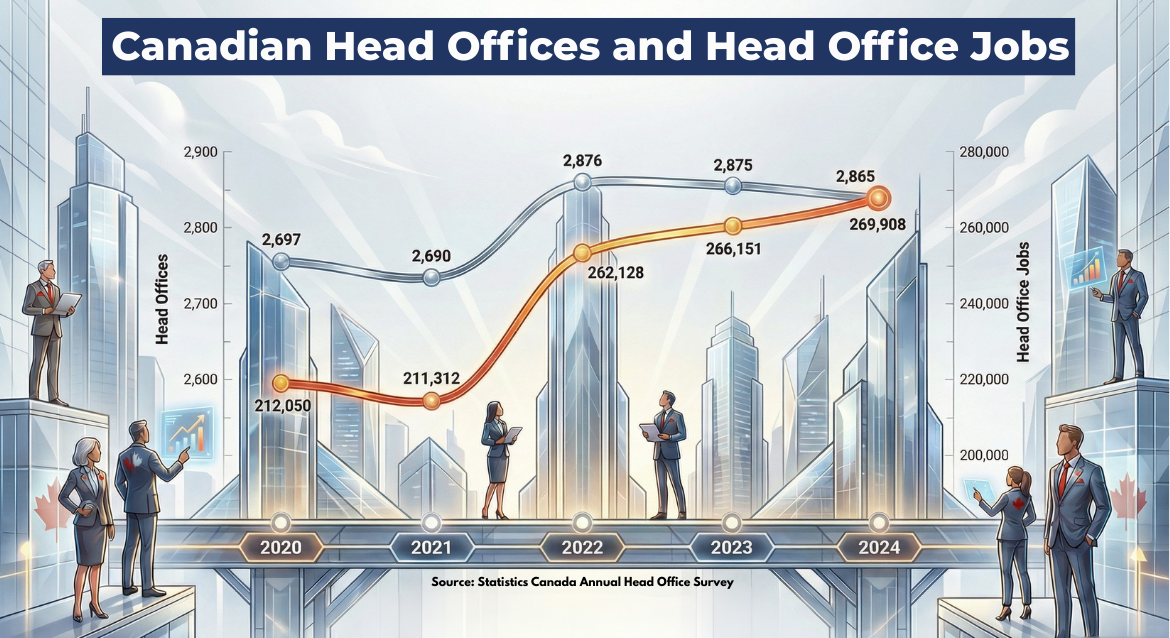
Statistics Canada’s latest survey of corporate headquarters provides updated counts of head offices and direct head office jobs for each province as...

The Independent Contractors and Businesses Association (ICBA), the country’s largest construction association, announced today the appointment of...