3 min read

The AI Revolution and the Demand for Labour in the Construction Industry

The AI Revolution and the Demand for Labour in the Construction Industry
5:00
By Jock Finlayson, ICBA Chief Economist

The onward march of artificial intelligence (AI) is drawing intense interest from investors, business leaders, technology analysts, and even economic soothsayers. All parts of the economy stand to be influenced by the ongoing improvement and deployment of AI tools and platforms and companion advances in automation. But not all industries or occupations will be equally affected. The International Monetary Fund (IMF) recently predicted that up to 40% of all jobs worldwide will be directly impacted by AI in the coming years.

In this post, we take a brief look at how the AI revolution is likely to shape the future demand for labour in the construction sector.

Construction occupations amid the AI surge

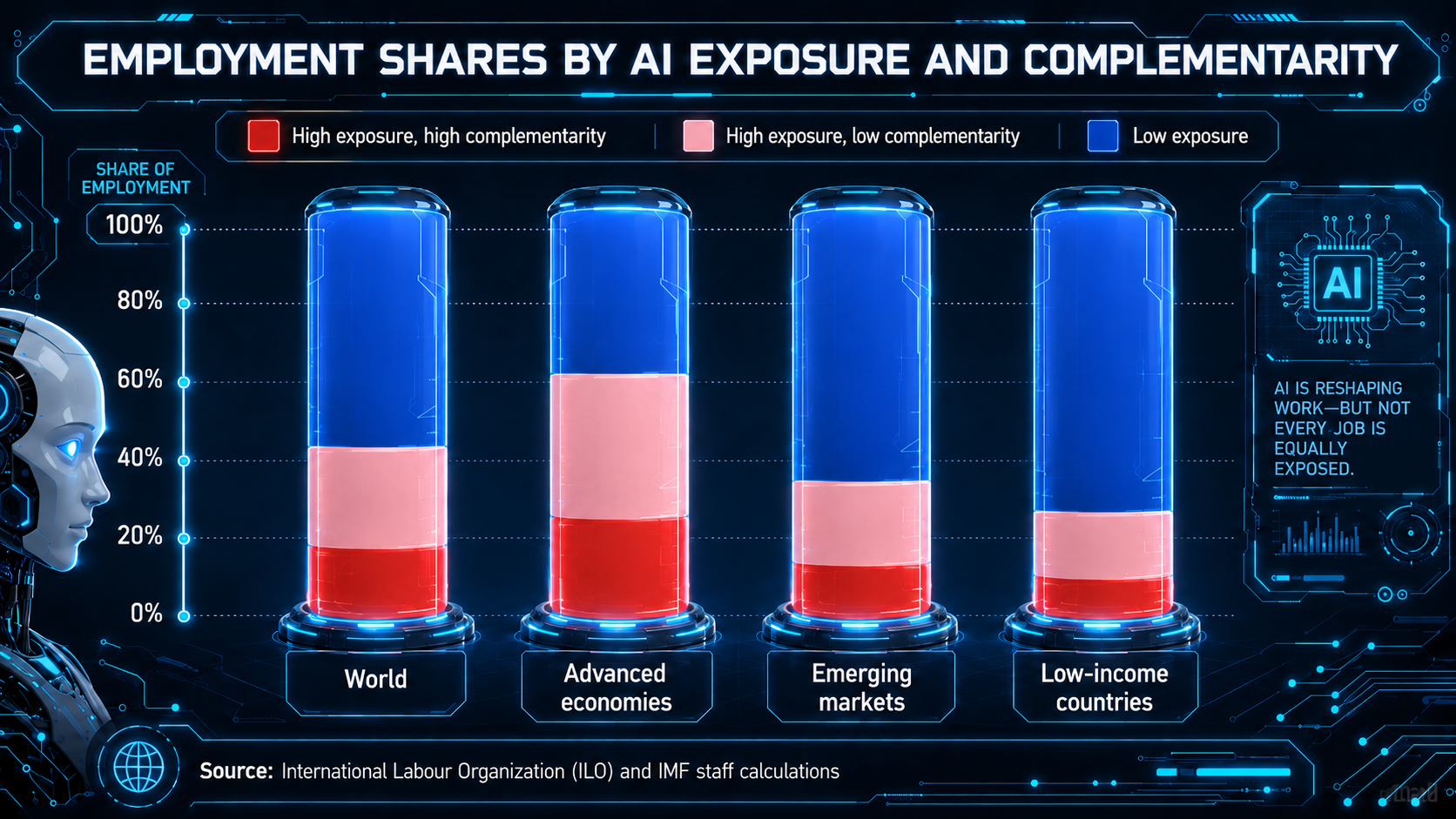
The same IMF study reported that jobs in construction tend to be less exposed to the risk of AI-driven disruption and disappearance than jobs in many other industries. In the advanced economies as a group, the IMF estimates that three-fifths of current jobs will feel the effects of AI (see Figure 1). Of these, in roughly half of AI-affected jobs the deployment of AI is expected to deliver “complementary” benefits, making workers and managers more productive and efficient in their jobs. In the other half of AI-affected jobs greater use of AI is more likely to have negative impacts on labour demand, replacing workers in some jobs and taking over previously human-performed tasks – thus reducing the need for labour in certain occupational categories.

Figure 1
figure1

How will all of this play out in the context of construction? One way to approach this question is to divide the large and notably diverse construction workforce into two broad categories:

  • “white collar” positions – e.g., professionals, managers, technicians, business and financial analysts, back office administrative staff, etc.; and,
  • “front line” construction workers – e.g., skilled trades, construction labourers, vehicle and equipment operators, and other employees whose tasks often involve the performance of hand’s-on tasks at worksites removed from the company “office”.

Employees in the first category of occupations are exposed to AI, but for the most part the increased application and use of AI is expected to make many of them more productive on the job. In other words, for many employees in this category, AI will be “complementary” to their work.

Employees in the second category – which represents a majority of the overall construction workforce – are generally viewed as less likely to be directly impacted by AI.

This is a very high-level assessment, and the details of how AI impinges on construction labour demand and human-performed work tasks will differ significantly from occupation to occupation – and even from company to company.

For example, some front-line construction jobs will disappear, as robot-related technologies continue to improve. According to the popular web site “WillRobotsTakeMyJob,” welders, insulation workers, electrician’s helpers, and crane operators are among the construction occupations where robots may replace people. Moreover, it’s already clear that some “white collar” office support roles in construction companies are set to experience a decline in labour demand as AI becomes more widely deployed across the industry.

A Canadian study

A recent Statistics Canada study sheds further light on the topic of AI, automation and the future of the construction workforce. The study focused on individuals who have completed an apprenticeship program and/or obtained a formal certificate of qualification in a designated trade. Importantly, the authors distinguish AI from automation. The former encompasses technologies that are capable of completing complex, non-routine tasks; in contrast, automation refers to the use of machines and equipment to perform simple, more routine tasks.

The Statistics Canada analysis concludes that journeyperson occupations “face relatively lower exposure to artificial intelligence-related job transformation compared to other occupations” in Canada. However, about one-fifth of construction workers in journeyperson occupations were deemed to be “at high risk of automation-related job transformation,” due to advances in robotics and greater use of machines on construction worksites.

Despite the uncertainties stemming from the rapid development and adoption of AI tools as well as continued advances in automation technologies, published projections forecast a robust need for workers in many construction-related occupations. A McKinsey study from two years ago predicted a 12% increase in the demand for construction workers in the U.S. to 2030. Closer to home, the latest demand side forecasts from the federal government’s Canadian Occupational Projection System point to skill and labour shortages in various segments of the construction sector into the early 2030s, driven in large part by an accelerating wave of retirements.

Construction and the Economy in 2025: A Preliminary View

1 min read

Construction and the Economy in 2025: A Preliminary View

By Jock Finlayson, ICBA Chief Economist In early May, Statistics Canada published preliminary data on GDP by industry for the ten provinces and three...

Read More
ICBA ECONOBOT: Oil Tumbles on Iran Deal Hopes — Easing the BoC’s Stagflation Headache

1 min read

ICBA ECONOBOT: Oil Tumbles on Iran Deal Hopes — Easing the BoC’s Stagflation Headache

The ICBA EconoBot is an AI-powered briefing trained in the analytical perspective and policy interests of ICBA Economics. Prepared with data from...

Read More
Earnings, Income and Wealth in B.C. and Alberta

1 min read

Earnings, Income and Wealth in B.C. and Alberta

What can we say about the economic well-being of families and workers in Canada’s two westernmost provinces – British Columbia and Alberta? The...

Read More