1 min read
U.S. Tariffs Aren’t B.C. Forestry’s Biggest Problem
The following piece was co-authored by ICBA Chief Economist Jock Finlayson and consulting economist Ken Peacock. Subscribe to Ken's Substack HERE.
2 min read
%20(2).png)
By Jock Finlayson, ICBA Chief Economist, and Ken Peacock (https://kenpeacock.substack.com/), consulting economist
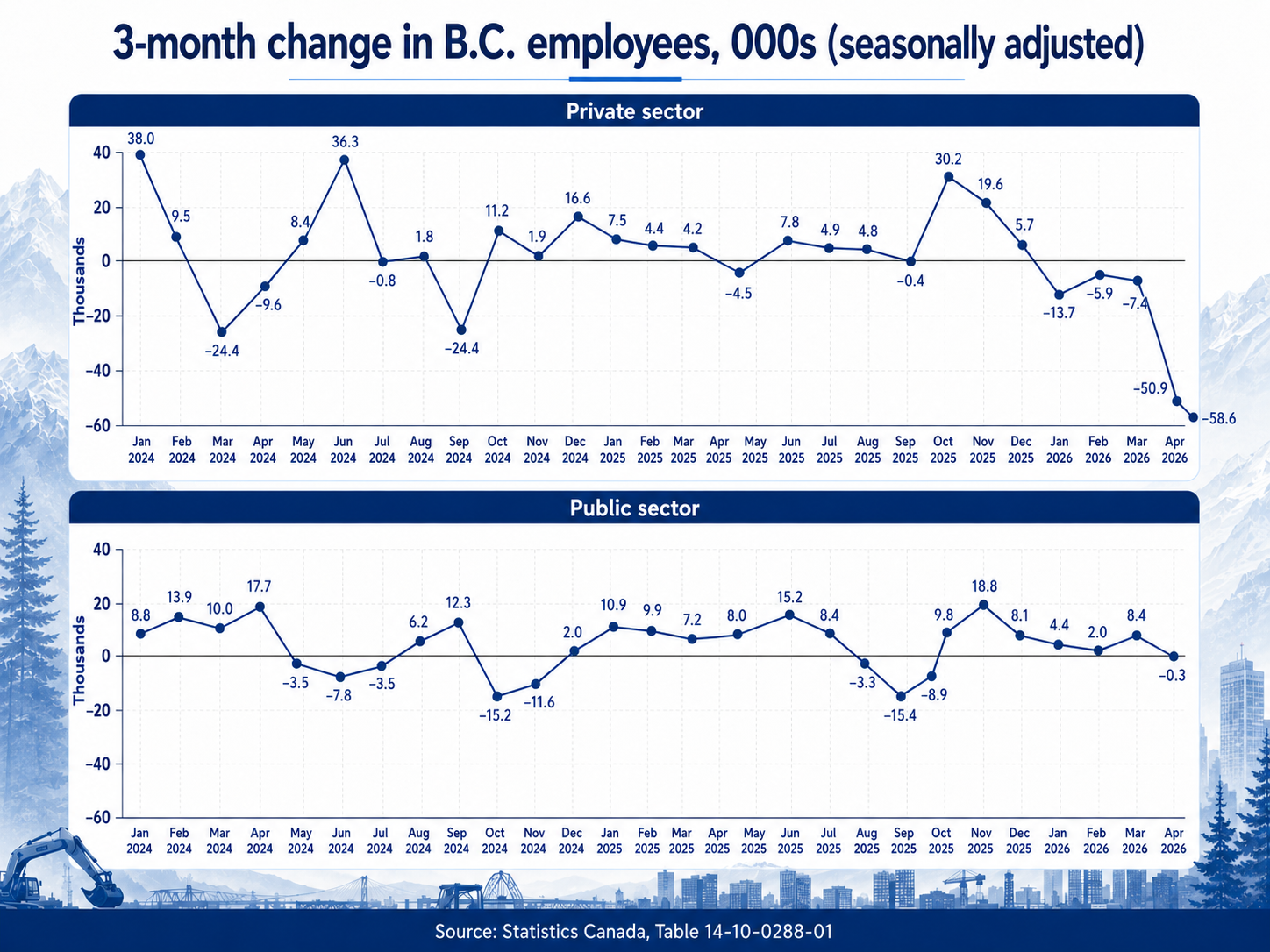
Statistics Canada’s latest Labour Force Survey confirms that B.C.’s labour market is weakening quickly. Following record monthly job losses in February and March, the province shed another 4,300 jobs in April. Since the start of the year, total employment is down almost 44,000, the largest three-month decline in several decades (outside of the 2020 pandemic).
The losses are concentrated in the private sector. In April alone, private-sector employment fell by another 9,000 positions, adding to steep declines earlier in the year. Since January, the struggling B.C. private sector has shed an eye-popping 59,000 jobs, a 3.1 per cent drop. That is the largest three-month contraction on record going back to at least the late 1990s, again excluding the pandemic.
For context, the next largest decline in private-sector employees over a three-month period was 2.6 per cent during the 2008–09 global financial crisis.
Buoyant employment growth in the public-sector is no longer offsetting these losses. The number of public sector jobs fell by 5,600 in April, reversing a similar-sized gain the previous month. Since January, public-sector employment (inclusive of health care, education, and public administration) has been essentially flat, after years of solid growth.
The only area showing growth is self-employment. A 2.3 per cent increase in April leaves the number of self-employed workers up 3.5 per cent since January, offsetting some of the losses among paid employees. But this is a modest counterweight to much larger declines in payroll employment.
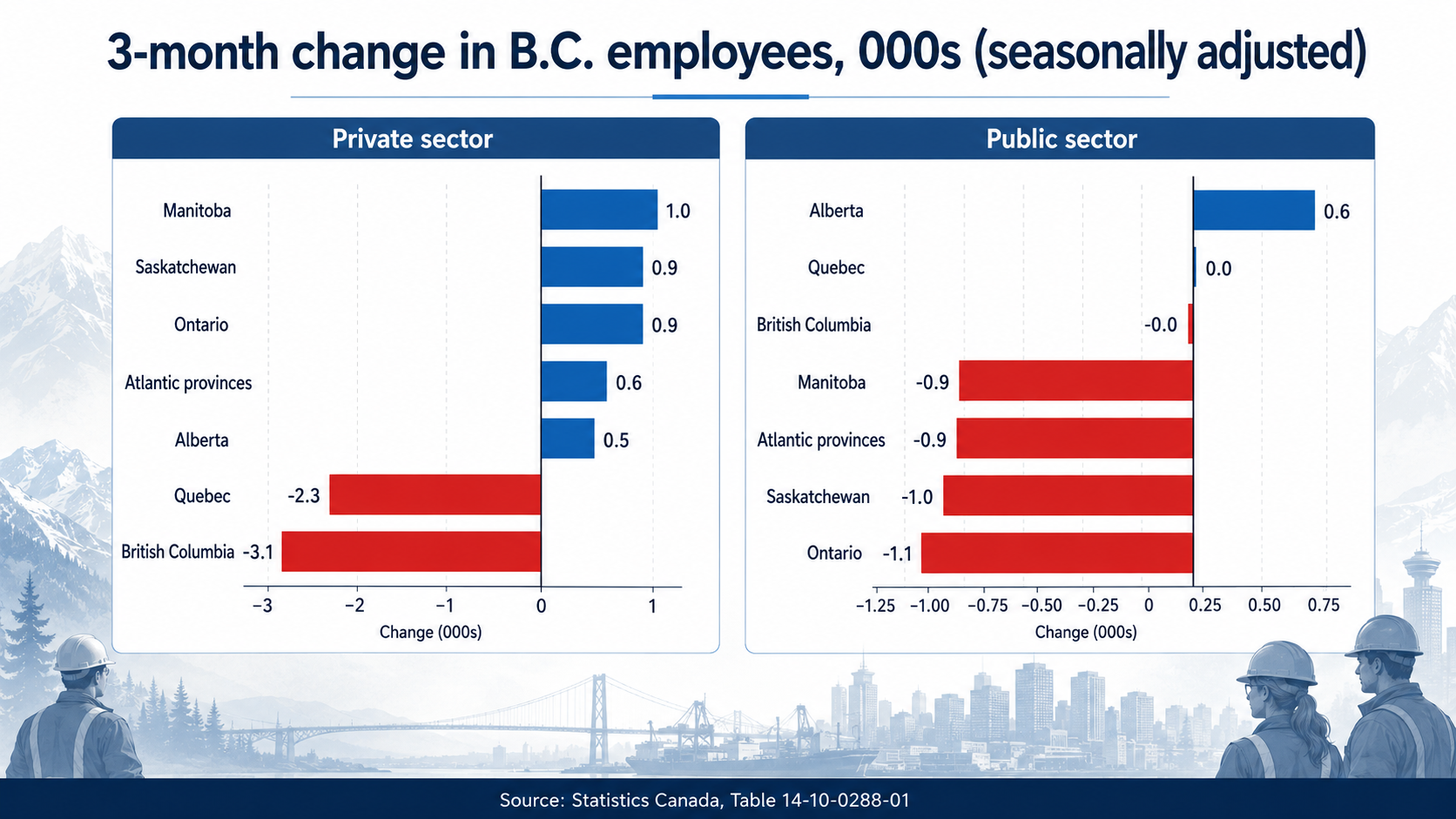
B.C.’s labour market continues to diverge from the rest of the country. Alongside Quebec, B.C. is the only other province/region to see private-sector employment fall since the beginning of the year—and B.C.’s losses are larger. Other provinces have continued to post at least some employment gains.
In most provinces, public-sector employment has declined following years of strong expansion. In B.C. and Quebec, it is essentially unchanged, while in Alberta it has increased.
Job losses are also widespread across B.C. industries. Only three sectors have seen employment levels rise since the start of the year, two of which are in the public sector. Two sectors have seen little change while the remaining eleven industries have posted employment declines.
Recent job gains in manufacturing are a positive development, but they appear to reflect some short-term volatility rather than a trend. Compared to year-ago, even with the recent gains, the number of people working in manufacturing in B.C. is still down 3.7% compared to year-ago levels. This isn’t surprising given the impact of U.S. tariffs and an uncompetitive domestic business environment on the B.C. lumber industry.
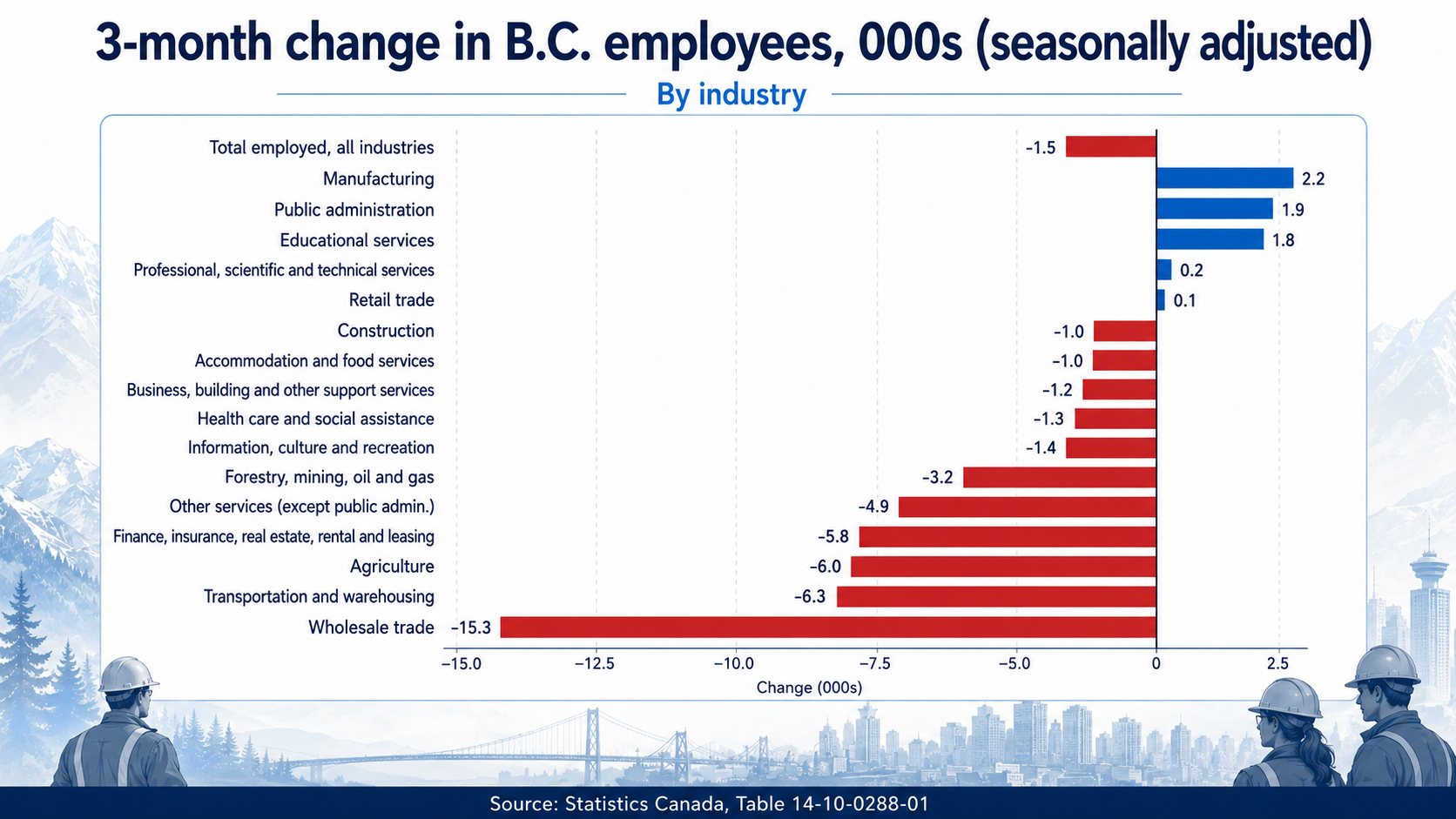
Construction employment in the province has dipped by 1 per cent since January, although this follows a multi-year period of fairly steady growth in the sector.
There is little in the latest data to suggest a near-term turnaround. The decline in B.C.’s private-sector employment now exceeds what occurred during the worst months of the global financial crisis in 2008-09. The number of people on private sector payrolls has fallen to its lowest level since late 2023.
Some rebound in the months ahead would not be surprising, as losses of this magnitude are unlikely to continue. It is also worth noting that the Labour Force Survey is a sample-based estimate of employment and can overstate short-term swings. Even allowing for this volatility, however, the direction is clear: B.C.’s private-sector job market has been weakening – and doing so at an unusually rapid pace. This is consistent with our view that the overall economy is essentially stagnant.
.png)
1 min read
The following piece was co-authored by ICBA Chief Economist Jock Finlayson and consulting economist Ken Peacock. Subscribe to Ken's Substack HERE.
1 min read
Recent economic developments and data releases raise the possibility that British Columbia may have stumbled into an official “recession” – defined...
%20(1)-1.png)
1 min read
The following op-ed, written by ICBA Chief Economist Jock Finlayson and consulting economist Ken Peacock, first ran in Business in Vancouver on April...