1 min read
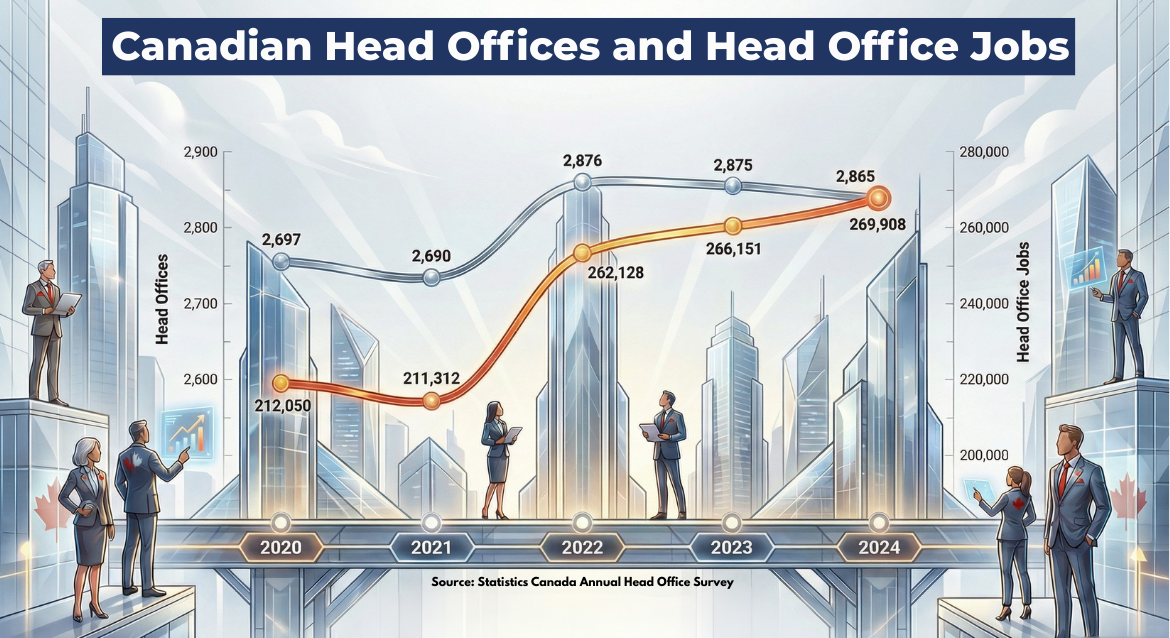
ICBA ECONOMICS: Where B.C. and Alberta Stand on Corporate Head Offices
Statistics Canada’s latest survey of corporate headquarters provides updated counts of head offices and direct head office jobs for each province as...
2 min read
Jordan Bateman : May 14, 2026
TOP STORY
Finlayson: Alberta’s Construction Engine Pulls Ahead as B.C. Sputters
In a new analysis of Statistics Canada’s preliminary 2025 GDP-by-industry data, ICBA Chief Economist Jock Finlayson lays bare a widening west-coast gap: Alberta’s economy grew 2.7% last year — best in the country outside PEI — while B.C. managed 2%, beating forecasts but still trailing its eastern neighbour. Construction tells the same story. Alberta construction GDP jumped 5% in 2025 vs 3% in B.C., and residential output surged 6.7% in Alberta on the back of a population boom while B.C. residential builders eked out just 0.7%. Zoom out to 2021–25 and the divergence is stark: Alberta residential construction GDP is up 18.9% — tops in Canada — while B.C. residential output has shrunk 13.4%. Jock’s bottom line for the next two years: “more optimistic about Alberta’s economic prospects than B.C.’s.” When population grows and hosting conditions for investment are favourable, construction thrives. When they don’t, it doesn’t.
THE NUMBERS — STATISTICS CANADA
Wholesale Trade, March 2026 — National wholesale sales rose 1.9% to $89.0 billion, led by machinery, equipment and supplies (+6.5% to $19.5B). Alberta posted the second-largest provincial gain, up 3.2% to $9.7 billion, with machinery and equipment surging 10.7%. Ontario led at +3.5%; Quebec fell 2.2%. Six of seven sub-sectors grew — a sign B-to-B activity is holding up despite tariff noise. Statistics Canada
New Motor Vehicle Sales, March 2026 — Canadians bought 176,500 new vehicles in March, down 6.6% from a year earlier. Truck sales fell 6.9% — a leading indicator worth watching for contractors and fleet operators digesting tariff pass-through. ZEVs hit 12.2% of new sales, up from 6.5% a year earlier. Statistics Canada
FROM THE ECONOMISTS
Bank of Canada — Summary of Governing Council Deliberations (April 29 hold) — Released yesterday. Governing Council says the outlook is “highly conditional” on U.S. tariffs holding steady and Middle East oil prices easing. New U.S. tariffs could prompt cuts; entrenched oil-driven inflation could force hikes. Translation: no clear path, and contractors should not plan on rate relief.
WORTH WATCHING
Carney-Smith Carbon & Pipeline Deal — Friday — Ottawa and Alberta are set to announce a deal Friday ramping the industrial carbon price to $130/tonne by 2040 — clearing a major hurdle to federal backing for a new oil pipeline to B.C.’s Pacific coast. The Business Council of Alberta says the framework could flip a projected $9-billion provincial deficit into a $6-billion surplus on stronger energy investment. For B.C. contractors, a new west-coast pipeline would mean years of engineering and heavy construction work. CBC News
Softwood Lumber Duties — August Final Results — U.S. duties on most Canadian softwood now sit at 45.16% (combined countervailing, anti-dumping, and Section 232). The Commerce Department’s preliminary April 9 review pointed higher; final results land in August at the earliest. B.C. mills remain in the firing line, and any further escalation will tighten domestic lumber supply. U.S. Dept. of Commerce
1 min read
Statistics Canada’s latest survey of corporate headquarters provides updated counts of head offices and direct head office jobs for each province as...
1 min read
The following piece, by ICBA Chief Economist Jock Finlayson for the Fraser Institute, first appeared in the Calgary Sun on April 2, 2025.
1 min read
By Jock Finlayson, ICBA Chief Economist Amid President Trump’s mad-cap trade war, Canada’s economy has lost a step in the first few months of 2025. ...