ICBA EconoBot | Rate Relief Is Dead, and the Next Move Might Be Up
The Bank of Canada is likely to hold rates steady, but forecasts suggest possible hikes. With inflation concerns and upcoming tariffs, economic...
3 min read
.png?width=1200&height=600&name=Jock%20pullquote%20NEW%20(3).png)
By Jock Finlayson, ICBA Chief Economist
Canadians are increasingly aware that the country’s long stretch of historically feeble productivity growth poses a risk to future living standards and points to the existence of broader competitiveness challenges. Labour productivity – defined as the amount of economic “output” (gross domestic product) generated per hour of work – has been on a declining growth trend for decades and was especially weak over the last decade. As of 2024, the gap between Canada and the U.S. in economy-wide labour productivity stood at a record level. Losing ground to the U.S. on this key measure has negative consequences for the growth of wages and real incomes in Canada as well as for the ability of governments to pay for services, programs and infrastructure services over the long-term.
The role of the construction industry in Canada’s productivity woes is garnering more attention among researchers and policymakers, in part owing to concerns over housing affordability and the high cost of delivering new housing units. The Carney government’s Spring 2026 Economic and Fiscal Update is the latest government document to reference this problem. Because construction is a big industry – accounting for 8-9% of Canadian GDP and employing more than 1.5 million people – its productivity performance has an outsized influence on broad measures of productivity growth in the overall business sector.
If there is any “good” news on this issue, it’s that Canada is far from alone in struggling to boost productivity in the construction sector. The U.S., Japan and many European countries face a similar predicament.
For any industry or firm, the higher the level of productivity, the more “output” can be produced using a given number of workers and a fixed capital stock (e.g., buildings, equipment, machinery, etc.). Because of higher skills, investment in new and better equipment and tools, advances in technology, and improvements in management practices, productivity tends to rise – slowly but steadily – over time. Unfortunately, that is not the prevailing pattern in most of the construction sector.
Why is construction a laggard when it comes to increasing productivity? This question is taken up in a new research study published by investment firm Goldman Sachs. The study looks at trends in construction productivity in the U.S. and several other advanced economy jurisdictions since the early 1970s.
In the U.S., aggregate labour productivity more than doubled from 1970 to 2024. However, labour productivity in the construction sector “declined by 30% over the same period.” Several other advanced economies examined in the study (Canada was not included, unfortunately) also saw construction productivity fall in the last two decades, but to a lesser extent than in the U.S. Figure 1 provides the details.
Figure 1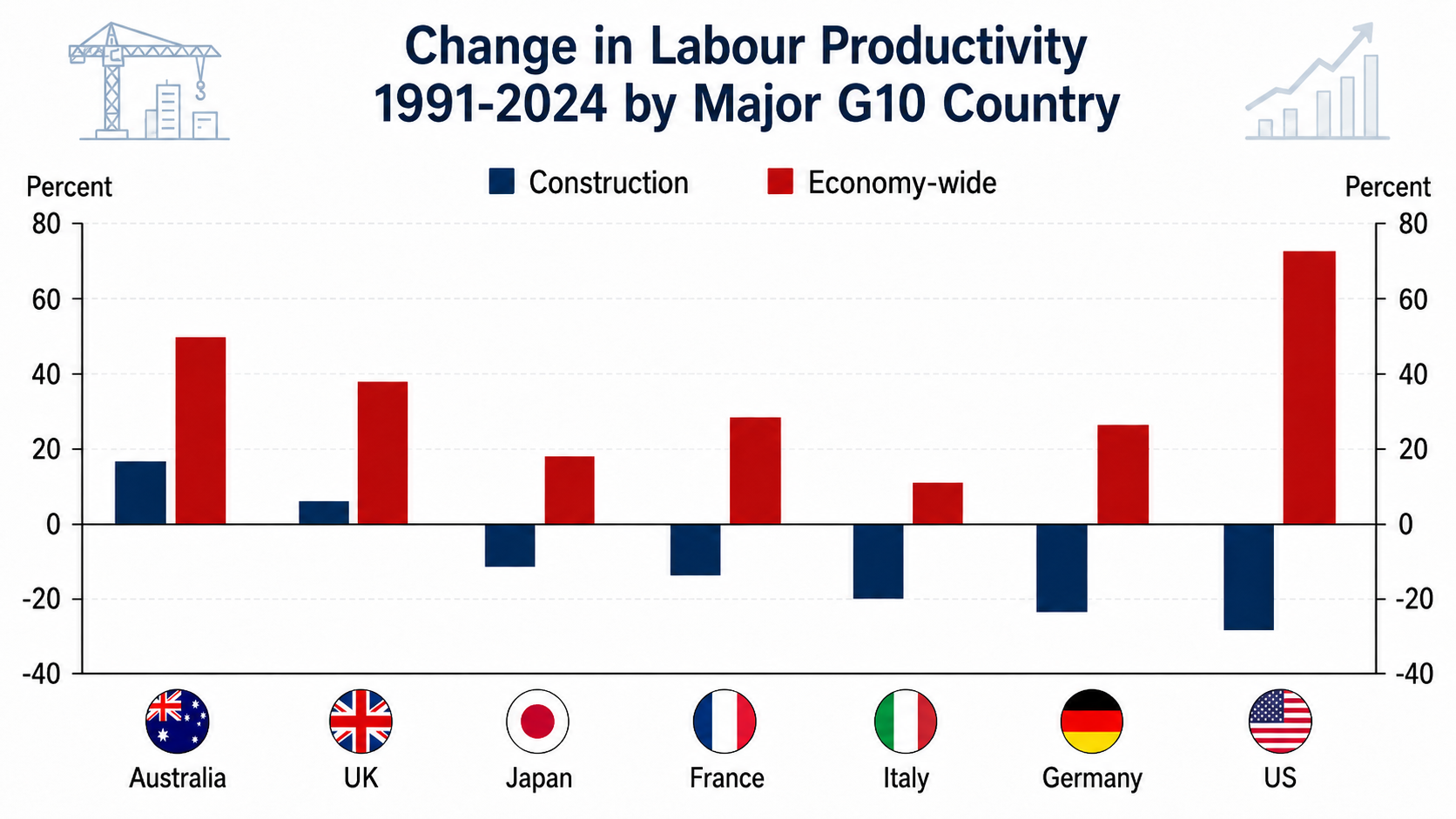
Explanations for construction’s unimpressive productivity track record are organized under three headings.
Limited innovation:
A relatively slow pace of “innovation” in construction, compared to manufacturing and some other industries, helps to explain the lack of productivity growth in the sector. The Goldman Sachs report notes that “most of the major machines used for construction today had already been invented in the 1950s [and 1960s]. Since then, technological changes within construction have been incremental.” Figure 2, reproduced from the Goldman Sachs report, identifies the lineage of the major machines, tools and technologies used in the construction business.
Figure 2
Within the wider economy, the most impactful technological advances have occurred in sectors like information and communications, chemical production, machinery and equipment manufacturing, and pharmaceutical manufacturing and bio-technology – industries “that are quite distant from the construction industry’s supply chain.” This means that “the economy-wide innovation spillover to…construction has remained very limited” compared to what’s happened in some other sectors of the economy.
Mounting regulatory burden:
Government policies, regulations and administrative processes have contributed to the construction industry’s productivity problem, especially in the residential segment. Goldman Sachs finds that the ever-greater regulatory burden imposed on residential development and homebuilding “has been a major drag on construction productivity growth.” This includes more restrictive land use regulations in the U.S. and other countries and longer approval times for new projects. The report estimates that “a 1% increase in country-level regulation intensity lowers annual construction productivity growth by 0.6 percentage points.”
Measurement issues:
In common with some other experts, Goldman Sachs believes that “mismeasurement of real construction output” has also played a role in the reported lack of productivity growth in the construction sector. Specifically, Goldman argues that the construction output price indexes used in the U.S. and some other countries “have failed to fully account for improvements in housing quality, resulting in a persistent downward bias to real construction output and productivity.” Similar mismeasurement concerns apply to some other parts of construction, notably the non-residential building segment.
As Canadian policymakers and business leaders continue to be seized with the challenge of improving productivity, the construction industry is likely to remain in the spotlight.

The Bank of Canada is likely to hold rates steady, but forecasts suggest possible hikes. With inflation concerns and upcoming tariffs, economic...

LNG Canada's $32 billion Phase 2 gets the green light. What it means for B.C. and Alberta construction, plus July GDP, ATB's Alberta outlook and the...
%20(2).png)
Canada's trade surplus hit $3.9 billion in June — but a weaker loonie and gold did the heavy lifting while energy exports fell 10%. The real signal...