ICBA OP/ED: B.C. unions lose ground in the workplace but gain leverage in government
Unions in B.C. face declining membership due to economic shifts but gain influence through government policy changes, raising challenges for business...
3 min read
The trade union movement in Canada, as in many other advanced economies, is in the throes of change. Rapid technological innovation along with shifts in business practices, the distribution of employment by occupation, and the demographic make-up of the working age population all pose challenges to the traditional strategies adopted by unions to grow and sustain their membership.
A glance at the evolution of “union density” (or “union coverage”) is revealing. Union density measures the share of all paid employees who belong to unions; union coverage also includes workers who are covered by collective agreements but are not officially union members.
Data reported by the Organization for Economic Development and Cooperation (OECD) shows declining union density/union coverage in most industrial countries since the early 1980s. Several factors help to explain this pattern:
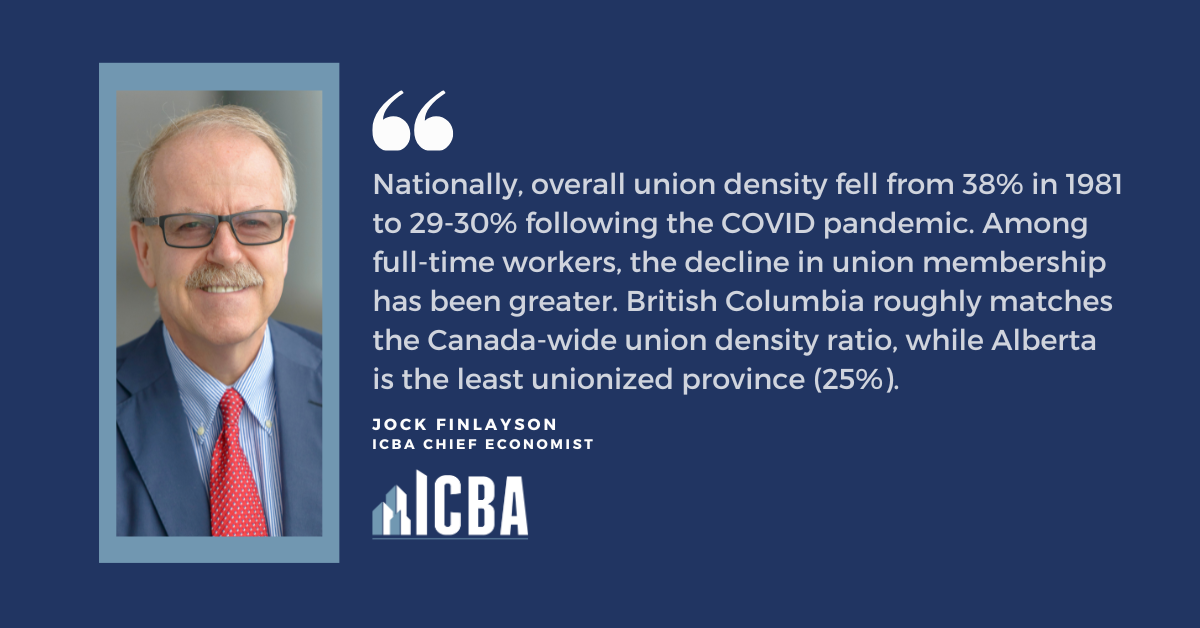
Canada has not been immune to the trends influencing union density that are summarized above. Nationally, overall union density fell from 38% in 1981 to 29-30% following the COVID pandemic. Among full-time workers, the decline in union membership has been greater. British Columbia roughly matches the Canada-wide union density ratio, while Alberta is the least unionized province (25%).
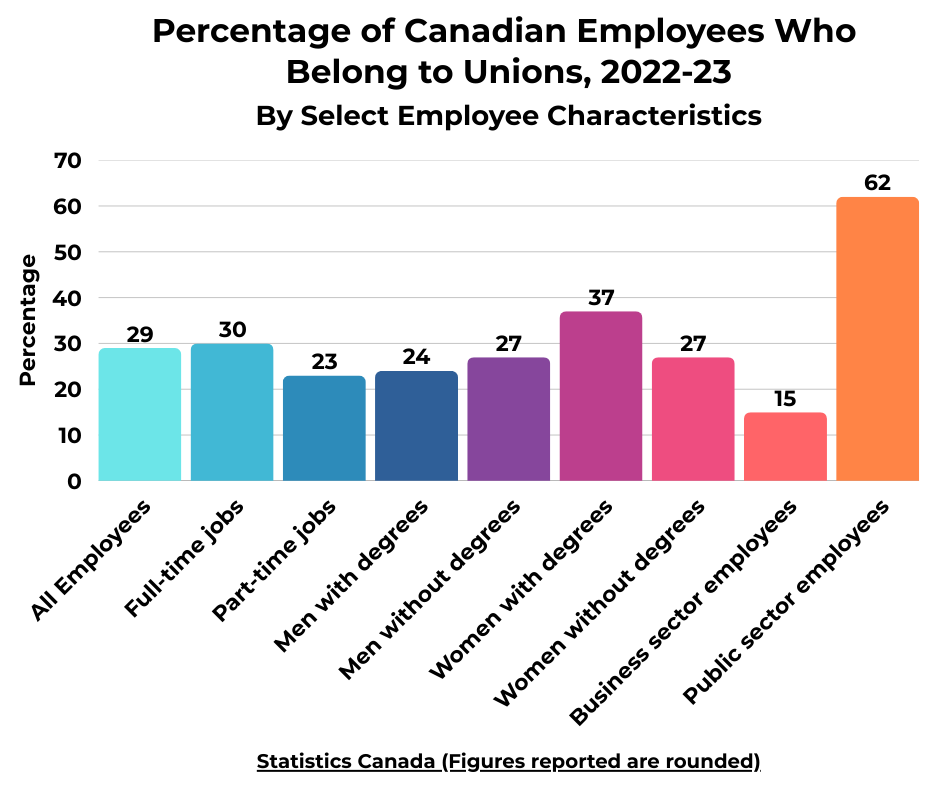
Figure 1 presents data on the percentage of Canadian employees who are union members by gender, education level, and broad economic sector. The large gap between the public and private sectors stands out. Of interest, women with university degrees are significantly more likely than men with degrees to belong to a union – a finding that is consistent with the predominance of women workers in the education, health care and social services sectors.
Figure 1
What about the construction industry? The share of Canadian construction workers covered by collective agreements has remained steady since 2000, at slightly over 30%. The national average is inflated by Quebec, where more of the industry is unionized owing to provincial government policy. In both B.C. and Alberta, the union coverage rate in construction is significantly lower – below 15% in most years. In B.C., this partly reflects the small size of construction companies – 80% have fewer than ten employees – and the fact that the sector is heavily weighted toward the homebuilding/home renovation segment, which is almost entirely non-union. As of 2024, some 36,000 of the approximately 250,000 people working in the B.C. construction industry were represented by a union.
Unions in B.C. face declining membership due to economic shifts but gain influence through government policy changes, raising challenges for business...
British Columbia's job market struggles with rising unemployment and uneven growth, with the public sector expanding while the private sector...
.png)
The Carney government has pledged to double Canada’s exports to markets other than the United States over the coming decade. That’s a tall order –...