ICBA ECONOMICS: Growing Wear and Tear on Canada’s Public Infrastructure
ICBA ECONOMICS: Growing Wear and Tear on Canada’s Public Infrastructure
3 min read
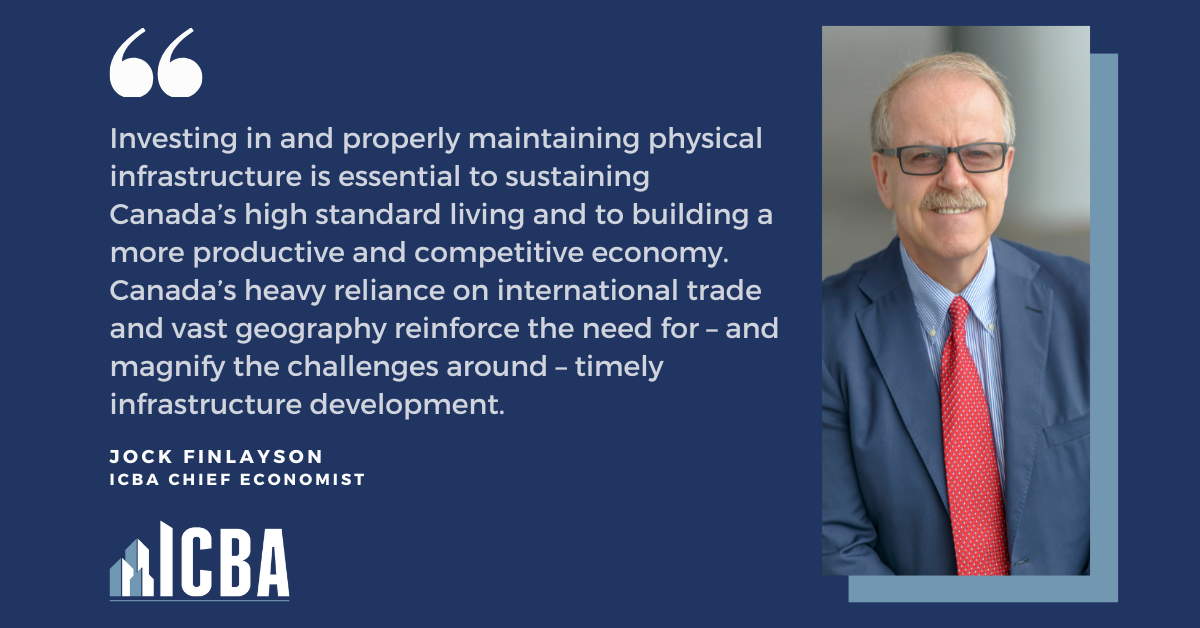
Investing in and properly maintaining physical infrastructure is essential to sustaining Canada’s high standard living and to building a more productive and competitive economy. Canada’s heavy reliance on international trade and vast geography reinforce the need for – and magnify the challenges around – timely infrastructure development.
Infrastructure spending can be divided into three components: “strategic” investments that help to boost productivity, enhance competitiveness, and improve key infrastructure services; “maintenance” investments to refurbish, expand or extend the useful life of existing infrastructure assets; and infrastructure-related spending that takes place in connection with governments’ fiscal policies aimed at “stimulating” the economy during periods of recession or unusually weak growth.
Statistics Canada collects extensive data on the composition, vintage, and levels of investment in a wide range of physical infrastructure assets that are important to the country’s economic performance and long-term well-being. It also provides estimates of the year-end value of the nation’s existing infrastructure stock. This ICBA Economics post summarizes some recent data produced by the agency on investment in infrastructure assets.
Figure 1 reports on national investment in current dollars in both 2018 and 2024, focusing on the principal types of infrastructure assets. Note that this data series excludes housing-related investment, as Statistics Canada does not treat housing as part of the nation’s economic infrastructure.
Figure 1
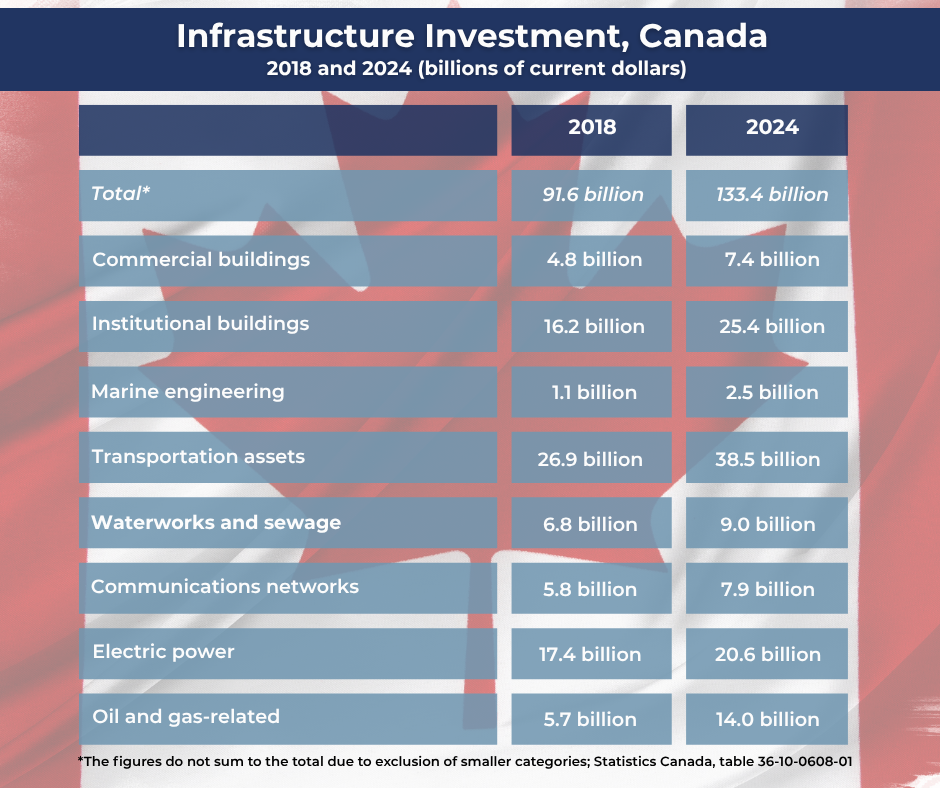
Last year, total Canadian infrastructure investment reached $133 billion, roughly 45% more than the $91.6 billion recorded in 2018. These figures do not capture inflation and so fail to account for the sharp jump in construction costs since 2018. After adjusting for inflation, the increase in “real” infrastructure investment from 2018 to 2024 was likely in the range of 15-20%, rather than the 45% gain measured in current dollars.
Nationally, the four largest infrastructure asset categories, in order of the amount invested in 2024, were transportation/engineering infrastructure; institutional buildings; electric power; and oil and gas engineering construction. Smaller sums were allocated to communications networks; commercial buildings; waterworks and sewage infrastructure; marine engineering infrastructure; and a few other minor categories.
The public sector has an outsized presence in the Canadian infrastructure sector. Governments are the dominant source of capital spending in the broad “institutional” segment as well as in transportation infrastructure, waterworks and sewage. The private sector is the primary source of investment spending in oil and gas engineering infrastructure, communications networks, commercial buildings, and marine engineering infrastructure. In the case of electricity generation, transmission, and distribution, the public/private investment mix varies across the country, based on whether the electric utilities in the provinces are state-owned or operate in the private sector.
According to Statistics Canada, the combined value of the nation’s non-residential physical infrastructure at the end of last year stood at $1.34 trillion, up from $900 billion six years earlier.
Focus on B.C. and Alberta
Figures 2 and 3 provide data on current dollar investment in major infrastructure asset categories in British Columbia and Alberta in 2018 and 2024.
Figure 2
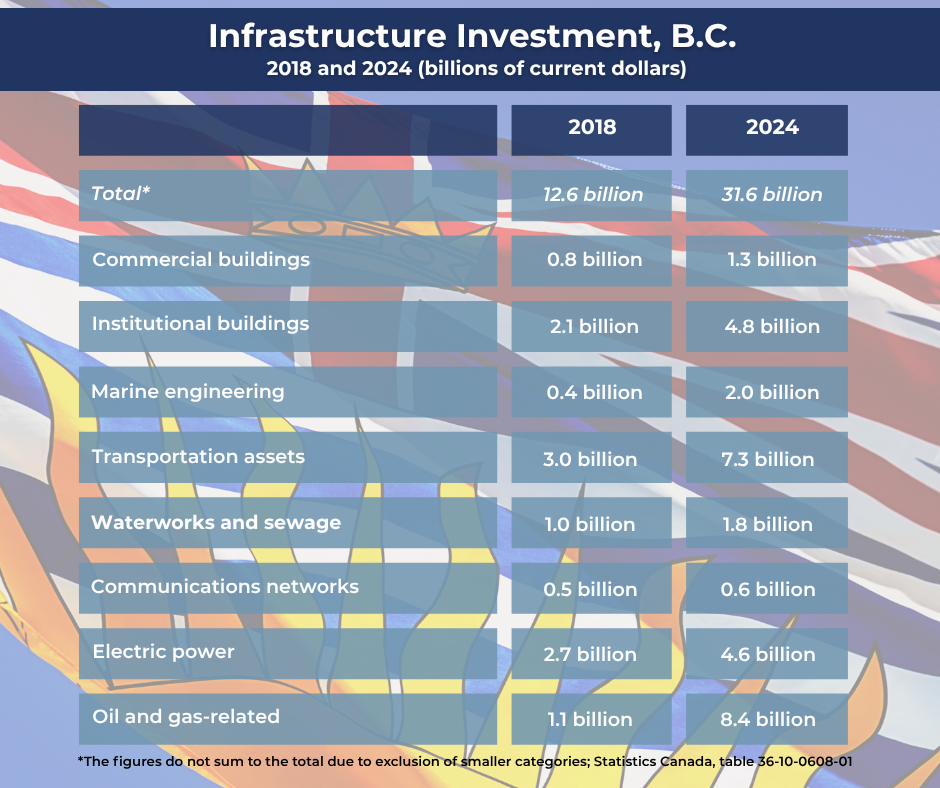
In British Columbia, infrastructure investment spending rose dramatically over the period, due in large part to ongoing work on several major energy-related projects as well as ramped-up public sector capital outlays on transportation infrastructure, hospitals/schools, and electricity generation/transmission (mainly via government-owned B.C. Hydro). Marine engineering infrastructure investment also increased owing to significant new port projects. In dollar terms, the four top categories for B.C. infrastructure investment in 2024 were oil and gas construction, transportation infrastructure, the institutional sector, and electric power. Large capital outlays on oil and gas construction are explained by pipeline projects that have now concluded; back in 2018, investment in oil and gas infrastructure was less than one-eighth of the level reported last year. With the winding-up of major energy-related projects, B.C. faces the prospect of a much weaker investment spending profile over the coming years – underscoring the need for policymakers to redouble efforts to attract more private sector investment in sectors such as mining, LNG development, electricity generation, and transportation infrastructure.
Figure 3
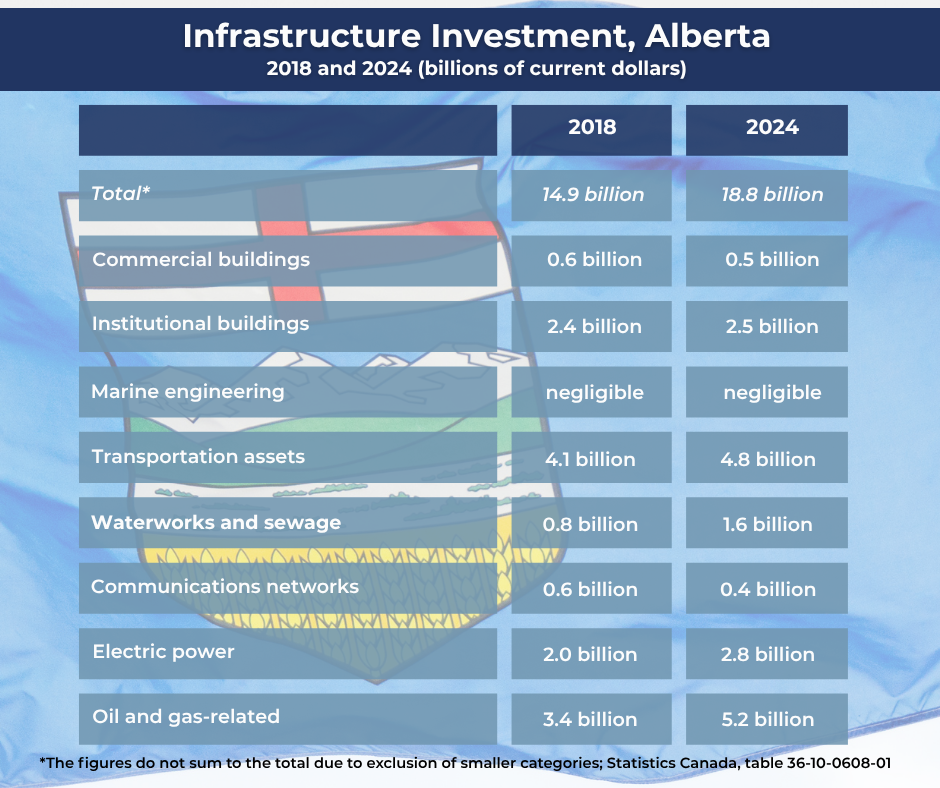
Overall infrastructure investment in Alberta has trailed well behind that in next-door B.C. in the last few years – again, this is partly because of the impact of a handful of large B.C. projects that were mostly or wholly completed by the end of last year. As of 2024, the top four categories for infrastructure investment in Alberta were oil and gas engineering construction, transportation, electric power, and institutional buildings. The comparatively small amount invested in commercial buildings is surprising considering Alberta’s strong population growth in the last half-decade.
The value (in current dollars) of the stock of physical infrastructure assets in B.C. was $230 billion last year, almost double the figure ($121 billion) in 2018. Over the same period, the value of Alberta’s infrastructure stock rose from $154 billion to $214 billion, based on Statistics Canada’s latest estimates.
Finally, it should be noted that capital spending in the infrastructure categories tracked by Statistics Canada represents only a portion of total non-residential capital investment. The latter also includes investment in machinery, equipment, vehicles, advanced technologies, intellectual property products, and some other categories.
ICBA ECONOMICS: Growing Wear and Tear on Canada’s Public Infrastructure
ICBA ECONOMICS: An Update on Canada’s Lopsided Labour Market
Canada's capital stock's service life is declining, indicating a need for increased investment in infrastructure and machinery to maintain economic...