ICBA ECONOMICS: Digging Into British Columbia’s Lopsided Job Market
British Columbia's job market struggles with rising unemployment and uneven growth, with the public sector expanding while the private sector...
4 min read
In a previous post, we reviewed the broad implications of the brewing Canada-U.S. trade conflict and provided estimates of how across-the-board 25% American tariffs on Canadian exports, along with matching Canadian levies on goods imported from the U.S., could affect the B.C. economy in 2025-26. In this companion post, we consider the same story but through the lens of the B.C. construction industry.
Construction is not classified as a “traded” industry, in that the output of the construction sector tends not to be a significant component of Canada’s exports or imports. As such, construction arguably is not in the direct line of fire when governments institute tariffs or other border-focused trade restrictions.
However, that doesn’t mean construction will be unscathed amid escalating trade tensions – to say nothing of the onset of the full-scale “tariff war” mooted by U.S. President Donald Trump. British Columbia’s large construction industry stands to feel the effects, both as a result of a downturn in the domestic economy triggered by declining exports (following the imposition of higher U.S. tariffs), and also because the retaliatory measures the Canadian government has proposed will increase the cost of building materials and other “construction inputs”.
Consider first how construction is likely to be affected by a weaker economic backdrop. A tit-for-tat bilateral tariff war will cause overall economic activity in B.C. to contract, via three key channels:
Faced with President Trump’s threat of 25% tariffs on most Canadian exports to the United States, the Canadian government pledged to follow suit with tariffs on goods imported from the U.S. This is in addition to the 25% tariffs Canada has already imposed on imports of steel and aluminum from the U.S., following the Trump administration’s decision to levy 25% tariffs on all American steel and aluminum imports on March 12. How will Canada’s proposed tariff retaliation impact the domestic construction industry – which, in B.C., accounts for around 8% of our GDP and directly employs some 250,000 British Columbians?
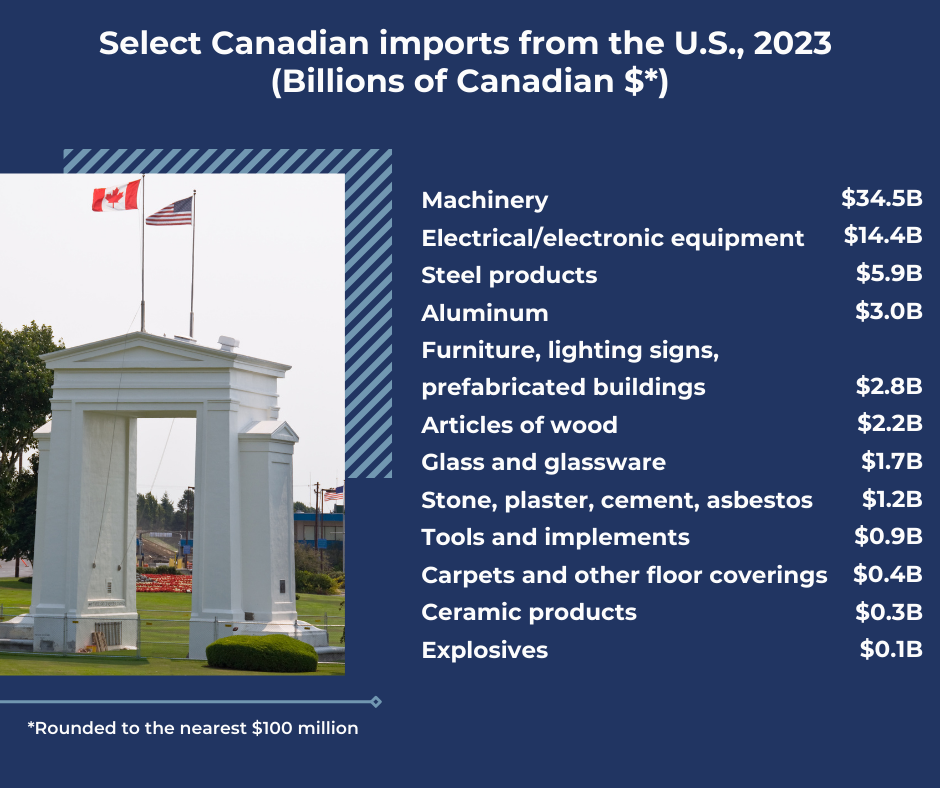
We can start by looking at the categories of Canadian merchandise imports from the United States which are most relevant to construction. Exhibit 1 lists many of these and shows the value of Canada’s imports from the United States in 2023. The large category of “machinery” is included because it encompasses various types of equipment as well as certain specialized vehicles (e.g., backhoes) used by construction companies in Canada.
Exhibit 1
As of March 17, 2025, Canada has imposed “retaliatory” tariffs of 25% on imports of steel and aluminum from the United States. In addition, following President Trump’s initial announcement of 25% tariffs on imports from both Canada and Mexico, Canada unveiled 25% tariffs on $30 billion of goods imported from the United States. The latter are now in place, even though the threatened across-the-board American tariffs have been delayed until early April.
Exhibit 2 lists the principal categories of building materials and other “construction inputs” covered by Canada’s phase one retaliatory tariffs. In the event the U.S. proceeds with across-the-board tariffs on all/most Canadian exports, the Canadian government has indicated it will respond by significantly expanding the list of imports covered by its own retaliatory levies. This would be a much longer list than the one in Exhibit 2, extending to more categories of construction hardware, appliances, electrical equipment, piping, tubing, and other building materials.
Exhibit 2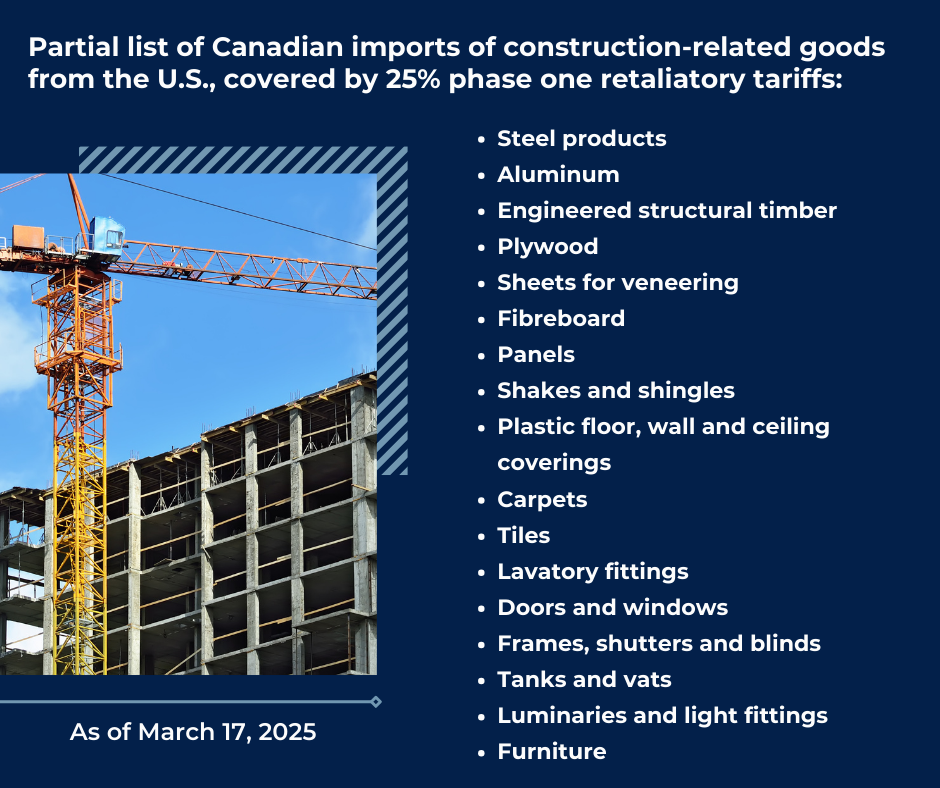
Tariffs effectively are a tax on goods – one levied on the imported items subject to the duty. In the first instance, tariffs are “paid” by the importer, at the point when the good enters the country imposing the tariff. However, in practice much or even all of the incremental cost stemming from higher tariffs is passed on to the ultimate (domestic) consumer, whether that is a household or a business. Economic research confirms that even in a very large economy such as the United States, tariffs lead to higher inflation and more expensive goods for residents of the importing jurisdiction. This is even more true for a mid-sized economy like Canada.
While we understand the political impulse to push back when confronted by the economic threats being made by the Trump Administration, ICBA is concerned that Canada’s plans for retaliatory tariffs risk making a bad economic situation worse. Broadly applied retaliatory tariffs on imports from the U.S. will put upward pressure on inflation, weaken the Canadian dollar, and increase the cost of all types of construction in Canada – residential, industrial, engineering, commercial, and public sector/institutional. This comes at a time when Canada is grappling with both an unprecedented shortfall in housing supply and the consequences of almost a decade of alarmingly low levels of business investment.
Construction has been identified as one of the Canadian industries most exposed to the damaging effects of retaliatory tariffs. In the current environment, we believe Canada should steer clear of policies that promise to further inflate construction costs. As noted in a recent commentary from Altus Group:
“The concern for the construction industry is that tariffs are layering on top of already high construction costs and government taxes related to new construction.”
British Columbia's job market struggles with rising unemployment and uneven growth, with the public sector expanding while the private sector...
Explore the diverse industrial landscape of British Columbia's economy and understand its evolution through the NAICS framework. Learn about key...

British Columbia's mining potential faces challenges from moratoriums and court decisions, risking economic growth and Indigenous relations in the...