ICBA.ca Exclusive: The NDP Construction Philosophy – Unfair, Unaffordable, Unsustainable
The NDP's Community Benefits Agreement restricts competition in B.C. construction, driving up costs and excluding local contractors from public...
3 min read
Jordan Bateman : Published
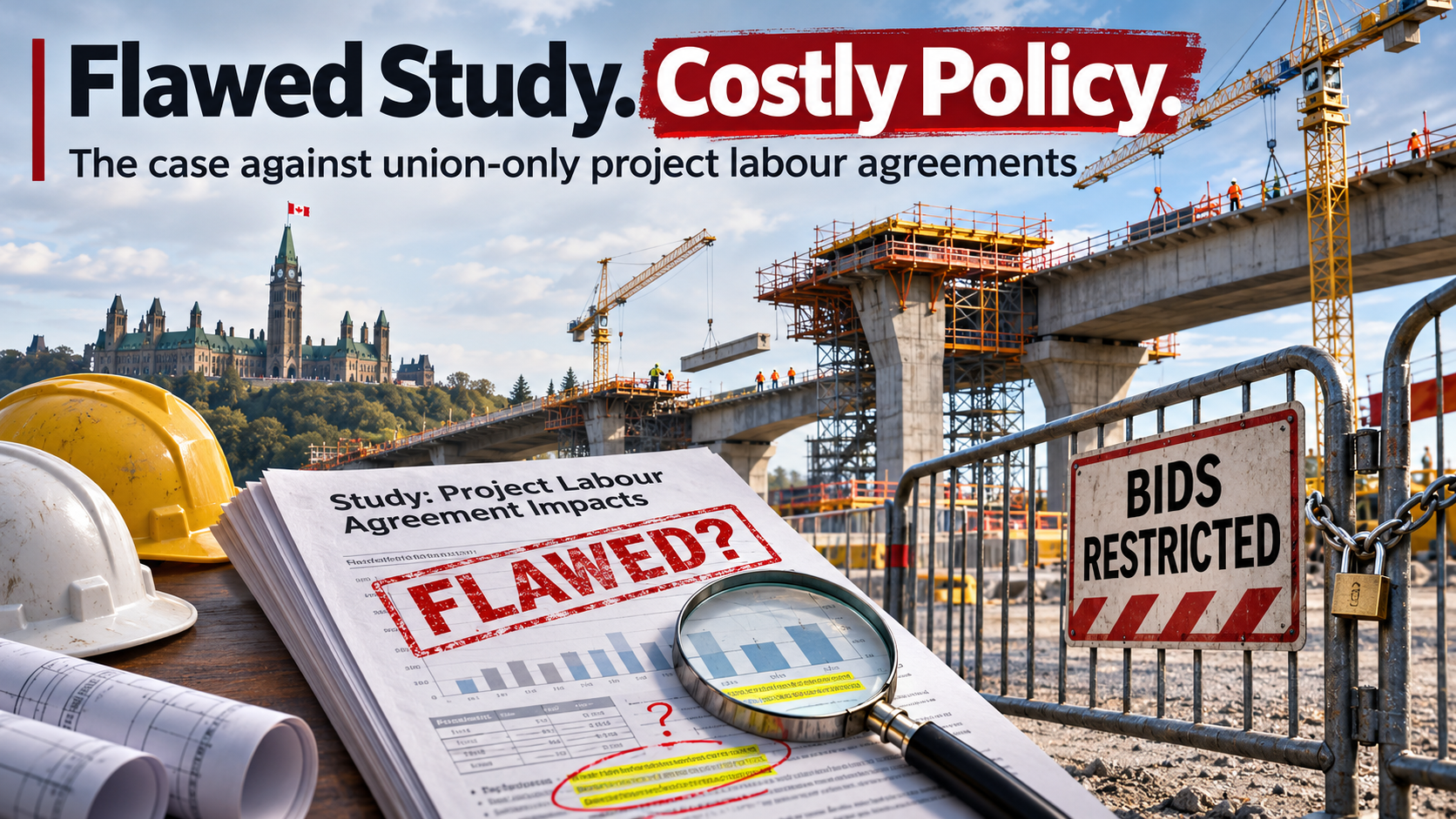
NDP MP Don Davies stood up in Question Period this week and asked the Liberals to mandate project labour agreements on every taxpayer-funded infrastructure project in Canada. His evidence: “Productivity from unionized labour is 17% higher than for open-shop contractors.”
Not so fast, Don. That "study", bought and paid for by the Building Trades Unions, is incredibly flawed.
This “study” was released by the Building Trades of Alberta and the BC Building Trades, and it’s the third report in a row that “Independent Project Analysis, Inc.” has written for the union side — 2008 for the union mechanical contractors’ association, 2022 for the fund that association runs with the plumbers and pipefitters’ union, and now 2026. That 2022 report says its client “is interested in promoting the value of union labor to the American industry.”
Fine. Lots of research is paid for by somebody – but Davies and the “study” news release left a lot of salient detail out.
First, it isn’t a study of construction. It’s a study of plant maintenance. All 140 projects were “executed at existing manufacturing sites and largely reflect site and sustaining capital projects” (page 5). Twenty-nine of them replaced pipe inside a plant. Twenty replaced valves. Eighteen were electrical upgrades. Seventeen swapped out process equipment. That’s a turnaround at a refinery – not a bridge, a hospital, a school, a condo tower or a highway. Nothing in it touches the work 85 per cent of B.C. construction workers do with open shop companies, or the public projects where the NDP forces union-only Community Benefits Agreements on taxpayers.
And their examples are small. The median union project was $2.97 million. The median open shop project was $2.18 million. The biggest open shop job in the whole study was $10 million (page 6, Table 1). IPA’s own worked example is a $5.2-million refinery piping job where the union “saving” is $300,000 (page 9). The authors then say these savings matter when “extrapolated to a 50 to 100 million dollar annual capital portfolio” (page 10). That is the scale they’re talking about: a plant’s yearly maintenance budget. Not a multi-billion-dollar subway. Not a billion-dollar bridge. Davies wants union-only agreements on every road, bridge, transit line, hospital and school Ottawa helps pay for. He’s backing that with a study of who replaces valves at a pulp mill.
The “study” looked at just 61 open shop projects, spread across two provinces, four sectors and 15 years. Nine owner companies in total. That isn’t much of a sample size.
And it never measured productivity, which should end the conversation. Productivity means hours per unit of work — feet of pipe, tons of steel. IPA admits it didn’t have that: “labour hours are not always available” (page 7). So instead it took each project’s labour cost, adjusted it to “the prevailing rate at the time for comparable projects in the United States Gulf Coast,” ran it through a model built on 2,700 projects from around the world, and called whatever was left over “efficiency.” Their words: once we control for scope, “the only difference in labour costs between comparable projects is the efficiency of the labour.” That’s not a finding; it’s an assumption. Every dollar of difference the model couldn’t explain got stamped “union productivity.” And the wage rates they adjusted for — the single number that drives the whole result — appear nowhere in the report.
What else is missing? Skill ratings: “unavailable due to differences in survey design” (page 9). Turnover: also unavailable. Why union crews supposedly did better: “the exact root causes for these differences cannot be identified from the data” (page 2). The one thing they could test was a yes/no survey question to owners about whether a labour shortage hurt the project. That’s all they had.
One more. The report coded a project as “open shop” if more than 80 per cent of the hours were open shop (page 5). So an “open shop” project in this study can be one-fifth union, and vice versa. And the open shop sample had more than twice the share of expansion work — 31 per cent versus 13 per cent (page 6) — a different kind of job than tearing out old pipe in a running plant.
And the answer Davies got? Liberal Labour Secretary of State John Zerucelli didn't question the number. He welcomed the BC Building Trades to Ottawa and touted $420 million for union training centres. A union-funded study, read into the record by an NDP MP, answered by a Liberal minister with a cheque for union halls.
The “study” fails to offer a single project where a government actually forced union-only labour and saved money. Of course, we don’t need a model for that; we have the invoices. The BC NDP’s Community Benefits Agreement put the Pattullo Bridge under a union-only deal. Budget: $967 million. Final cost: $1.6 billion. Finished three years late. The Broadway Subway has gone the same way. Don’t even get us started on the Cowichan Hospital debacle. The Progressive Contractors Association puts the CBA premium on public infrastructure at about 20 per cent. If union-only labour really saved seven per cent, Pattullo would be the cheapest bridge in Canadian history. Instead it’s one of the most expensive.
And here’s who the CBA shut out: 85 per cent of B.C.'s qualified construction workforce — including more than 40,000 unionized workers whose union isn’t a Building Trades affiliate. That’s the model Davies wants on every federal project in the country.
Cost overruns, lack of competition, long delays: that’s what happens when you shut 85 per cent of the industry out of the bidding.
Open shop contractors don’t need a consultant to tell owners they’re worth hiring. They win the work every day, on price and performance, against anyone who shows up. The Building Trades spent money on a “study” because they can’t win it any other way — and even the “study” they paid for couldn’t clear the bar.
Jordan Bateman is VP of Communications & Advocacy at ICBA.
The NDP's Community Benefits Agreement restricts competition in B.C. construction, driving up costs and excluding local contractors from public...
OP-ED: NDP will have to choose between union and Indigenous priorities

Canadian policymakers face challenges from new U.S. tariffs. This op-ed outlines strategies to navigate the trade landscape and protect Canada's...