3 min read

OP/ED: Build Communities Strong – Not More Expensively

OP/ED: Build Communities Strong – Not More Expensively
5:09

This op-ed, by ICBA President and CEO Chris Gardner, was first published in the Journal of Commerce on May 6, 2026.

Ottawa is selling its new Build Communities Strong Fund as a $51-billion answer to Canada's long-festering infrastructure backlog. The government’s marketing slogans are “speed, flexibility, impact.” Read past the slogans and into the design documents, and the catch is right there: federal infrastructure dollars are going to come with a thumb on the scale in favour of certain unionized contractors, and the bill goes to the taxpayer.

Budget 2025 says it plainly: BCSF projects will be selected based on criteria including ‘use of unionized labour, and use of Community Employment Benefits agreements.’ That's the principle. The mechanism lives in bilateral agreements between Ottawa and the provinces – most of which are still being negotiated. Industry sources tell ICBA those negotiations include a 10 per cent scoring advantage for unionized bids on projects over $5 million. If true, federal infrastructure spending will systematically tilt toward the 25 per cent of Canadian construction workers in building-trades unions and away from the other 75 per cent.

Ontario has already signed on, and other provinces are being pressured to follow. You can bet the NDP governments in B.C. and Manitoba will be on board.

This is a tax on the 85 per cent of B.C.’s construction workforce, and 88 per cent of Albertans working in the construction trades, who do not work for a building trades union-affiliated employer. They show up on jobsites every morning. They train apprentices. They work on the most important projects in our communities. They pay the taxes that fund this $51-billion pot. And now, Ottawa has apparently decided that their skill and experience matters less than that of a smaller, politically connected slice of the industry.

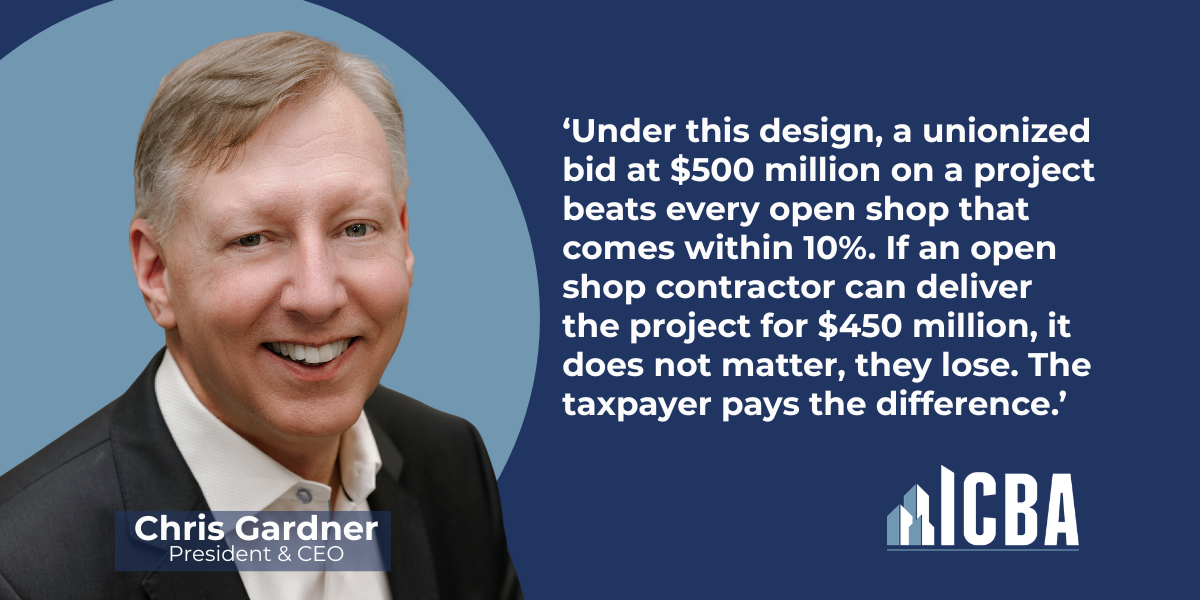
Taxpayers need to understand what that means in real life. Under this design, a unionized bid at $500 million on a project beats every open shop that comes within 10 per cent. If an open shop contractor can deliver the project for $450 million, it does not matter, they lose. The taxpayer pays the difference. Across $51 billion in federal infrastructure spending, the difference is not theoretical. It is hundreds of millions of dollars that buy nothing – no extra kilometres of road, no extra runways or port slips. They simply make sure the work goes to a smaller pool of bidders at a higher cost.

We have seen this movie before. British Columbia has spent years restricting public construction contracts to a narrow group of building trades-unionized firms under what the NDP government calls Community Benefits Agreements. This has come at great expense to taxpayers and lost opportunity for workers and contractors. Major projects are delivered years behind schedule and for significantly higher cost – the Broadway Subway, the Pattullo Bridge, and the Cowichan Hospital. That is what happens when you use procurement to do labour policy: projects get built slower, more expensively, by fewer companies – because most of the industry has been disqualified from bidding before the tender even opens.

Now Ottawa wants to take that flawed and costly model national.

This is the same playbook the federal government has rolled out on the Clean Economy Investment Tax Credits, where major projects lose 10 percentage points of their tax credit if they do not sign onto union-pattern wage agreements. One penalty stacked on another, with climate policy weaponized as labour policy.

There is a fairness problem here, too. Federal infrastructure dollars come from every Canadian taxpayer. Open-shop and unionized workers both pay into that system. There is no principle of fairness, and no commonsense public policy, that justifies federal officials writing rules that make it 10 per cent harder for the majority of Canada’s construction workers to compete for projects their own taxes are funding.

The fix is simple and it does not cost Ottawa a dollar.

Federal infrastructure projects should be awarded on merit – experience, price, quality, safety record, ability to deliver on time. The contractor who can build a hospital best and cheapest should win the job, regardless of whether the workers on site carry a union card. Goals related to training, safety and local hires can all be included in the tender documents; just provide a level playing field so every worker and every contractor have an equal shot at the work and the opportunity.

The Carney government has the right ambition on infrastructure, but the wrong design on engaging the industry and on project deliver. Ottawa should listen to the contractors who build this country – all of them – before locking in a model that makes every highway, runway, and port in Canada more expensive than it needs to be and longer to construct. Competition and choice drives innovation and is the cornerstone of smart procurement policy. It’s time to get back to it.

ICBA.ca Exclusive Op-Ed: Private Property Rights on Trial

1 min read

ICBA.ca Exclusive Op-Ed: Private Property Rights on Trial

The following op-ed, by ICBA President and CEO Chris Gardner, was written for ICBA.ca. Other outlets wishing to use it are welcome to do so, with...

Read More
ICBA to Ottawa: New Federal Trades Money Must Reach the Whole Industry

1 min read

ICBA to Ottawa: New Federal Trades Money Must Reach the Whole Industry

SURREY – The Independent Contractors and Businesses Association (ICBA), Canada's largest construction association, is welcoming the federal Spring...

Read More
OP/ED: B.C. economy stuck in low gear as trade risks cloud 2026 outlook

1 min read

OP/ED: B.C. economy stuck in low gear as trade risks cloud 2026 outlook

The following piece, by ICBA Chief Economist Jock Finlayson and consulting economist Ken Peacock, was first published in the print edition of ...

Read More