3 min read

OP/ED: B.C. Is Losing More Businesses Than It's Creating — That Should Worry All of Us

OP/ED: B.C. Is Losing More Businesses Than It's Creating — That Should Worry All of Us
5:21

The following op-ed, written by ICBA Chief Economist Jock Finlayson and consulting economist Ken Peacock (Substack HERE), was first published in Business in Vancouver on May 11, 2026.

The B.C. government’s economic development strategy is increasingly centred on facilitating a new wave of large projects – mainly in the energy, mining and infrastructure sectors. Such projects are important and offer the tantalizing prospect of kick-starting a struggling economy. Advancing more projects will generate good jobs, foster new business for local suppliers of “inputs” (like engineering, technical and financial services), and add billions to the economy. But on their own, a few big projects will not be sufficient to sustain a healthy pace of growth or materially move the dial on overall economic well-being.

The last round of big energy investments, starting in 2016, came at a time when B.C.’s broader private-sector economy was expanding at a solid clip—around 2.5 per cent annually. The construction boom triggered by these large energy projects lifted private sector GDP growth to roughly three per cent per year between 2017 and 2023. Today, the starting point is much less favourable. In the past two years, private-sector GDP growth in British Columbia has averaged just one per cent.

Timing is also an issue. Megaprojects take years to develop and commonly encounter delays before shovels enter the ground. Even with recent pledges to expedite approvals by the Eby government (echoed by the Carney administration in Ottawa), construction of the projects on the provincial government’s “preferred” list is unlikely to be fully underway before 2027 – or later.

This highlights a lacuna in the province’s economic growth strategy. Beyond supporting large-scale projects, policymakers should be looking to strengthen the underlying drivers of private-sector expansion. Chief among these is entrepreneurship.

By some measures, entrepreneurship in B.C. is under strain. The share of self-employment in total employment has dipped from 17–18 per cent during the decade to 2020 to a smidgeon over 15 per cent today. This trend is not unique to B.C. but is concerning nonetheless.

More telling is that the number of self-employed individuals who have paid help, a category that best captures the economic contributions of entrepreneurial activity, has declined as a share of the workforce, both in B.C. and some other provinces. Tiny one-person businesses without “paid help” do provide an array of goods and services, but they are not an important impetus to the growth of output, employment, or exports across the wider economy.

Relatedly, business dynamism is also waning. In B.C., the number of new businesses formed in 2023 was lower than in 2017, despite a steadily growing population. By contrast, most other provinces saw an increase in business entrants over the same period.

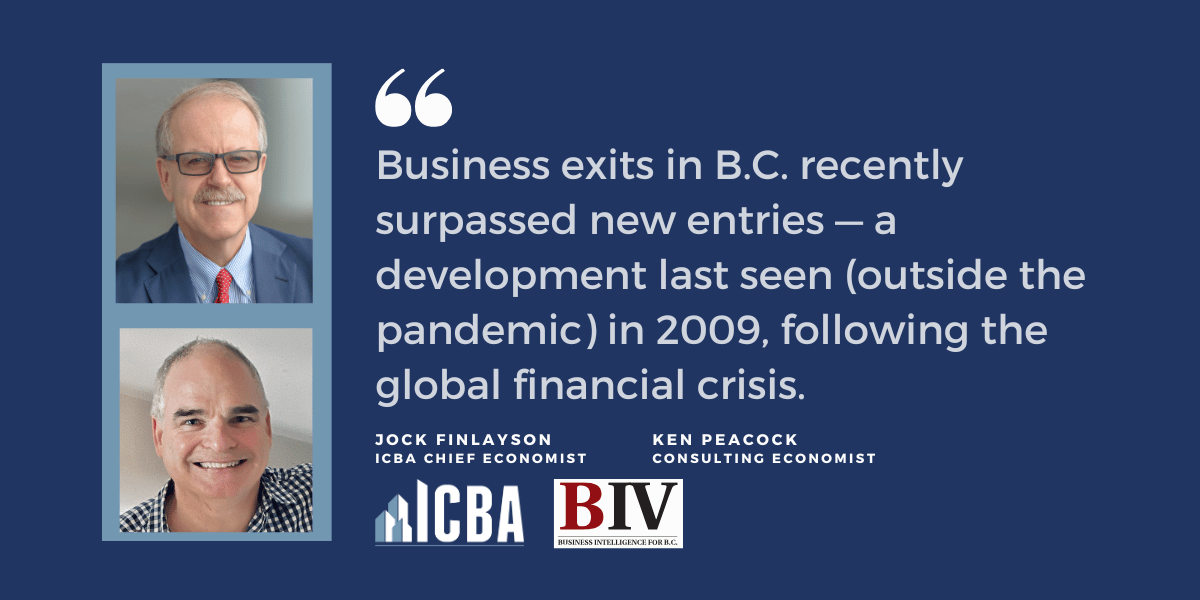
At the same time, business exits are rising. In 2023, there were more than 25,000 business exits in B.C., up 11 per cent from 2017. More recent monthly data suggest exits have continued to climb. Indeed, business exits in B.C. recently surpassed new entries—a development last seen (outside the pandemic) in 2009, following the global financial crisis.

All of this points to a problematic business climate, reflecting a mix of domestic policies that have raised business costs and discouraged investment, as well as the impact of external economic shocks (COVID, the 2022-24 inflation surge, and Trump’s tariff barrage). Policymakers should be paying attention to dwindling business dynamism and be alert to the dangers posed by a diminished appetite among firms and entrepreneurs for risk-taking.

This is a national issue, but the negative trends are particularly apparent in B.C., beginning around 2018. The timing coincides with a series of federal, provincial and municipal policy changes affecting business costs, including higher payroll taxes (notably B.C.’s Employer Health Tax), higher corporate income tax rates, steeper energy taxes, and steadily rising property and other real estate-related taxes and fees. In British Columbia, these tax-driven cost pressures have been compounded by substantial increases in the cost and complexity of government regulation affecting large swathes of the private sector economy – including serial changes in the Labour Code, the Employment Standards Act, and WorkSafeBC regulations; the adoption of more stringent building codes and energy efficiency standards; and policy decisions that sharply reduced the supply of fibre for the forest industry.

Last year, Statistics Canada reported that a 37 per cent rise in federal regulatory restrictions between 2006 and 2021 reduced GDP growth by 1.7 per cent. Including the effects of B.C.’s mounting regulatory burden points to significantly larger cumulative hit to economic growth in this province.

In today’s environment, progress in advancing a handful of major projects will certainly deliver an economic boost. But without a stronger foundation of business formation, investment, and entrepreneurial activity, that will not be enough.

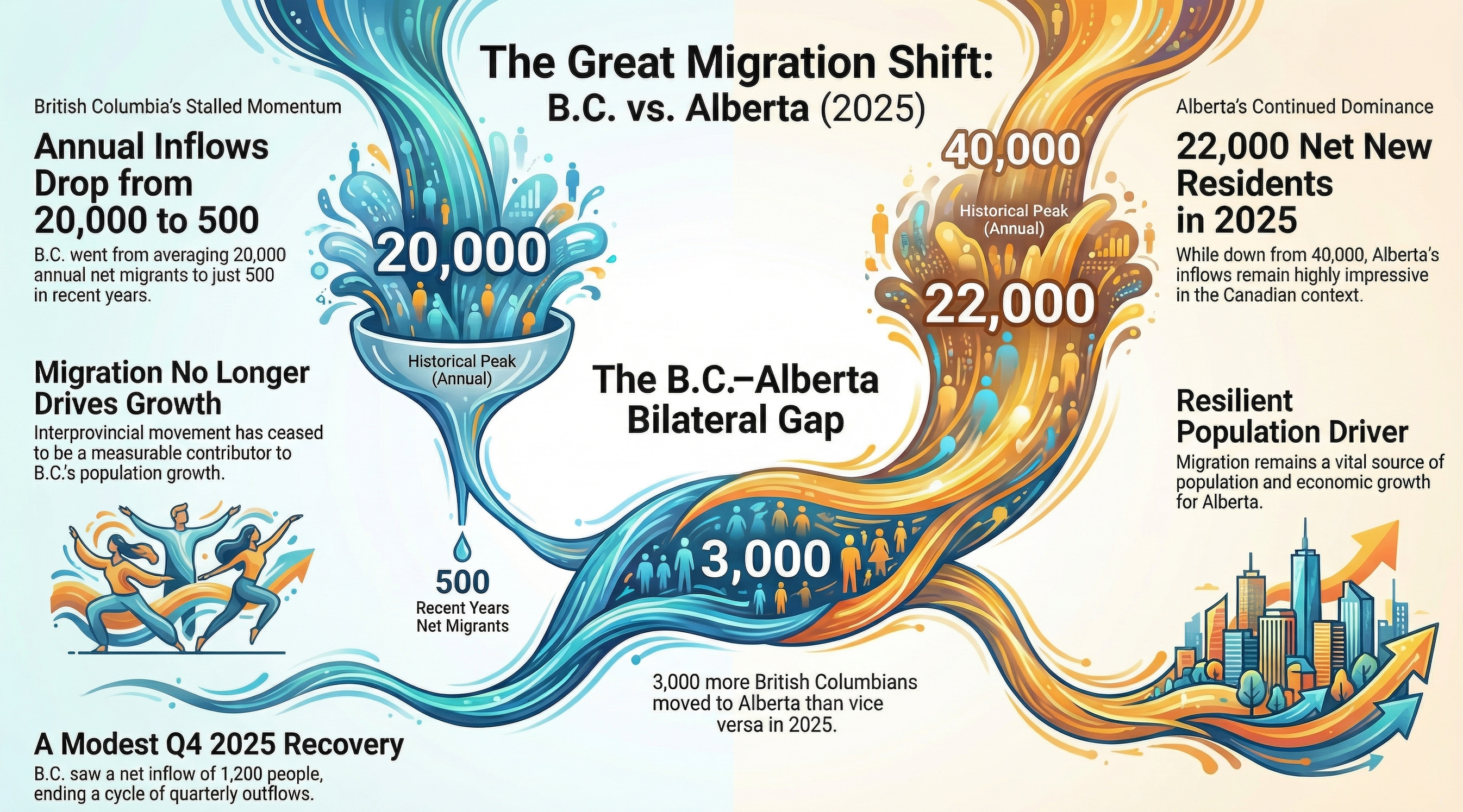
ICBA ECONOMICS: The Shifting Sands of Interprovincial Migration Trends in B.C. and Alberta

1 min read

ICBA ECONOMICS: The Shifting Sands of Interprovincial Migration Trends in B.C. and Alberta

By ICBA Chief Economist Jock Finlayson and consulting economist Ken Peacock (see Ken's Substack HERE).

Read More
OP/ED: B.C. economy stuck in low gear as trade risks cloud 2026 outlook

1 min read

OP/ED: B.C. economy stuck in low gear as trade risks cloud 2026 outlook

The following piece, by ICBA Chief Economist Jock Finlayson and consulting economist Ken Peacock, was first published in the print edition of ...

Read More
OP/ED: Eby Lit the DRIPA Fire – Now He Wants Credit for Talking About Putting It Out

1 min read

OP/ED: Eby Lit the DRIPA Fire – Now He Wants Credit for Talking About Putting It Out

The following op-ed, written by ICBA President and CEO Chris Gardner,first appeared in Northern Beaton December 12, 2025.

Read More