4 min read

OP/ED: B.C. government must tackle youth employment decline

OP/ED: B.C. government must tackle youth employment decline
OP/ED: B.C. government must tackle youth employment decline
7:57

The following piece, by ICBA Chief Economist Jock Finlayson and consulting economist Ken Peacock, first ran in Business in Vancouver on October 21, 2026.

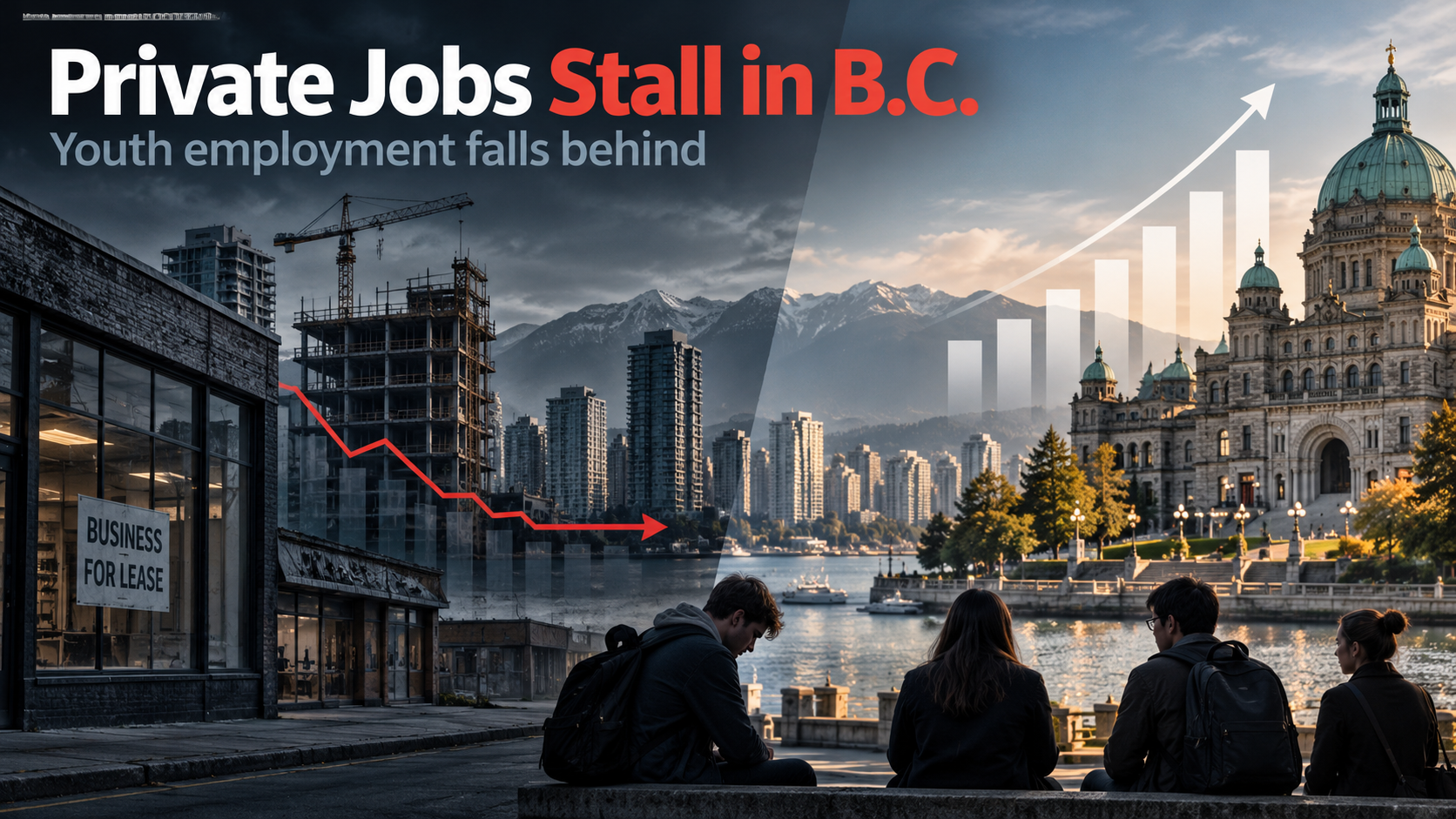
B.C.'s private sector is struggling. One of the clearest signs is that private-sector employment has not increased over the past three years and has made very little headway since 2019. The number of private-sector employees is up a dismal 3 per cent in seven years, a shockingly small advance over such a long period. Meanwhile, under the NDP public-sector employment has surged 45 per cent.

This marked labour market divergence has consequences throughout the provincial economy. Mushrooming government payrolls have added to spending pressures and the province's unfolding fiscal crisis, while weak private-sector hiring has limited the opportunities for British Columbians seeking to enter the workforce or advance their careers. A persistently sluggish private sector job market also weighs on personal and household income growth and makes it harder for young adults to get on the career ladder.

Since 2017, employers in B.C. have faced a succession of government-mandated policy changes that have increased employment costs and added regulatory complexity. These include the Employer Health Tax, several substantial minimum-wage increases, expanded paid sick leave, an additional statutory holiday, and various changes to employment standards and labour legislation.

The effects on B.C.'s job market first became evident in 2019. In a January 2020 column in this newspaper, we warned that job losses in resource industries were spreading to other parts of the economy, and that escalating tax and regulatory costs were creating additional challenges for employers.

We acknowledged that these policy changes were not all "unnecessary or wrong headed," but cautioned that their cumulative impact "may start to affect the decisions of business owners and operators, including decisions around job creation and retention." Subsequent trends have validated our earlier concerns.

Since 2019, the NDP government has introduced further tax increases, expanded paid leave and introduced additional changes to labour legislation. Regulatory complexity and uncertainty surrounding the implementation of the Declaration on the Rights of Indigenous Peoples Act (DRIPA) have also increased.

The employment trends are revealing.

Between 2016 and 2019, the number of private-sector employees grew by roughly 3.5 to four per cent annually. From mid-2019, when private-sector hiring first began to ebb, to mid-2022, employment growth across the overall business sector slowed to a meagre 0.4 per cent annually. Since late 2022, private-sector jobs have largely flatlined, punctuated by a large 2.3 per cent decline over the past year.

In our view, the most troubling consequence of this prolonged weakness in the private sector job market is the deterioration in employment opportunities for young British Columbians.

The public sector employs people across a wide range of occupations, but many positions require post-secondary qualifications, specialized training, or several years of relevant experience. Teachers, nurses, physicians, public administrators and other professionals typically enter their occupations after substantial education and training.

Young people, particularly those under 25, are therefore less likely to benefit directly from expanding public-sector payrolls.

The employment data bear this out. Before 2019, employment among British Columbians aged 15 to 24 was growing at an average annual rate of about 3.5 per cent. Between 2019 and 2023, youth employment actually declined by 0.8 per cent annually. As private-sector hiring weakened further, the pace of youth job losses accelerated to 1.5 per cent annually.

The cumulative result is striking. B.C. now has approximately 30,000 fewer employed young people than back in 2019. Despite years of population and economic growth, fewer young British Columbians have jobs today than in 2019—or even 2017, when the NDP first formed government.

Youth employment challenges are not unique to B.C., but the province's experience stands apart. B.C. is the only province where youth employment has declined since 2019, underscoring the connection between prolonged private-sector stagnation and dwindling job and career development opportunities for younger workers.

Many of the government's labour-policy changes provide tangible benefits to employees. Considered individually, their additional costs may also be manageable. But businesses make hiring and investment decisions based on their aggregate operating costs and expected returns. The cumulative effect of rising employment-related costs and expanding regulatory requirements can discourage investment and hiring, particularly among smaller employers and those who typically employ entry-level workers.

The result is an increasingly divided B.C. labour market, with some workers enjoying greater employment security, higher wages and improved benefits while others struggle to gain a foothold.

Young workers are especially vulnerable to end up on the wrong side of this divide. Those who secure employment may benefit from higher minimum wages and improved workplace protections. But these gains offer little consolation to those unable to find work or forced to subsist on gig assignments.

For these young people, the costs extend well beyond lost wages. They are missing opportunities to gain workplace experience, develop skills, build professional connections and advance their careers. Academic research confirms that delayed entry into employment can have lasting consequences for earnings and career progression.

The trends summarized above are also evident in labour-force participation.

In 2017, B.C. had one of the highest youth labour force participation rates among the provinces, well above the national average. Since then, the proportion of young British Columbians working or actively seeking employment has fallen by more than six percentage points, the biggest decline of any province.

At just over 60 per cent, B.C. now has the lowest youth participation rate among the provinces, alongside Ontario.

This should be a wake-up call for policymakers. In its efforts to improve employment conditions while expanding public-sector payrolls, the NDP government has contributed to the emergence of an increasingly divided, "insider–outsider," labour market structure, rather than one in which all British Columbians—including young adults—can participate and benefit.

The longer these conditions persist, the greater the risk of lasting damage to an entire cohort of young workers. Some may postpone their career plans, others may relocate to places offering better employment prospects, and still others may become discouraged and withdraw from the formal labour market altogether.

The evidence suggests that this withdrawal is already occurring.

Whoever forms government will need to confront one of the most troubling developments in B.C.'s labour market: the steady erosion of employment opportunities for young British Columbians. Reversing this trend will require more than improving conditions for those already employed. It will require restoring the conditions that encourage private-sector businesses across the economy to invest, expand and create jobs.

OP/ED: B.C.’s export troubles began well before the recent U.S. tariffs

OP/ED: B.C.’s export troubles began well before the recent U.S. tariffs

B.C.'s export economy faces challenges beyond U.S. tariffs, highlighting a shift towards services and the decline in traditional goods exports....

Read More
ICBA ECONOMICS OP/ED: Why B.C. may already be in a recession

ICBA ECONOMICS OP/ED: Why B.C. may already be in a recession

B.C. faces potential recession signs as job losses mount and population growth stalls, raising concerns about the province's economic stability.

Read More
OP/ED: Natural gas must be top of mind for B.C.’s next government

OP/ED: Natural gas must be top of mind for B.C.’s next government

Natural gas should be a priority for B.C.'s next government to enhance energy security and affordability, as the province navigates a changing energy...

Read More