Losing Steam: The B.C. Job Market in 2025
British Columbia's job market saw modest growth in 2025, but rising unemployment and a shift to part-time work signal a struggling economy. Explore...
3 min read
Recent economic developments and data releases raise the possibility that British Columbia may have stumbled into an official “recession” – defined as two consecutive quarters of declining economic output (inflation-adjusted GDP). To be clear, a recession is not the prevailing outlook for the province’s economy in 2026. Until now, virtually all forecasters (including ICBA Economics) have projected that B.C. would eke out at least a bit of economic growth this year, albeit less than in 2025 The recent B.C. budget, for example, assumed real GDP growth of 1.3%, down from roughly 2.0% in 2025 but still in positive territory. That was also ICBA Economics’ view as the year began.
However, the external landscape is deteriorating, with the U.S. job market losing momentum and the ongoing conflict in the Middle East pushing up energy prices (and inflation) and thereby dimming the near-term global picture. Closer to home, there are also worrisome signs of economic distress here in B.C. As this blog is being posted in late March, a credible case can be made that the province is in the initial stages of an outright economic contraction.
There are several reasons for extra caution when considering B.C.’s economic prospects in 2026.
A weak handoff for 2026: Canada’s economy ended 2025 on a sour note, with real GDP declining by 0.6% (annualized rate) in the fourth quarter. While some of this was due to temporary factors -- labour disputes and inventory effects (as many Canadian firms drew down inventories to meet the demand for goods) -- the broader economy remains sluggish. This assessment was confirmed by the February 2026 Labour Force Survey, which reported a sharp drop (~84,000) in national employment. Unfortunately, Statistics Canada does not produce quarterly GDP estimates for the provinces. As a result, there is no “official” word on whether B.C.’s economy also shrunk in Q4 2025. But the stagnation of Canadian output in the latter part of 2025 did not leave B.C. unscathed.
B.C. job losses: The same Labour Force Survey contained dismal news for British Columbia on the employment front: the province shed a whopping 20,000 jobs in February. On a year over year basis, employment was down by 0.4%. A look below the hood reveals that the job decline was concentrated in full-time positions… a bearish sign. Construction, manufacturing, and natural resources are among the B.C. industries that experienced job losses. Figure 1 summarizes the month-to-month and year-over year percentage changes in employment for the six largest provinces, as reported in the latest Labour Force Survey.
Figure 1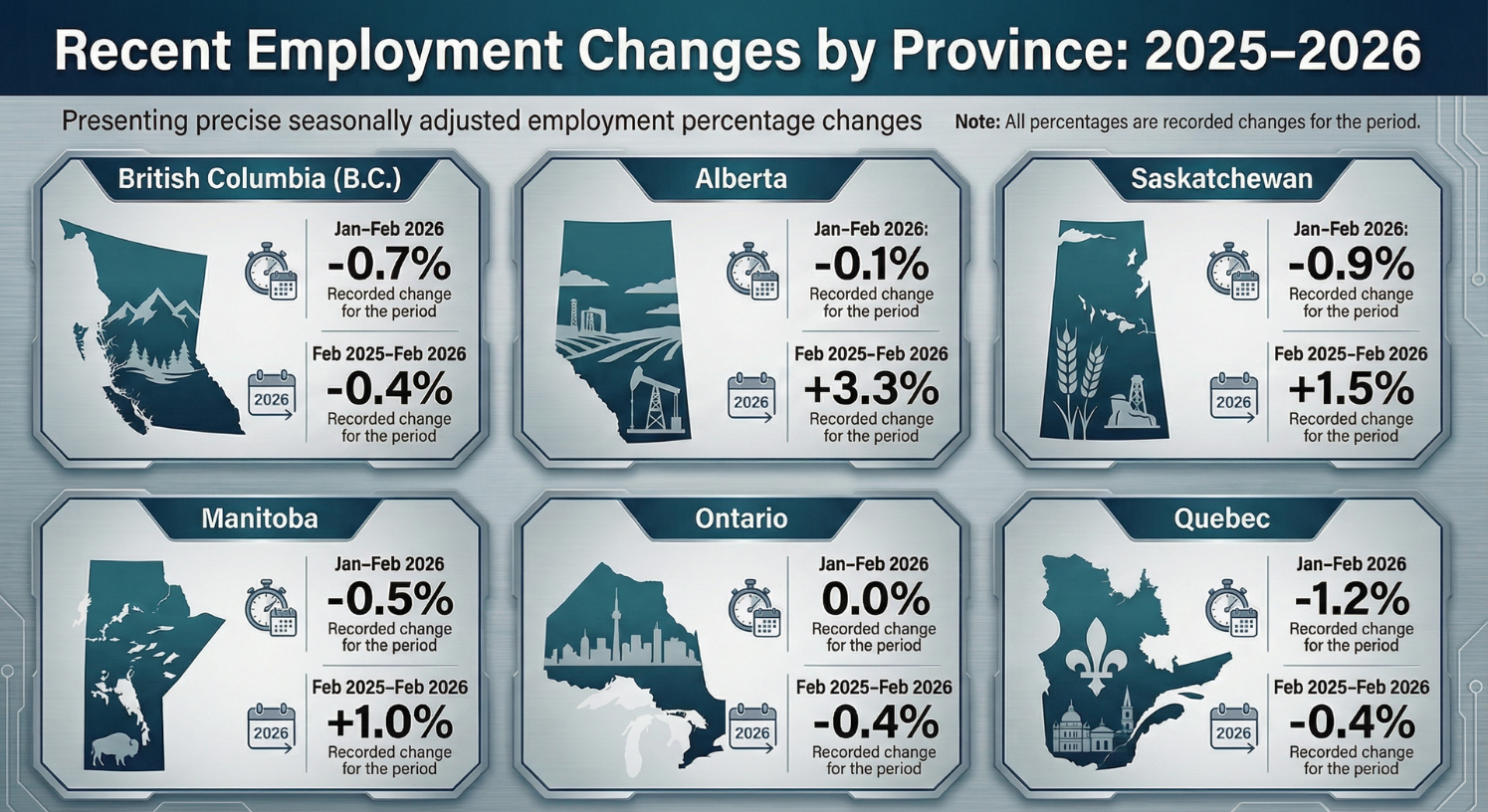
Population growth: After many years of steady population gains, the demographic picture has shifted dramatically. B.C.’s population has been shrinking in recent quarters, driven by fewer new international immigrants, the departure of more temporary immigrants living in B.C., and accelerating out-migration of B.C. residents to other provinces. After climbing from 5.3 million in Q1 2022 to 5.7 million by Q4 2024, the province’s population fell slightly last year. Little growth is expected over 2026-2027. A stalled population removes an important previous driver of economic growth in British Columbia.
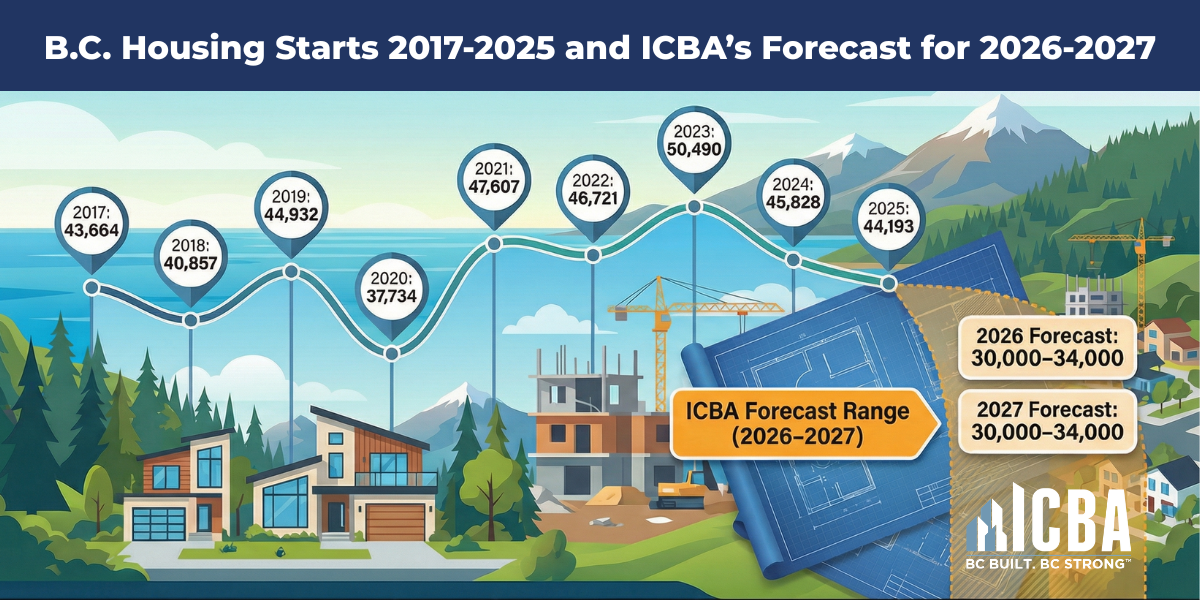
Housing and real estate: Homebuilding, home renovation spending and real estate sales & intermediation, taken together, play an outsized role in the B.C. economy. It follows that the ongoing slump in real estate development and very weak sales activity, combined with what ICBA expects will be a sharp downturn in home-building in 2026-27, represents a significant economic headwind for the province. Home sales across B.C. remain on a downtrend, falling another 2% in February (seasonally adjusted) following January’s 8% drop; on a year-over-year basis, home sales are down about 9%. January building permits data show a noticeable decline in residential permits compared to the previous month, reaching the lowest level since April 2025. This aligns with ICBA Economics’ view that housing starts in B.C. are about to enter a nuclear winter, decreasing substantially from last year’s level of a little over 44,000. We see housing starts dipping to a range of 30,000-34,000 in both 2026 and 2027 (Figure 2). The weakness in homebuilding will be concentrated in the multi-family segment and in the lower mainland region. One bright spot amid the dark cloud over homebuilding is purpose-built rental, where the number of new dwelling units has been on the rise.
Figure 2
Business and investor confidence: CFIB’s latest reading of business confidence among small and mid-sized B.C. firms finds they are less optimistic than their counterparts in most other provinces. In part, this may reflect the tax hikes announced in the February 2026 B.C. Budget and the massive future deficits being planned by the Eby government. Eroding business confidence may also be linked to concerns over the status of private property in British Columbia, in the wake of recent court rulings and government decisions championing the notion of “Aboriginal title.” Uncertainty about property rights, should it become widespread, is likely to undermine business and consumer confidence and depress real estate activity as well as private sector investment generally.
Conclusion: Overall, we see a material risk that B.C. has now entered a recession – albeit a shallow one – with the value of economic output diminishing. This perspective is not yet reflected in published forecasts. Even if the economy shrinks in Q1 2026 on the heels of a flat or slightly negative Q4 2025, that won’t necessarily translate into negative economic growth for calendar year 2026. Nonetheless, the incoming data confirms that B.C.’s economy is struggling to show any growth amid a challenging external environment and an increasingly unattractive business climate.
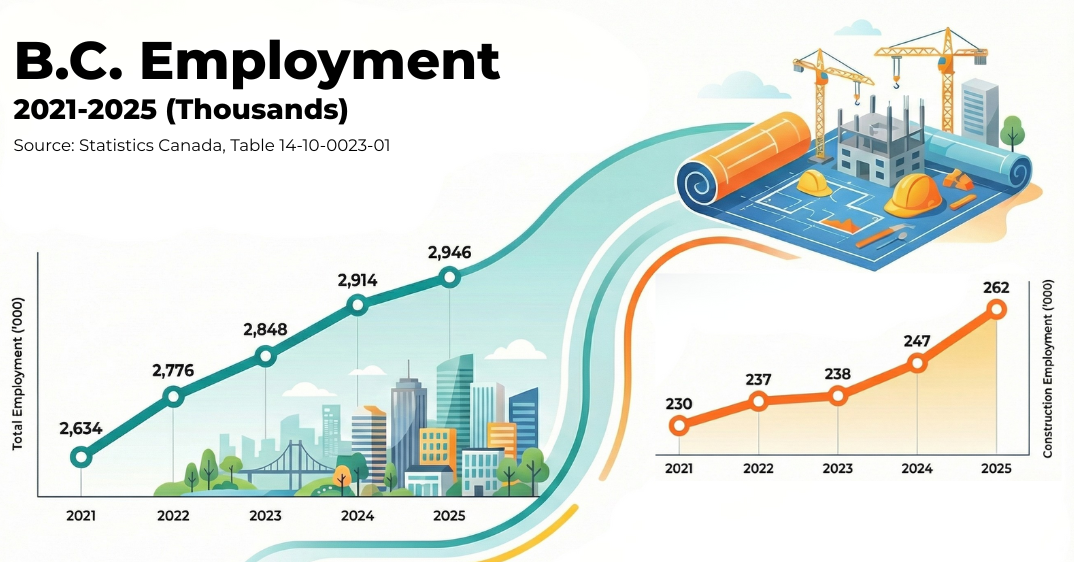
British Columbia's job market saw modest growth in 2025, but rising unemployment and a shift to part-time work signal a struggling economy. Explore...
B.C. faces potential recession amid job losses and housing downturns. ICBA advocates for fair procurement and successful DCC rollbacks for builders.
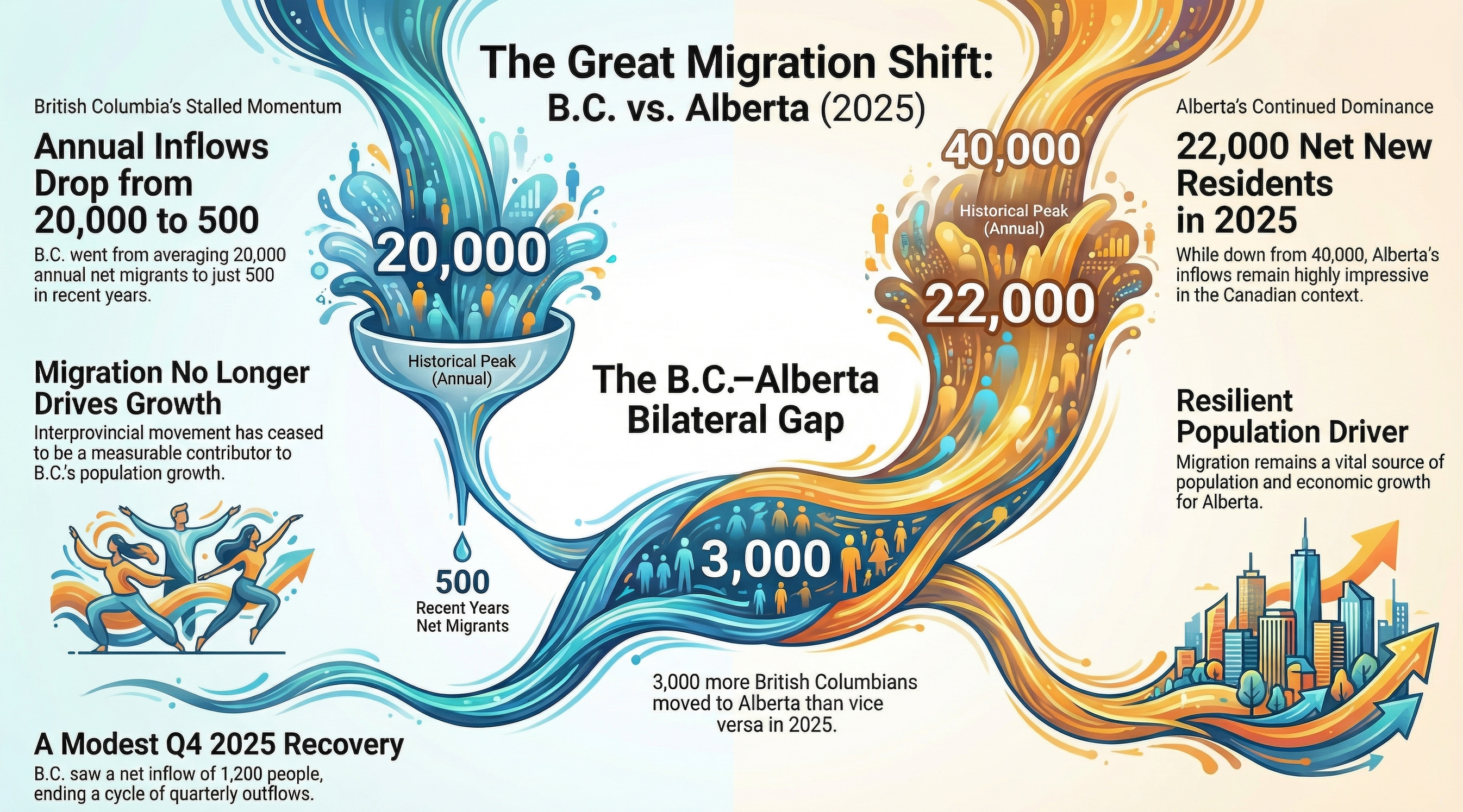
Explore the recent trends in interprovincial migration between B.C. and Alberta, highlighting shifts in population dynamics and economic influences.