Recession Warning. WorkSafe Meltdown. Your Property Rights. ICBA is with you.
KEY POINTS Construction is in crisis, not a dip: With housing starts projected at less than two-thirds of what the government is forecasting,...
4 min read
KEY POINTS
B.C. ALREADY IN RECESSION?
%20(1)-1.png?width=1200&height=600&name=Copy%20of%20jock%20pullquote%20horiz%20(1200%20x%20600%20px)%20(1)-1.png)
A new Business in Vancouver op-ed from ICBA Chief Economist Jock Finlayson and consulting economist Ken Peacock makes a case for what our members are already feeling: B.C. is now likely in a recession.
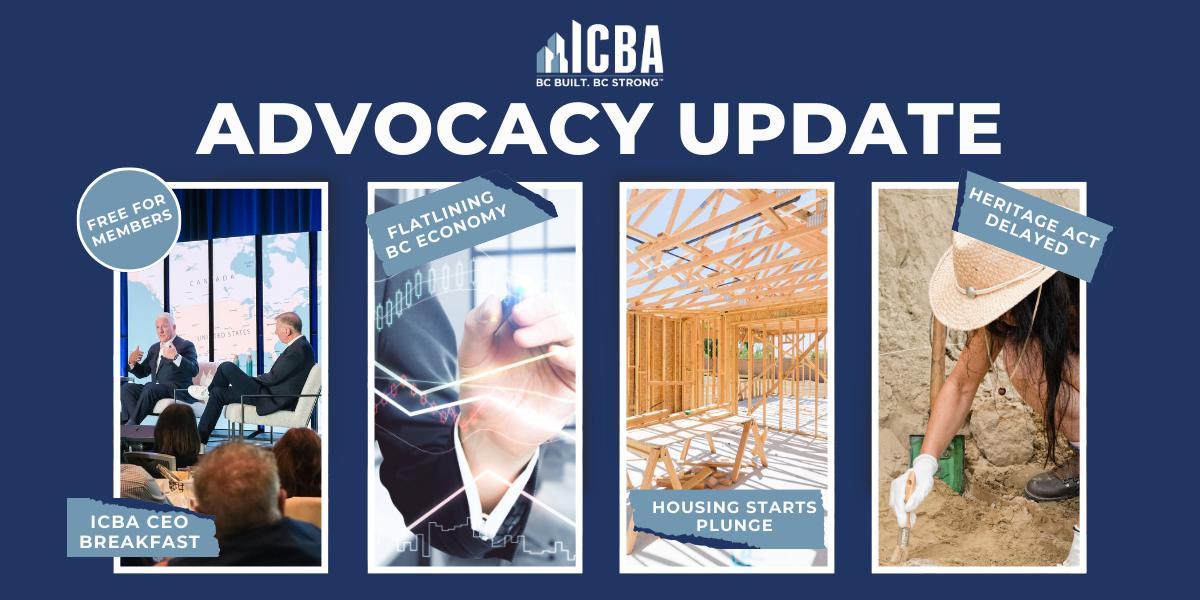
B.C. shed a staggering 20,000 jobs in both February and March – consecutive monthly losses of that magnitude are record declines outside of the pandemic shutdown. All the losses were in full-time, private sector positions, while public sector employment kept climbing. Population is shrinking. Business confidence is tanking. And housing starts are heading for what Jock calls a "nuclear winter" – dropping from roughly 44,000 last year to closer to 30,000 in both 2026 and 2027.
The external picture isn't helping – a sluggish U.S. job market, Middle East conflict pushing up energy prices, and ongoing trade uncertainty. But the domestic damage is largely self-inflicted: tax hikes in Budget 2026, massive deficits and out of control government spending, and mounting uncertainty over private property rights have made B.C. an increasingly unattractive place to invest.
Even if B.C. technically avoids the textbook definition of a recession – two consecutive quarters of a decline in GDP – the incoming data tells a clear story: many parts of the economy are struggling to show any growth at all. Read the full piece HERE.
FIGHTING FOR FAIRNESS
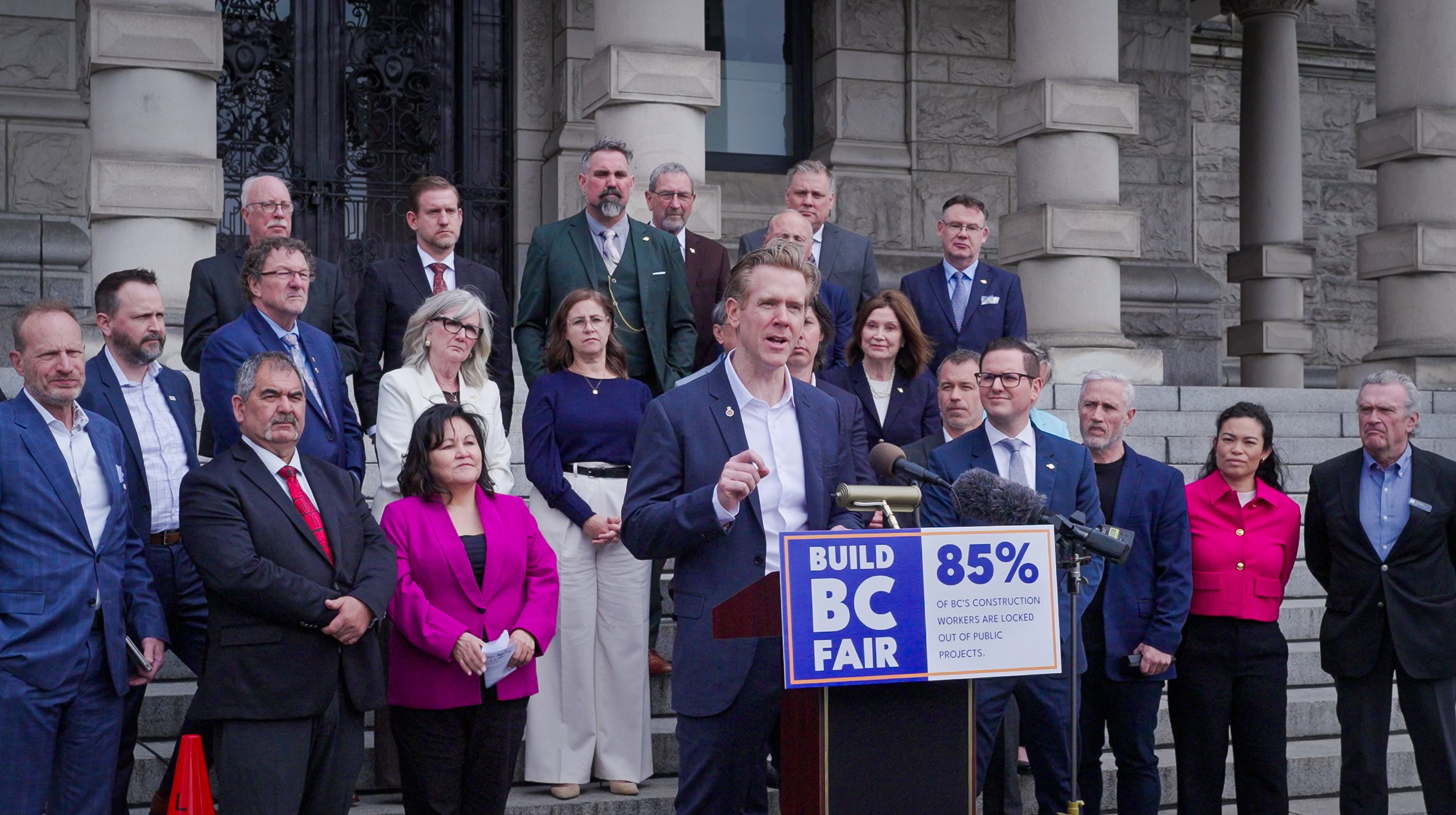
On Monday, ICBA Regional VP Mike Davis and COO Todd Cumiskey joined BC Conservative MLA Kiel Giddens and a broad coalition of industry leaders at the Legislature to champion The Public Sector Construction Projects Procurement Act – Giddens’ bill that would require labour-neutral procurement on all public sector construction in B.C.
The coalition included CLAC and the Progressive Contractors Association of Canada delivering the same message: award public construction contracts based on merit – safety record, qualifications, experience, and price – not labour affiliation.
The numbers behind the push are damning. 85% of B.C.'s construction workers aren't affiliated with building trades unions, yet the NDP effectively shuts them out of major public infrastructure work. Since those restrictive tendering rules were introduced in 2018, CBA capital projects have gone $17.3 billion over budget with a combined 158 years of delays. That's not a procurement model – it's a procurement disaster.
The bill is a long shot to pass under this NDP government. But the growing coalition behind it shows the construction industry is unified: fair and open tendering means contracts go to the most qualified bidders, creating real competition that benefits workers, companies, taxpayers, and the public.
METRO DCCs: A WIN
After a year of sustained ICBA advocacy and our industry partners, Metro Vancouver's Board voted today to roll back the 2026 Development Cost Charge increase and reduce the 2027 hike. This is exactly what we asked for – and it didn't happen by accident. When staff tried to push directors toward a half-measure that locked in the 2026 increase, ICBA President Chris Gardner sent a letter to every MVRD director making the case plainly: you can't collect DCCs on towers that never break ground. The Board listened.
This matters. Water DCCs had tripled. Parkland DCCs jumped overnight. A new condo was carrying tens of thousands in Metro fees alone – before a single municipal charge was added on top.
Rolling back these charges puts real dollars back into project pro formas at exactly the moment the housing market needs it most. Credit to the directors who followed through, and to every builder and association that helped make the case. In the end, every time a developer walks away from a project, it means job losses, fewer apprentices trained, businesses that can’t grow, and local sports team and other community group that lose sponsors.
PUSHING BACK (AGAIN) ON HCA
ICBA filed our third formal submission on the NDP's Heritage Conservation Act overhaul – a fight we've been in since 2023. New in this version: “Consent” is out, but consent-based decision-making agreements are in; and “Intangible heritage” is gone but “cultural practices” walked in through the definitions section.
We'll keep pushing until the answer is better than “trust us, it'll work out in regulation” – especially when the same proposal includes million-dollar fines for builders while exempting equivalent Indigenous activities on Crown land.
REPLACE THE TAYLOR BRIDGE
ICBA President Chris Gardner is calling on the provincial government to stop patching and start replacing the Taylor Bridge – the 65-year-old Highway 97 crossing over the Peace River that's the backbone of northeastern B.C.'s economy. After a nine-month wait, ICBA obtained inspection reports showing cracked floor stringers that have been welded, re-cracked, and welded again; corroded gusset plates with confirmed material loss; and a coating system the government's own engineers describe as failed.
Chris argues that rehabilitation is the wrong call – a new bridge built to modern standards would serve the north for 75 years, while every year of reactive maintenance drives costs higher and service life shorter. Read Chris' full piece in Energeticcity.ca and watch the TV coverage.
ICYMI
ICBA continues our work on these and other advocacy files on behalf of our members – if there's a public policy or red tape issue your company is facing municipally, provincially, or federally, that you could use some help with, reach out to us at jordan@icba.ca.
KEY POINTS Construction is in crisis, not a dip: With housing starts projected at less than two-thirds of what the government is forecasting,...
1 min read
KEY POINTS B.C. is flatlining: ICBA’s Construction Monitor forecasts just 1.1% GDP growth in 2026. Housing starts are projected to drop 42,200 →...