By Jock Finlayson, ICBA Chief Economist
The trade union movement in Canada, as in many other advanced economies, is in the throes of change. Rapid technological innovation along with shifts in business practices, the distribution of employment by occupation, and the demographic make-up of the working age population all pose challenges to the traditional strategies adopted by unions to grow and sustain their membership.
A glance at the evolution of “union density” (or “union coverage”) is revealing. Union density measures the share of all paid employees who belong to unions; union coverage also includes workers who are covered by collective agreements but are not officially union members.
Data reported by the Organization for Economic Development and Cooperation (OECD) shows declining union density/union coverage in most industrial countries since the early 1980s. Several factors help to explain this pattern:
- Changes in the occupational distribution of employment. In most countries, net job creation has been concentrated in private sector services and the broad public sector (which includes government administration, health care, education and social services). Private sector service industries – e.g., retail and wholesale trade, financial services, information and culture, communications and digital services, transportation, tourism, and professional, scientific and technical services (PSTS) – tend to have union density ratios well below the economy-wide average. These sectors have generally seen the fastest private sector job growth since the early 2000s. In some jurisdictions (including Canada), public sector “industries” have also reported steady gains in payroll counts over time. Unlike with private sector service industries, the growth of public sector service industries has had a positive impact on overall union density, because trade unions are strongly entrenched in public administration, education and health care. Indeed, in Canada public sector workers are almost five times more likely to hold union membership cards than their counterparts in the broad private sector.
- A second trend that has affected union density is the rising share of the labour force consisting of well-educated and highly skilled “knowledge workers.” Compared to the population as a whole, these types of workers typically have more education, higher incomes, more flexible career paths, and a desire for ongoing skill upgrading. Outside of the public sector, unions in a number of developed countries have had limited success in organizing knowledge workers across many professional and technical occupations.
- Greater reliance on and integration with global markets for goods, services and capital have made it harder for unions to expand their presence in private sector industries directly exposed to international competition. Heightened competitive pressure stemming from engagement with global markets means that unions sometimes have little capacity to boost workers’ wages -- unless higher pay is accompanied by increased productivity at the firm and industry levels.
- Finally, the growing diversity of the work force and in the types of jobs created in our technology-driven economy have also played a role in dampening union density in the private sector. Compared to 40-50 years ago, more jobs today are part-time or “gig” positions, involve remote rather than on-site work, and/or allow people to earn income as self-employed contractors. Given their traditional focus on full-time factory and office jobs, unions have been slow to respond to changes in the nature of work.
The Canadian Situation
Canada has not been immune to the trends influencing union density that are summarized above. Nationally, overall union density fell from 38% in 1981 to 29-30% following the COVID pandemic. Among full-time workers, the decline in union membership has been greater. British Columbia roughly matches the Canada-wide union density ratio, while Alberta is the least unionized province (25%).
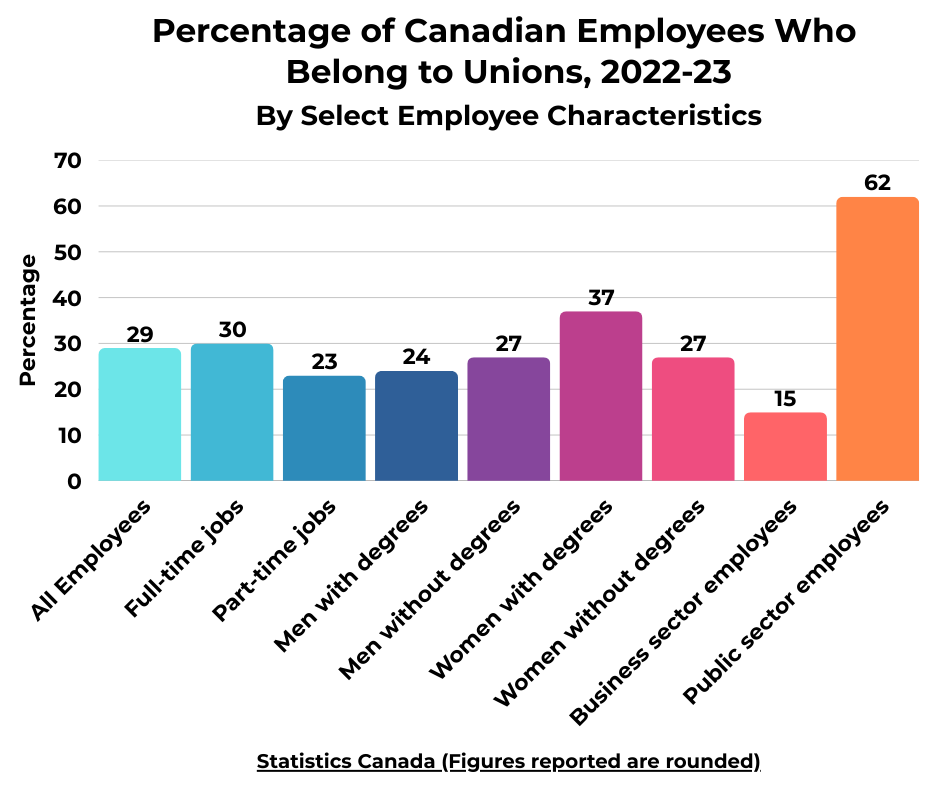
Figure 1 presents data on the percentage of Canadian employees who are union members by gender, education level, and broad economic sector. The large gap between the public and private sectors stands out. Of interest, women with university degrees are significantly more likely than men with degrees to belong to a union – a finding that is consistent with the predominance of women workers in the education, health care and social services sectors.
Figure 1
What about the construction industry? The share of Canadian construction workers covered by collective agreements has remained steady since 2000, at slightly over 30%. The national average is inflated by Quebec, where more of the industry is unionized owing to provincial government policy. In both B.C. and Alberta, the union coverage rate in construction is significantly lower – below 15% in most years. In B.C., this partly reflects the small size of construction companies – 80% have fewer than ten employees – and the fact that the sector is heavily weighted toward the homebuilding/home renovation segment, which is almost entirely non-union. As of 2024, some 36,000 of the approximately 250,000 people working in the B.C. construction industry were represented by a union.