Citizens and policymakers in any jurisdiction should be interested in how well the economy is performing. This typically involves keeping tabs on a few widely-cited economic indicators – such as employment growth, household incomes, business investment, consumer spending, and exports. Sometimes, it may also entail looking at non-economic factors that bear on overall living standards – the health status of the population, education levels, or the impact of human activity on the environment.
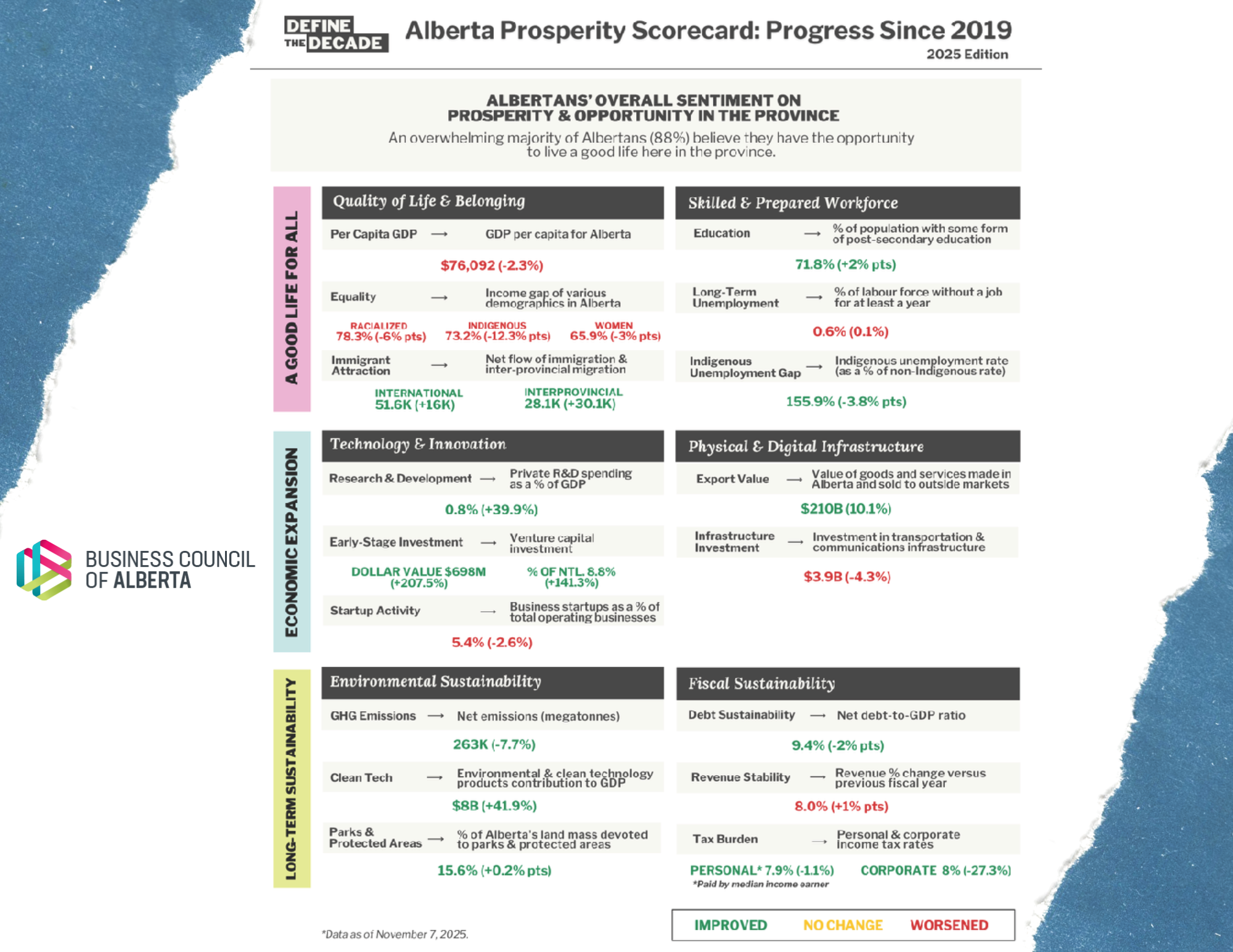
In the case of the province of Alberta, we have the benefit of the periodic Alberta Prosperity Scorecard reports published by the Business Council of Alberta (BCA). The Scorecard gathers and presents data on 22 “measures of prosperity” which are intended to inform readers about the province’s economic well-being, trends in the quality of life, environmental performance, and innovation.
Alberta leads Canada in the value of both economic output (GDP) and real income on a per person basis – an important accomplishment. However, mainly because the province’s population has been growing rapidly, Alberta has experienced a decline in “GDP per capita” after stripping out the effects of inflation. This core economic metric has fallen over the last several years, similar to the trend in Canada and other provinces. Alberta’s surging population has also added to the stress on physical infrastructures, with new infrastructure investment failing to keep up with the demand for services in areas like health care, transportation and education. As in Canada as a whole, business start-ups in Alberta have dwindled relative to the total number of operating businesses in the province.
Other prosperity indicators are more positive. Alberta’s share of Canada-wide venture capital investment has more than doubled since 2019; the unemployment gap between Indigenous and non-Indigenous Albertans has narrowed; and emissions of greenhouse gases have come down, despite steadily rising production from the oil and gas sector. The value of the province’s exports has climbed by 10% since 2019. At the same time, the proportion of the working-age population with some form of post-secondary education has inched ahead another two percentage points and now stands at 72%.
As for government finances, Alberta continues to boast the lowest government debt-to-GDP ratio in the country (although the province recently slipped back into an operating deficit). Personal and corporation taxes remain less burdensome than in the rest of Canada; the same is true of consumption taxes. It is fair to say that when it comes to taxes, the Alberta advantage persists.
The accompanying figure summarizes the 22 indicators used to create the Alberta Prosperity Scorecard and the changes recorded since 2019.
A few gaps…
No single list of prosperity indicators can be expected to cover everything that’s important to economic success. The BCA Scorecard does not track total non-residential business investment or major categories of investment such as machinery and equipment, intellectual property, or advanced technology products. Productivity is not directly measured, either economy-wide or in the broad business sector. Nor does the Scorecard provide information on the extent to which small and mid-sized Alberta businesses are “scaling up” over time to become larger companies. Other indicators relevant to prosperity which are not part of the Scorecard are the trend in average real wages, the pace of homebuilding relative to population size, or whether Albertans have timely access to health care services.
That said, the BCA Scorecard is a useful initiative that augments our understanding of Alberta’s performance on a host of measures that influence prosperity and play a role in determining citizen well-being.