There is a popular view – common in media stories, and repeated ad nauseum by union leaders and ‘progressive’ political voices – that the spike in inflation that Canada experienced following the COVID-19 pandemic significantly eroded the real earnings of workers. This perspective has influenced the negotiating positions recently adopted by public sector unions bargaining for new collective agreements.
The Canadian inflation surge of 2021-24 was an unwelcome shock that took many people, including most economic forecasters, by surprise. After more than 30 years of generally low, stable inflation – mostly in the narrow range of 1.7-2.5% per annum – the all-items Consumer Price Index (CPI) rose to 3.5% in 2021, before climbing to a multi-decade high of almost 7% in 2022. It then retreated to 3.9% in 2023 and 2.4% in 2024, measured on an average annual basis.
How did these few years of inflation running above the central bank’s preferred target affect the “purchasing” power of workers? Statistics Canada’s published data on hourly wages and weekly earnings help to answer that question.
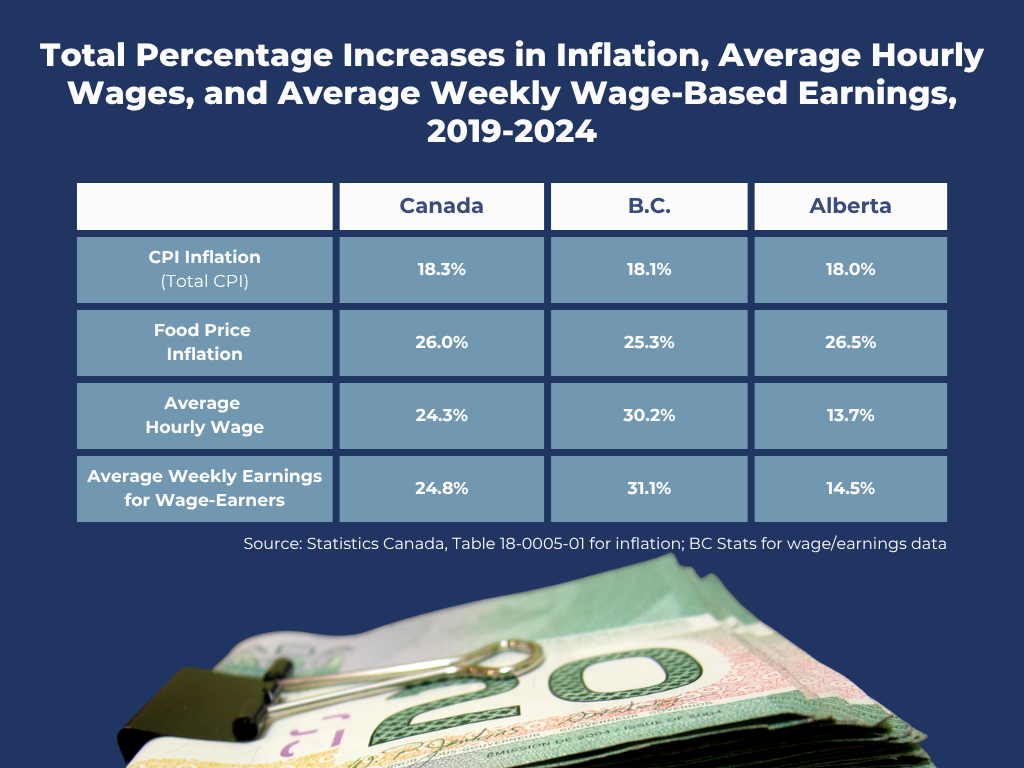
The accompanying table provides data on the growth of prices (inflation), hourly wages, and average weekly wage-based earnings for Canada, B.C. and Alberta, in the six-year period from 2019 to 2024. Nationally, the average hourly wage rose from $28.32 to $35.20 over the period; this equates to a cumulative percentage gain of 24.3%. In B.C., the average wage increase was greater – a little over 30%. In Alberta, it grew more slowly – by less than 14%.
These wage data are not adjusted for inflation – which captures increases in the cost of living, as proxied by the all-items CPI. The table also reports Statistics Canada’s estimates for both total inflation and food price inflation for Canada, B.C. and Alberta, from 2019 to 2024. We include food price inflation because the rising cost of food arguably has been the most visible part of the inflation story over the last few years.
For Canada, total inflation amounted to 18.3% over the period – several percentage points less than the contemporaneous increase in the average hourly wage. Food price inflation was significantly higher, reaching 26%, which is very close to the average hourly wage increase at the national level.
Turning to the picture in B.C., overall CPI inflation was 18.1% from 2019 through 2024, with food price inflation coming in at about 25%. Both of these figures are appreciably less than the increase in the B.C. average hourly wage (~30%) between 2019 and 2024. In Alberta, total CPI inflation was also 18% over 2019-2024, with the cumulative increase in food prices hitting 26.5%. In contrast to the pattern in B.C., both of these inflation figures exceed the increase in Alberta’s average hourly wage over 2019-2024.
Apart from the trend in hourly wages, it is also instructive to track a more comprehensive measure of employee earnings – the “average weekly wage rate.” This is Statistics Canada’s estimate of average weekly “earnings” for both full- and part-time employees combined; unlike the average wage, it takes account of how much time people spend on the job in a given week.
The last row of the table reports the percentage increase in average weekly earnings in Canada, B.C. and Alberta from 2019 to 2024. This measure of employee pay rose by 25% nationally, by 31% in B.C., and by 14.5% in Alberta over the period. Similar to the trend in the average hourly wage, this metric shows workers in Canada and B.C. posting gains in weekly earnings after adjusting for inflation, whereas the typical worker in Alberta had a drop in weekly earnings on a post-inflation basis.
Of course, average wages and weekly earnings don’t align with the real-life experiences of all job holders. Employees in some work settings – including parts of the broadly defined public sector – receive cost-of-living pay increases. But this is not universally true. Some Canadians undoubtedly have seen the purchasing power of their paychecks diminish in the last several years, amid a temporary jump in CPI inflation.
To summarize, some employed Canadians can legitimately complain that their paychecks haven’t kept pace with the cost of living since 2019. But it’s a fair bet that most of the workers in this position aren’t toiling in the country’s sprawling and generally well-compensated public sector; instead, they are more likely to be found in smaller businesses scattered across the private sector economy.