On the eve of another Labour Day, the Canadian job market is losing steam amid unprecedented tariff hikes, persistent geopolitical tensions, and a stagnant economy. Nationally, employment fell by 40,000 (seasonally adjusted) between June and July, with the job losses concentrated among workers in full-time private sector positions. Manufacturing and construction are among the industries that have experienced sizable employment declines so far in 2025.
In British Columbia, employment in July was down by 16,300 (seasonally adjusted) in July from the prior month. Construction jobs fell by 7,600 month-to-month. Alberta also recorded a sizable job drop (16,800) over the same period. The unemployment rate in both provinces has nudged higher in 2025.
The picture is less gloomy on a year-over-year basis. Total employment in Canada rose by 1.5% from July 2024 to July 2025. Alberta led the country on this metric, with the number of jobs climbing by 2.6% over the last year. B.C. roughly matched the national average (+ 1.4% y/y). But those modest job gains are now firmly in the rear-view mirror, as economic conditions have softened over the last six months.
Digging deeper into the data -- and going back in time to the pre-COVID years -- yields insight into the composition of job creation by broad sector over time.
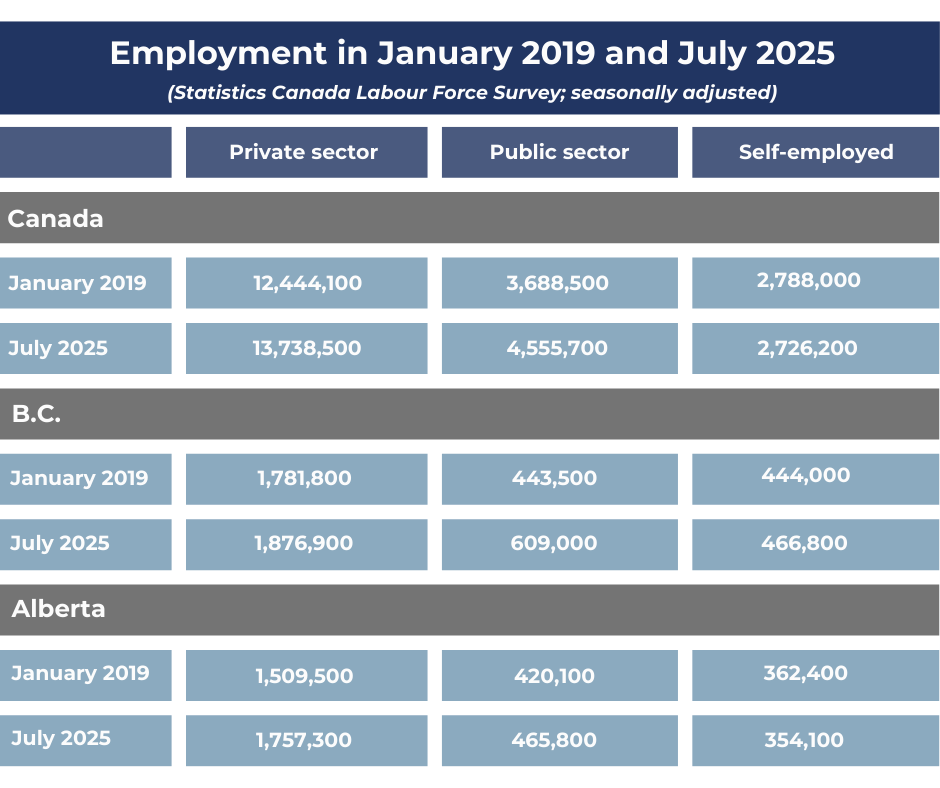
Figure 1 presents data on employment in Canada, B.C. and Alberta in January 2019 and July 2025 (a period spanning six-and-a-half years). The data is organized into three categories: private sector payroll employees, public sector employees, and the self-employed.
Figure 1
The outsized role of the aggregate public sector – consisting of public administration and most of health care, education and social services – in propelling Canadian job growth is clear. Since the start of 2019, public sector jobs are up by almost one-quarter, while private sector payroll positions have increased by just 10.4%. Meanwhile, the number of self-employed Canadians actually declined over the same period – suggesting a deterioration of the climate for entrepreneurship in the country.
In B.C., public sector positions have ballooned by a jaw-dropping 37% since the start of 2019, while private sector payroll jobs have eked out a comparatively meagre 5.3% gain. The pattern is different in Alberta: there, private sector payroll employment has increased by 16.4% since January 2019 while public sector jobs rose by 11% over the same period. At the same time, self-employed positions dwindled in Alberta and grew slightly in B.C.
The story told by these labour market statistics is revealing -- and troubling. No successful market economy can prosper indefinitely based on a progressively larger public sector. Ultimately, the private sector pays most of the taxes needed to fund public sector services and programs. It follows that private sector job creation is essential to support and grow the tax base on which governments rely.
Since 2019, Canada has developed a lopsided job market where the public sector has been responsible for a disproportionate share of overall job growth. This unhealthy pattern is especially stark in British Columbia, where the business community collectively has been eclipsed by a voraciously expanding public sector as the main engine of economic and employment growth.
The time has come to tame public sector hiring, downsize bloated bureaucracies and administrative structures, and return to a model that looks to the private sector to move the economy forward. The experience of the last 6-7 years should not and – in terms of fiscal capacity – cannot continue.
With Labour Day approaching, policymakers in Ottawa, Victoria and other provincial capitals need to reacquaint themselves with the basic arithmetic of a balanced, well-functioning, and fiscally sustainable job market.