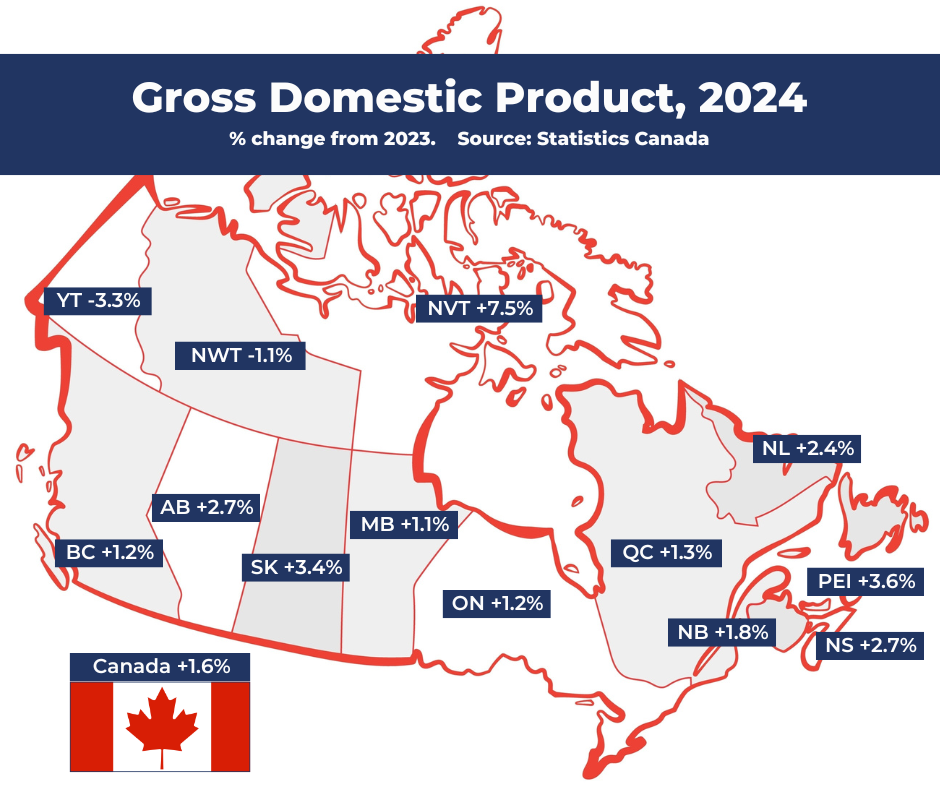
Amid President Trump’s mad-cap trade war, Canada’s economy has lost a step in the first few months of 2025. Unfortunately, this recent weakness comes after a very mediocre 2024.
Last year saw a softening of Canada’s job market, continued sluggish business investment, and a second consecutive annual decline in the value of economic output (real GDP) on a per person basis. Whereas Canada managed to crank out a feeble increase in real GDP of 1.6% last year, the U.S. posted a gain of slightly less than 3%, resulting in a further widening of the cross-border prosperity gap… a gap that now stands at a record level.
Canada’s population rose by 1.8% last year, down from the blistering 3.1% pace set in 2023 and also lower than in 2022 (+2.5%). With GDP -- as measured by the combined value of inflation-adjusted output across all Canadian industries -- growing by just 1.6%, per person output fell again last year, on the heels of a steeper drop in 2023.
The economic weakness was widespread. Consumer spending on non-durable goods barely increased after stripping out inflation. Real business non-residential investment contracted after a slim advance (1%) in 2023. At the national level, homebuilding failed to gain traction despite lower interest rates and a proliferation of government programs and initiatives aimed at boosting housing supply and sales activity. Canada’s exports were almost flat last year after removing the effects of inflation. Government spending, in contrast, jumped by almost 4% in real terms in 2024, continuing the story of a ballooning public sector during the tenure of former Prime Minister Justin Trudeau.
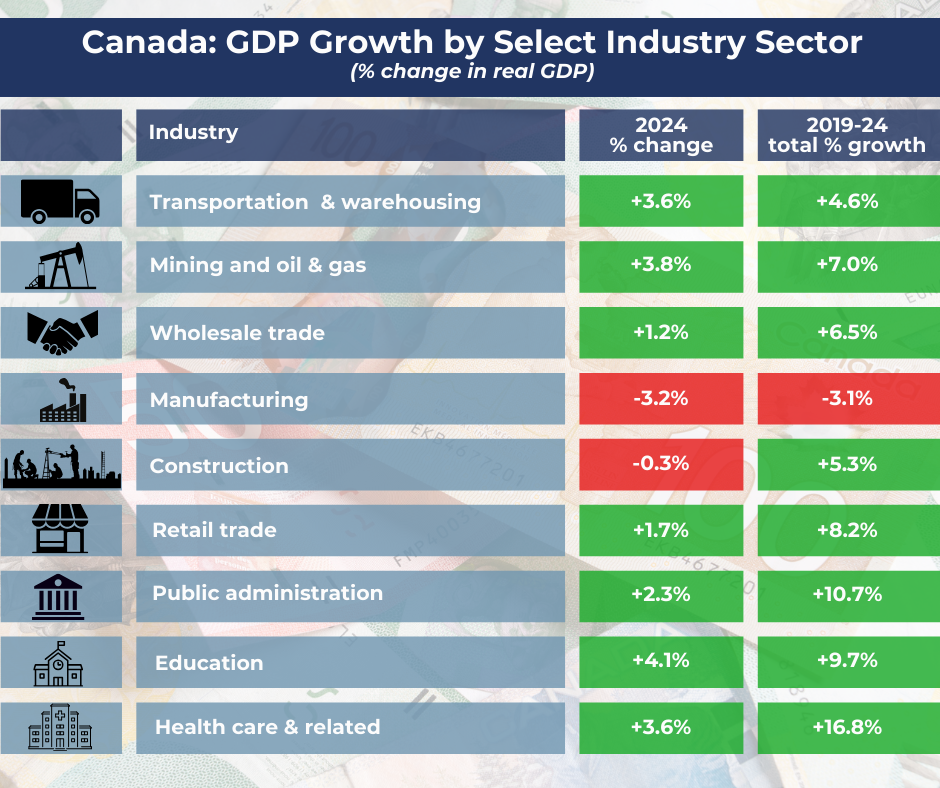
Looking at economic growth by industry, Figure 2 shows the percentage change in real GDP across the main Canadian industry sectors in 2024, as well as cumulative output growth over the period 2019-2024.
Canadian construction GDP dropped marginally last year, mainly due to reduced activity in the residential homebuilding segment. Since 2019, the value of the construction industry’s output has risen by close to 6%. Canadian manufacturing had an even tougher year in 2024; moreover, the manufacturing sector’s GDP has declined outright in the last half decade.
Public administration increased in size by almost 11% over the same period; other key parts of the wider public sector – notably health care and education, which in Canada are largely financed by government – have also expanded briskly. This lopsided growth pattern is neither desirable nor sustainable. To prosper, Canada must reinvigorate and kick-start growth across the private sector industries that still account for the bulk of production and employment – and drive almost 100% of exports -- in our economy.
In 2024, the two westernmost provinces were a tale of two cities: B.C. stagnated, while Alberta managed to record respectable growth even amid a very subdued Canadian economic backdrop. Among the ten provinces, Alberta tied with Nova Scotia for the second highest GDP growth rate (+2.7%) in 2024, bettered only by neighbouring Saskatchewan (+3.4%). Meanwhile, B.C. hovered near the cellar (+1.2%), joining Ontario and Manitoba as the country’s growth laggards.
In dollar terms, Alberta was responsible for more than a quarter of national GDP growth last year, with its out-performance partly attributable to a 3.7% increase in output in the oil and gas extraction sector. A surging population also played a role in boosting Alberta’s GDP.
British Columbia lost economic momentum in 2024, driven by declining construction spending, plunging manufacturing production, and the headwinds fostered by an uncompetitive business climate – the cumulative consequence of more than seven years of interventionist NDP government.
The construction industry struggled in B.C. in 2024, performing more poorly than the overall economy; as a result, its share of economy-wide activity slipped from 9.89% of GDP in 2023 to 9.20% last year. In Alberta, construction grew slightly faster than the total provincial economy, with its share of GDP inching ahead from 7.37% to 7.58% over the year.