The completion of the $34 billion Trans Mountain pipeline expansion project marks a milestone for both the country and the Western Canadian oil industry – Canada’s number one generator of export earnings. Since 2017, almost 30,000 people have worked on the project, which will triple the volume of oil that can be moved on the expanded pipeline and give Canada a much-needed outlet to sell into offshore markets.
The hefty capital spending on TMX was divided between Alberta and B.C. Now that it’s finished, it is timely to ask about the outlook for other major project investment. In this blog, I focus on Alberta. A subsequent ICBA Economics post will summarize the pattern of current/proposed project investment spending in British Columbia.
Alberta Leads the Pack
Alberta has long punched above its economic and demographic weight within Canada, particularly when it comes to business investment. It is, by a wide margin, the most “investment-intensive” province, meaning that non-residential investment in productive capital, measured on a per worker basis, far outstrips the Canadian average. At the same time, Alberta also leads the country in productivity (GDP per hour worked).
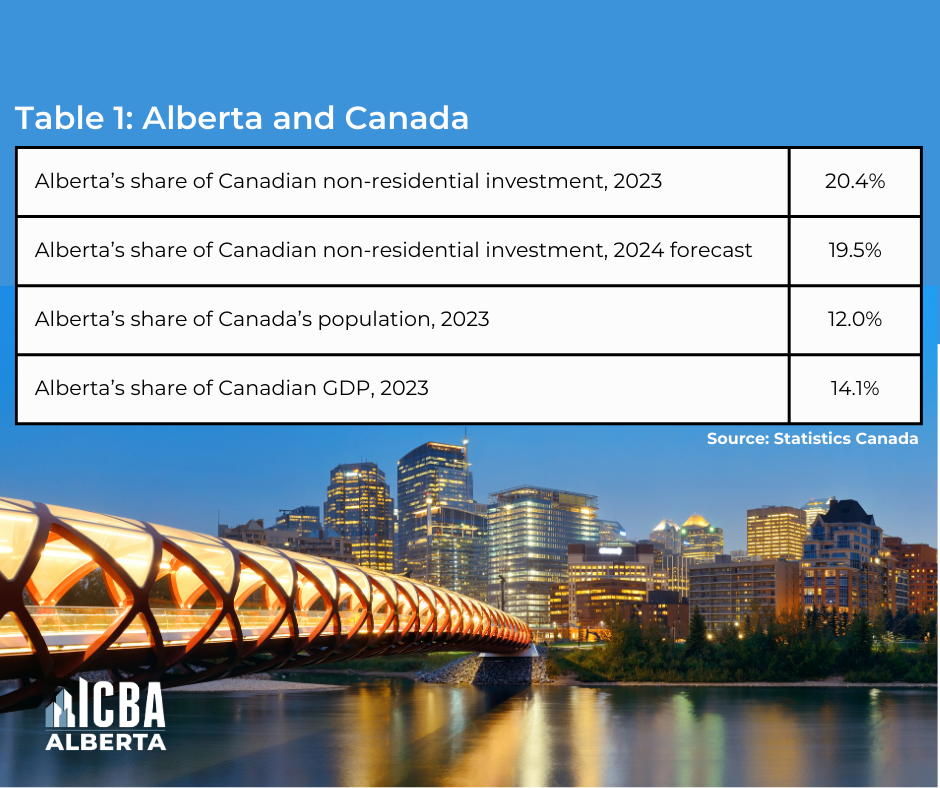
Statistics Canada’s 2024 update on investment spending confirms that Alberta continues to lead the pack. As shown in Table 1, Alberta accounted for one-fifth of Canadian non-residential capital spending in 2023, while being home to roughly 12% of the country’s population. This year, Alberta’s share of Canada-wide investment is expected to dip slightly but will stay close to 20%. In large part, this reflects the outsized role and dynamism of the energy industry within the Alberta economy. Indeed, the broadly defined energy sector is responsible for more than two-fifths of all non-residential capital spending in the province.
Comparatively high levels of non-residential investment, in turn, bolster Alberta’s position as Canada’s most affluent province, as judged by GDP per person. Alberta also ranks first in Canada in average incomes – both pre-tax and after-tax.
Focus on 'Major Projects'
The data in Table 1 capture various forms of non-residential investment spending – in buildings and other structures, machinery and equipment, advanced technology products, and for the repair and maintenance of existing capital assets. Investment in “major projects” represents only a sub-set of total capital spending outside of the housing sector. A key characteristic of project-related investment is that the associated capital spending typically takes place over a period of years, not all at once or within a given calendar year.
The Alberta government keeps track of actual, planned and proposed capital projects valued at $5 million and more, covering both the public and private sectors. The most recent count shows more than 600 individual projects involving – assuming they all proceed – $150 billion of capital spending. Many of these are already underway (some are essentially completed); others are planned and have in some cases received the government permits required to commence construction; while others have been “proposed” but at this point are best treated as “possible/aspirational” rather than confirmed. In practice, a non-trivial number of “proposed” projects never advance.
In the discussion below, I have grouped the projects into different categories. Note that residential building projects are excluded. In addition, only projects with defined capital budgets are identified; numerous other “planned/proposed” projects are not listed because they lack estimates for capital spending.
Conclusion
Apart from those listed in this post, Alberta has hundreds of other smaller projects “on the books,” totalling more than $50 billion in planned investment spending. Most of these have commenced or are sure to advance, adding materially to total construction-related capital spending in the province in 2024 and beyond.
In looking at trends in and levels of investment, Alberta remains a busy place. The energy industry has revived after taking a temporary hit during the COVID shock. The rebound has occurred even though the current Canadian public policy mix serves as an obstacle to growth and capital spending in most segments of the energy sector. Energy-related projects sanctioned several years ago continue to come on-line, boosting Alberta’s production of crude oil, petrochemicals, and natural gas. The outlook for energy will be key to investment patterns in Alberta over the balance of the decade. Further gains in output and exports are expected at least until 2030; thereafter, the picture gets murkier. Alberta’s oil and gas sector is at the forefront of the “energy transition” and will be investing heavily to increase efficiency and lessen the industry’s carbon footprint going forward.
Strong population growth is also an important driver of investment – both in the housing sector and across the wider economy. Alberta’s rapidly expanding population automatically increases the demand and need for office and commercial space; roads, bridges and rapid transit service; education and health care facilities; water, wastewater and other municipal infrastructure; and much else besides. In common with Ontario and B.C. – Canada’s two other fast-growing provinces – Alberta faces a significant infrastructure deficit that governments will be struggling to address in the next 1-2 decades, if not longer.